
The Misconceptions About Work-Life Balance and How To Gain Clarity Through the Yin-Yang Lens
Work-life has multiple shades
Work-life balance has been a buzzword in recent years, especially in the corporate world. It won’t go away as long as stress remains the norm in the modern era.
This phrase seems to scratch some folks’ nerves, including business leaders. For instance, Jeff Bezos made it clear that he dislikes the phrase work-life balance. Instead, he prefers work-life harmony.
And he is not alone. Once I heard a female VP say work-life balance is not feasible at a conference. Some people also attempt to quantify work-life balance by splitting time equally, and then conclude work-life balance is an illusion.
Not surprisingly, phrases such as work-life harmony and work-life integration are rising to the surface.
I believe there are misconceptions in these schools of thought about balance in this phrase.
The word balance means equal, even, and equilibrium. When it comes to work-life, it appears that some people take it too literally by putting them on the opposite ends of the work-life spectrum.
Let’s dive into the nature of work-life balance by leveraging the ancient Yin-Yang philosophy.
Yin and Yang represent the two forces or phenomena in the universe. They are opposite yet complementary, interrelated, and dependent on each other, none can exist without the other, unfolding through dynamic balance and together becoming whole.
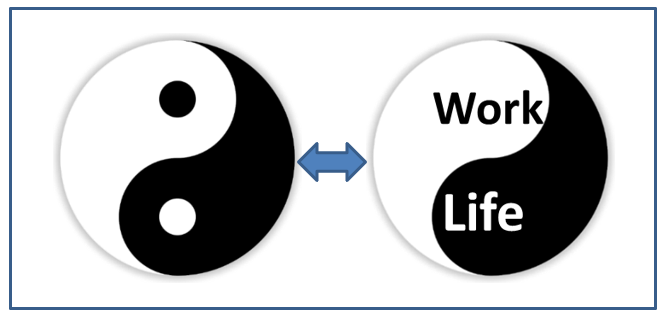
Through the Yin Yang lens, work-life balance embodies harmony as well as integration. For illustration purposes, let’s consider work as Yin and Life as Yang.
Work-Life balance is dynamic, not static.
As we can see from the Yin-Yang symbol, the Yin-Yang divider is curved not straight in the middle. It reflects the dynamic nature of Yin and Yang. There is a boundary between Yin and Yang, but the boundary is not rigid.
Balance does not just mean a static state. Many phenomena of balance are dynamic. We have four seasons due to the dynamic balance of Earth’s position relative to the Sun. Inside the human body, there are many self-regulated balances constantly working in progress. Motions such as walking and running also require the dynamic balance of the body. Even life itself.
“Life is like riding a bicycle. To keep your balance, you must keep moving.” -Albert Einstein
In terms of work-life, balance can evolve with time and circumstances, depending on the stage of one’s life personally and professionally. The priority and attention may need to shift at certain moments but the work-life balance can be achieved dynamically beyond a short time frame.
Work-life implies the opposite aspect.
Just as seen in the Yin Yang symbol.
We don’t need to turn a blind eye to this aspect. What matters is how we can learn and better manage it: seek support and understanding, and work around the conflict to minimize the imbalance. In the end, we may have to acknowledge that life is not perfect and shift priorities when strong conflict arises. Just keep things in perspective: priority tradeoffs could just be temporary. And in life, gain and loss can often go hand in hand.
I reflect on one occasion years back supporting a critical project involving new technology development which took three years of a few Task Forces (TF) to bring to completion. While deeply involved in the TFs, I also just started to lead a team. Not surprisingly, there were countless hours of hard work as we were constantly under time pressure to deliver to help risk assessment and enable solutions.
My kids were only 2 and 5 years old when the TF started. Husband ended up doing a lot more housework i.e. grocery shopping, preparing meals, taking kids to doctors, etc. He is a firm supporter.
The project was successfully wrapped up three years later. Then it hit me that my work-life balance was way out of whack. For one thing, I felt burnout and seriously considered taking personal leave for some time. Secondly, I realized that the kids were not as close to me as they clung to dad. For example, when we went out to eat, both kids wanted to sit next to dad. Admittedly, at that moment I felt a sense of loss and even embarrassment …
Could I have done better for work-life balance? Perhaps. If I had asked for some flexibility at work, been excused from meetings at times, or negotiated due dates of certain tasks, likely without any adverse impact on the project. In hindsight, I was just a little too serious. I should have paid more attention to my work-life balance. Lessons learned.
Work-Life is also complementary and intertwined.
In the Yin Yang symbol, Yin (black half) contains Yang (white dot), and Yang (white half) contains Yin (white dot). After all, work and life are not completely separable, and the boundary is getting blurring, regardless of whether working in the office, hybrid, at home, in corporate, or freelance.
When we are happy with work, we can bring more positive energy to home life. Vice versa. On the contrary, if things are not going well at work, we may carry those negative emotions back at home, complaining, nagging, etc.
Meaningful work and quality personal time can bring us joy, purpose, peace, and a sense of accomplishment. They are intertwined, mutually motivational, and also keep us grounded.
Through the Yin Yang lens, we can comprehend the multiple shades of work-life: dynamic, opposite, complementary, interrelated, and intertwined.
When work-life is in balance, it becomes a full circle as shown in the Yin Yang symbol. It means personal and professional satisfaction, harmony, and contentment: happiness, health, effectiveness, and success. It is a win-win.
Balance can be an artwork. And it takes learning and practice. Let’s aim for work-life balance.
Thank you for reading. I write about culture, work-life learning, and the ancient wisdom of Traditional Chinese Medicine for better living. Click here if you would like to be notified when I publish.