
The Milky Way was formed not long after the Big Bang. What secrets does our Galaxy hold?
It has existed for several billion years, and in ancient times was called the Blue River. I am, of course, talking about the Milky Way, the spiral galaxy in which our solar system is located. What does it look like and what does it consist of? These and other questions are answered below.
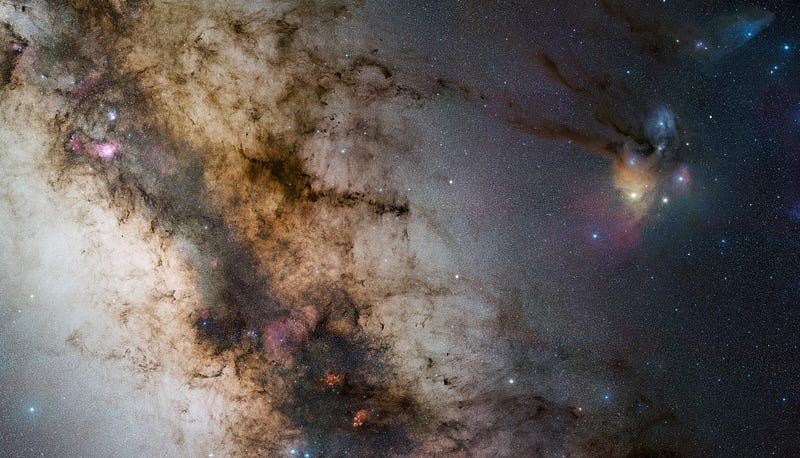

The characteristic bright belt stretching across the entire length of the sky was already observed by Greek and Arab astronomers. Some ancient scholars claimed that the phenomenon was nothing more than a burning part of the atmosphere. About 2,000 years later, Galileo Galilei looked at the night sky through the first telescope and concluded that what he was looking at was nothing but a cluster of stars.
Today we know much more about the Milky Way, but Earth’s parent galaxy still hides many questions that the scientific world does not know the answers to.
What does the Milky Way look like?
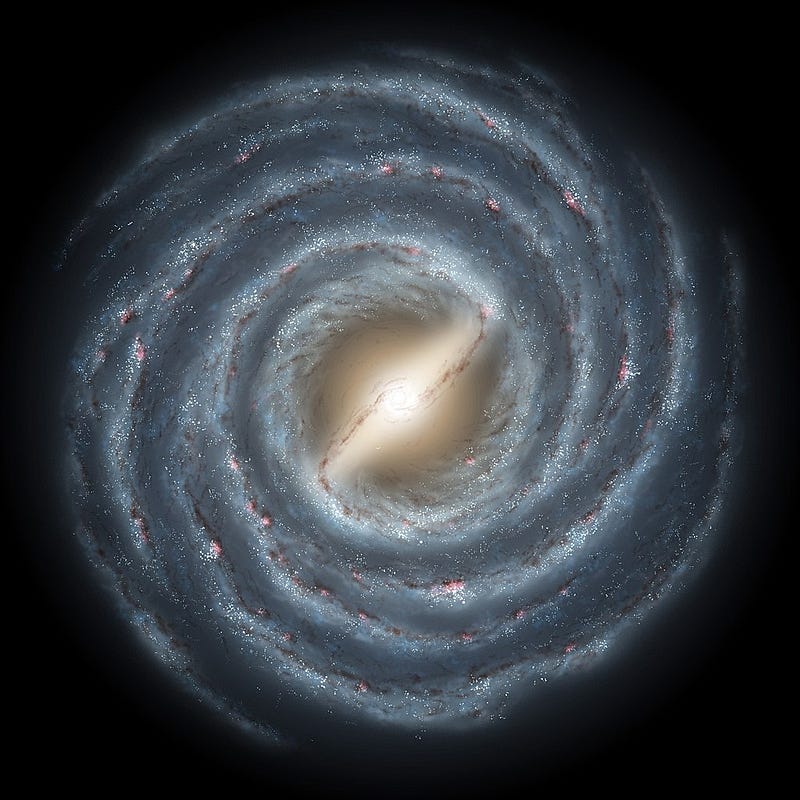
The Milky Way has the form of a flattened disk with a prominent central thickening, increasing toward the center of the galaxy. This area, is shaped like an elongated crossbar. Observing our galaxy from the side, one would conclude that it resembles a lens surrounded by a flat disk.
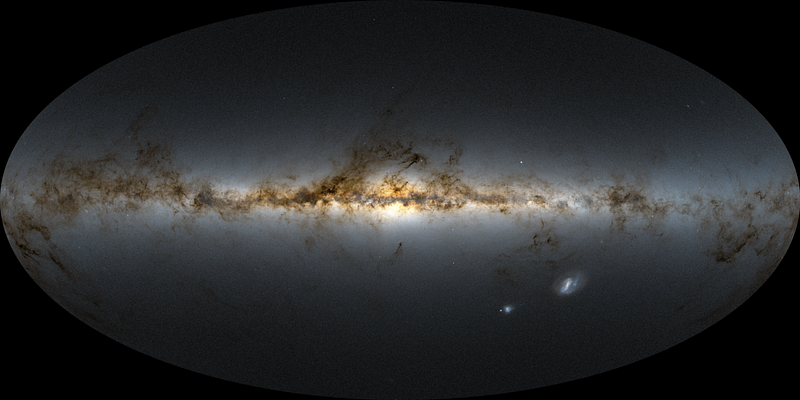

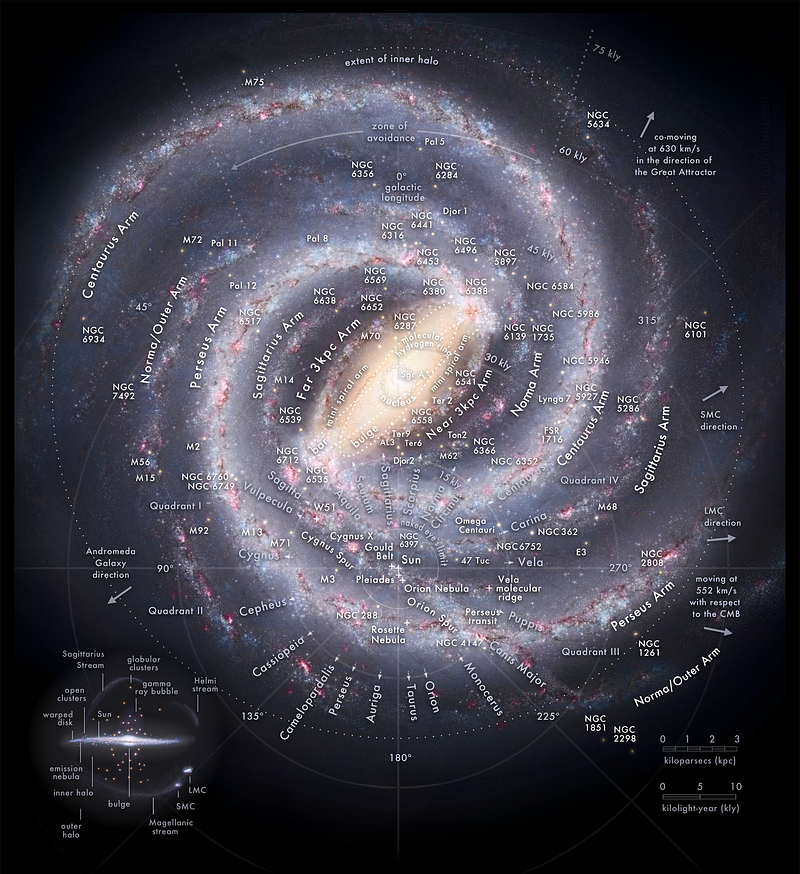
The Milky Way is included in the group of spiral galaxies, as is the Andromeda galaxy. This means that the galactic disk consists of arms. Their spiral shape is due to the significant rotational dynamics of the matter and stars that make up the disk. Unfortunately, so far the scientific world does not have the technology to observe the galaxy from the outside, which makes it difficult to determine their number.
Scientists have discovered four main arms:
- the Perseus Arm,
- the Sagittarius Arm,
- the Local Arm,
- Outer Arm.

How and when was the Milky Way formed?
According to astronomers, the Milky Way is not much younger than the Universe itself (noting that the indefinite numerator “not much” must be considered on a galactic scale). For a long time it was thought that the formation process of our galaxy began about 11 billion years ago. However, the current state of knowledge allows us to conclude that the Milky Way is much older.
Scientists observing space through two telescopes, Gaia and LAMOST, have studied the metallicity of 250,000 stars that are currently transitioning to the red giant stage. Their results indicate that the process of forming a galactic disk from a huge gas and dust cloud began 800 million years after the Big Bang, or about 13.2 billion years ago.
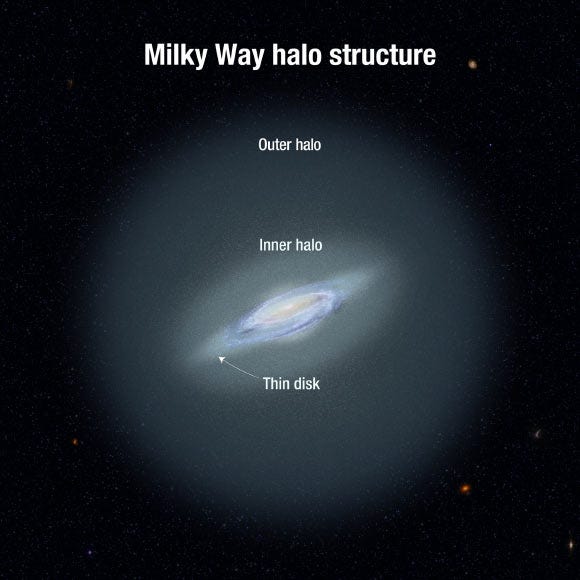
However, it should be noted that the shape of our Galaxy was most influenced by another event. When a galactic halo began to form around the emerging central part of the Milky Way, another system — the Gaia-Sausage-Enceladus dwarf galaxy — appeared within the gravitational range of the still young galaxy. This one was absorbed by the larger Milky Way, which initiated the process of star formation forming a thin disk.
Origin of the name
Where did our Galaxy’s name actually come from? To explain it, we need to go back to antiquity. Looking into the sky, Greek astronomers saw a bright belt, clearly distinguishable in the entire visible area of the sky. Based on this, they named our galaxy by the term galaxis kyklos, which means milky circle. The name was borrowed by the Romans, who began referring to the bright streak as the via lactea, or milky way. The name transcended the Roman Empire and is still in use today.

What does the Milky Way consist of?
The structure of the Milky Way still hides many unknowns. We know that our Galaxy is composed of three main elements: stars, gas and dust, and dark matter.
Stars are mostly divided by population. Population I consists of celestial bodies that form the galactic disk. This group includes young stars, a few million years old, as well as much older ones, existing for about ten billion years. These objects move in circular orbits and orbit around the center of the Milky Way.
Population II consists of stars located in the central thickening and galactic halo. We are talking about the oldest objects, 12–13 billion years old. Unlike the stars of population I, these move in more random orbits. They are not constrained by the plane of the galactic disk.
Population III is made up of historical stars that have not been observed. Here we mean objects consisting almost exclusively of pure hydrogen and helium, that is, matter formed in the aftermath of the Big Bang.
The Galaxy’s primary components in the plane of the Galactic disk are gas and dust. The gas portion is composed mostly of hydrogen (70%) and helium (28%).
The most enigmatic element of the Milky Way is dark matter. It’s a type of matter that does not interact with light and hasn’t been directly detected yet. Its presence is only detectable through its gravitational effects on visible matter.

How many stars are there in the Milky Way?
The estimated number of stars in the entire Galaxy ranges between 100 billion to 400 billion, according to scientists. They are mostly in the Galactic disk and vary in age, chemical composition and mass.
It should be noted that in the area of the Milky Way there may be between 100 and 200 billion planets, of which as many as 300 million may create conditions conducive to the development of life.
Observations of the Milky Way
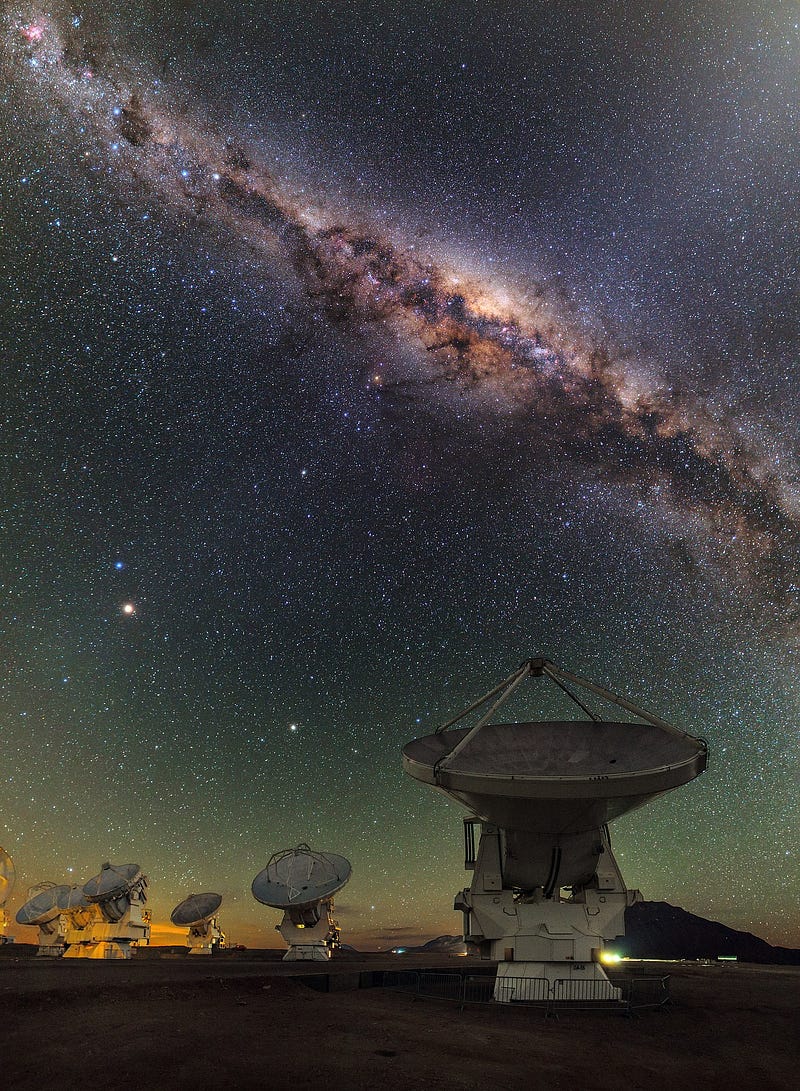
The bright disk streak should theoretically be perfectly visible from Earth. Only theoretically, in practice it turns out that light pollution prevents effective observation.
Wanting to observe the characteristic ribbon, choose a location away from urban areas and sources of diffuse light. The best conditions are created by areas protected from light pollution, i.e. dark sky parks.
Not only the place, but also the time is important. The best conditions are created at the end of April and the beginning of May, when the ribbon of the Milky Way floats low above the horizon, and observations are not disturbed by white nights.
Where is the Earth located in the Milky Way?
Finally, it falls to explain in which region of the Milky Way the Earth is located. The solar system is located within one of the spiral arms of the Milky Way galaxy, known as the Orion Arm or Local Arm. Specifically, the Sun and its planets are located about halfway between the center and the outer edge of this arm, which is around 25,000 light-years away from the galactic center.
The Earth is located between the major arms of the galaxy, which for astronomers is a major obstacle in mapping the Milky Way. With the technology available, it is possible to determine the location of only the brightest parts of the large arms, but not what lies between them.

Interesting facts about the Milky Way
Above we have listed the most interesting facts about our Galaxy. In conclusion, we have a handful of intriguing curiosities about the Milky Way for you.
- Scientists believe that dark matter is the most massive component of the Milky Way. Its mass is thought to be ten times greater than that of all the stars in the galaxy and a hundred times greater than the mass of gas and dust combined.
- Stars near the center of the Milky Way rotate at 220 km/s.
- The orbital velocity of the solar system, on the other hand, is 268 km/s.
- The diameter of the galactic disk exceeds 100,000 light years. Its thickness is about 1,000 light years.
- Only 0.000001 percent of all the stars of the Milky Way can be seen from Earth.
- Scientists believe that the dark matter halo has the shape of a spheroid slightly flattened at the poles. This is the conclusion they came to based on an analysis of its effect on visible matter.
Cool that you made it to the end of this article. I will be very pleased if you appreciate the effort of creating it and leave some claps here, or maybe even start following me. It would be nice if you also left a tip! Thank you!