The Mathematical Evidence that Eliminates the Idea of Singularities
Cyclones do occur; Cyclopes exist in the human mind only.

I have always been curious about the big picture. But sometimes there is a double take involved and the big picture has then two independent aspects. It is not always easy to communicate about that double take, but let me try describing this with mathematical evidence in hand.
A good number of people have seen the presented mathematical evidence below and dismissed it. Yet the act of dismissing information, the act of declaring something to have no value, done by one party to another, is exactly what is shown to be fundamental in our universe.
The evidence is found among the building blocks of math. Perhaps it is better to call it evidence about the mathematical building blocks, rather than mathematical evidence. Yet evidence it is.
Simple fourth-grade mathematical information can tell us that our material universe is based first and foremost on separation. This is then the first step, and only after the act of separation was there a move toward coming together and then only among matter moving outwardly in the same direction. This means that the universe is then based on two discordant states: it being divergent at the largest of levels and convergent at the specific levels.
— — -
Whether zero is a fundamental building block or not is shown with mathematical evidence. Let’s start out describing that many scientists declare, for instance, that there is no Year Zero. Our calendar starts out with the Year One CE (Common Era), and the prior year is the Year One BCE (Before CE). Nothing in between.
These scientists don’t like it much that the number of years between January 1, 500 BCE and January 1, 500 CE adds up to only 999 years. A year has gone missing, and that is not handy.
— — -
There are two groups of mathematicians: set theorists and number theorists. Number theorists do not have a Year Zero. Set theorists do have a Year Zero, mainly because it is unhandy to add and subtract that one year all the time when talking about information that spans thousands of years, for instance in astronomy. For them, 10,000 years ago is exactly that, and not 9,999 or 10,001 years ago.
Both mathematical groups made use of the option to choose whether to add that one year in or leave it out. Choosing is an act of making something important — it’s in — or making something unimportant — it’s out!
No other number provides the option to make something have value or have no-value like that pesky number zero. We use zero and place it on items we want to exclude. We don’t use zero for items we want to include. We do this without thinking much about it.
Apparently, this is a complicated aspect for the human mathematical brain: the act of excluding is done by number zero, and when looking at all numbers it is difficult to include that excluding number. There is some hard-wiring going on, a heartfelt desire to exclude that excluding number.
— — -
All it takes to provide the evidence that zero is a fundamental building block is fourth grade math; the information shows that zero must be used to explain one step in an area it supposedly does not belong to (according to number theorists). Through the required use in a pattern found among the natural numbers, zero must be seen as part and parcel of the natural numbers (just like set theorists are already saying). Number theorists are proven to be incorrect. There are five steps to follow in total.
— — -
The Mathematical Evidence
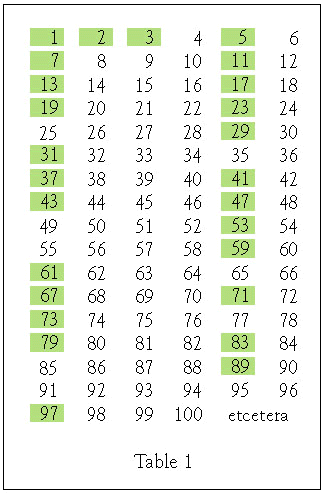
Take a look at Table 1. This table shows a strong resemblance to the work of Eratosthenes, who created his sieve for finding prime numbers more than 2200 years ago. In Table 1 the numbers between 1 and 100 are placed in lines of six numbers. In these “six-packs” (7–8–9–10–11–12 or 19–20–21–22–23–24) prime numbers will only be located in first and fifth position (7 and 11, and 19 and 23). They are shown in green and there are two exceptions: numbers 2 and 3.
To keep it simple (because we’ll be moving away from the prime numbers in Table 2), number 1 was also made green, though this is officially not seen as a prime number.
— — -
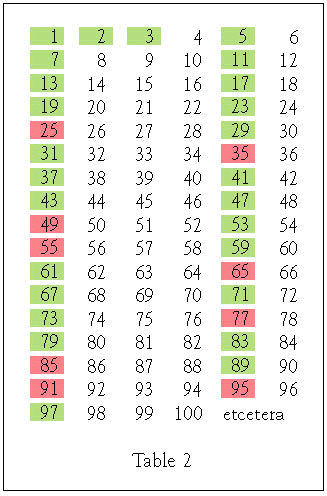
Next, in Table 2, the highlighted red numbers are numbers in first and fifth places that are themselves not prime numbers. It turns out that these numbers are all various multiplications of prime numbers. Follow the color code and it becomes apparent that all red numbers are multiplications of green numbers with the exception of 2 and 3. For example, 25, 35, 55, 65, 85, and 95 are numbers in first or fifth positions divisible by 5.
— — -
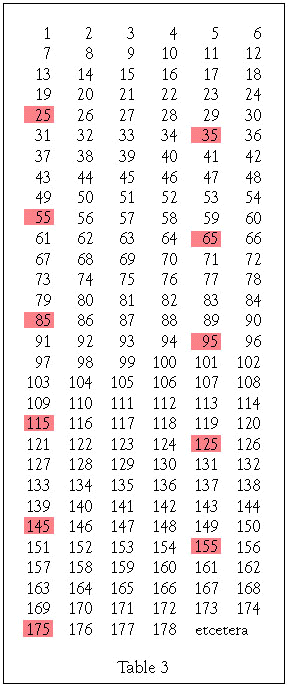
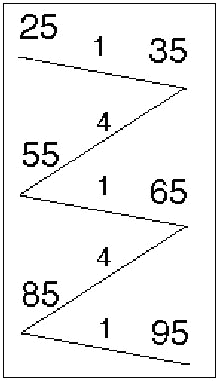
In Table 3, this specific outcome is made visible. The square of 5 is found in a line of six numbers in first position. Next, 35, is found one line below in a fifth position in a line of six. Next, 55, is four lines below in a first position. There is a pattern, and it is shown in this Zigzag Figure. The pattern for number 5 jumps 1 + 4 lines, while zigzagging toward the larger numbers forever.
— — -
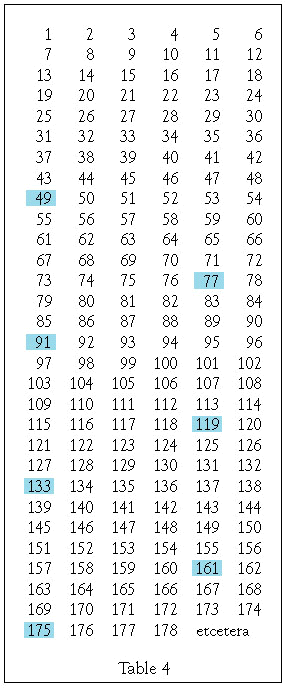
In Table 4, the zigzag pattern for prime number 7 is shown. The pattern jumps 4 + 3 lines forever.
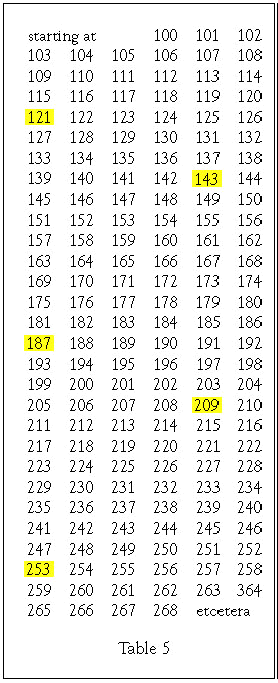
In Table 5, the zigzag pattern for prime number 11 is shown. The pattern jumps down 3 + 8 lines forever.
In Table 6, the zigzag pattern for prime number 13 is shown. The pattern jumps down 8 + 5 lines forever.
— — -
All these patterns have a pattern among them, called the Link Pattern. As you can see in the image, the pattern is predictable. The 4 found with the pattern of number 5 reappears up front with the pattern of number 7. The second part of the pattern with 7, which is 3, reappears upfront with the pattern of number 11.
As declared here just with number 11 and then for number 13 as examples: when the first part of the pattern for 11 is 3, then the second part of the pattern is 8 (11 minus 3). This 8 is then the first part of the pattern for number 13, and so the second part is also known (13 minus 8).
And on and on it goes, everything pattern-wise is known, all the way to forever with these first-and-fifth-place numbers (whether prime number or not).
— — -
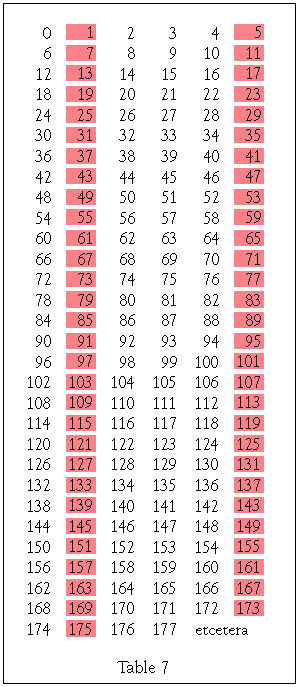
The last step occurs with walking this Link Pattern back to number 1. The specific pattern combination for number one is 0 + 1. The jump pattern is an actual stop on the same line and then a jump of one line. You can see it in Table 7.
In this table, number 0 was added to the list, so first and fifth places for prime numbers and the likes are now in second and sixth places.
The evidence that zero is linked to the other numbers lies in the fact that its use is required to name the specific pattern of number 1. Without zero that pattern cannot be named or explained. Zero is therefore a fundamental part of what may initially appear quirky and unimportant, but what is nevertheless an essential part of this rather basic pattern found in math.
Number theorists are incorrect. Zero is a natural number. It is natural to have a Year Zero. Our universe, starting out with the Big Bang or with the very similar Big Whisper (no bang, but a catapult mechanism), is foremost based on separation, and only subsequently based on unification.
— — -
This is evidence about the mathematical building blocks and their fundamental relationship. The conclusion is that a mathematical model that has just one fundamental aspect for any basic reality is not available. The model of singularity can therefore never be used, because a fundamental zero implies there are always two positions.
— -
Depth perception is self-evident for a person with two eyes open. The experience does not exist in the outside world, but is seen within. For a person with one eye open, depth is much harder to experience, and can even be denied to exist. Still, the denial is imperfect because, when we close one eye and look with just the other, we have not become Cyclopes.
Cyclones are correct singular phenomena, but there is nothing in our universe that follows the structure of a Cyclops. In stories, in 2D drawings and movies, Cyclopes can get created. But the only realm where a Cyclops roams is inside the human brain.
Even where math does not come to a conclusion, one cannot call a position or area a singularity, because we do not use words of fiction or of religion in any scientific field. Using singularity is like importing the word Santa into Science.
The idea that a scientist would pick a word such as singularity is a strong indication that this person does not know that the overall model we live in is a model in which separation is first and foremost and that there are two fundamental aspects to any basic outcome, even when one of the two does not amount to much.
Using the word for an unknown mathematical situation does not satisfy either, because the word is obviously pointing to making everything one. In a universe that is a result, making everything one is an improper scientific act.
If interested in more:
— — -
Delivery based on The Proof of Nothing, published by Penta Publishing (2000) and In Search of a Cyclops (2003), internet publication.