avatarGunnar De Winter

Free AI web copilot to create summaries, insights and extended knowledge, download it at here

1748

Abstract

g machine learning in aging research</a>, and a later study indeed used machine learning to develop <a href="https://readmedium.com/machine-learning-clock-predicts-lifespan-83986cc8d4e3">lifespan ‘clocks’</a>.</p><p id="2400">To make things even more complicated, the different parts of our body that are affected by age respond to aging in a different way.</p><p id="4c2e">Still, some interventions that are being studied (for example, <a href="https://academic.oup.com/ajcn/article/78/3/361/4689958">caloric restriction</a> — the effects of which on human longevity are still very much unclear, so don’t starve yourself just yet) appear to have a positive effect on many tissues in the body. So perhaps all the different ways in which different tissues age have some underlying shared pathways (the <a href="https://www.ncbi.nlm.nih.gov/pmc/articles/PMC6611156/#:~:text=Inhibition%20of%20the%20mTOR%20pathway,a%20wide%20array%20of%20organisms.&amp;text=Owing%20to%20its%20central%20role,to%20ameliorate%20age%2Drelated%20pathologies.">mTOR pathway</a> is a known one). But can we define a genetic ‘footprint’ of aging shared by different tissues?</p><h1 id="acaa">Finding the footprint</h1><p id="364e"><a href="https://www.cell.com/cell-reports/fulltext/S2211-1247(20)31192-X">In a new study</a>, scientists studied the effects of aging in three tissues (liver, heart, and muscle) in mice. More specifically, they looked at three ‘levels’ of information: the <a href="https://en.wikipedia.org/wiki/Transcriptome">transcriptome</a> (the collection of all RNA bits that have been copied from the genome’s DNA), the <a href="https://en.wikipedia.org/wiki/DNA_methylation">methylome </a>(the collection of epigenetic methylation marks on the DNA), an

Options

d <a href="https://en.wikipedia.org/wiki/Histone">histone </a>modifications (changes to the histone protein around which DNA is wound).</p><figure id="797a"><img src="https://cdn-images-1.readmedium.com/v2/resize:fit:800/0*GXepSYLQOMlZ05OP.png"><figcaption>Illustration of methylation and histone modification (Wikimedia commons, NIH)</figcaption></figure><p id="4922">The researchers found that age affected mostly the transcriptome and methylome in the liver, while heart and muscle aging were more characterized by histone changes.</p><p id="bd88">No shared footprint, then?</p><p id="c5ff">Hold on. Your footprint can change depending on the shoe you’re wearing. Or, in this case, the underlying genetic footprint can have different effects in different tissues.</p><p id="8f9d">And that indeed turned out to be the case. While each tissue had its own manifestation of the aging process, the researchers were able to identify several <a href="https://en.wikipedia.org/wiki/Transcription_factor">transcription factors</a> — proteins that control gene activity — that played a role in all three aging tissues.</p><p id="e391">What’s more, these transcription factors are evolutionarily conserved, meaning that they occur in several species due to common ancestry. In fact, the researchers found several of the age-related transcription factors in human DNA. These transcription factors have additionally been implicated in the human aging process previously. Or:</p><blockquote id="f279"><p>We conclude that conserved modulators are at the core of the molecular footprint of aging, and variation in tissue-specific expression of some may affect human longevity.</p></blockquote><p id="befe">Next step: regulate the regulators.</p></article></body>

The Master Regulators of Aging

Different parts of our bodies respond differently to aging, but there seems to be a genetic footprint made up out of a few key regulators
(Pixabay, EliasSch)

Time is not on our side

When we were children, most of us couldn’t wait to grow up. What fools we were. Once adulthood has crept around the corner, things started to go downhill. Slower for some, but still…

Aging, after all, is marked by the ‘gradual deterioration of functional characteristics’. The physical prowess of our teens and twenties is but a fading dream as time flies by.

For most people, it stills feels unconventional to call aging a disease. The case, however, has been made a few times by now. Whether you agree or not, it is uncontroversial to say that, in the vast majority of people, advanced age is a period marked by various health problems (unless we visit the blue zones).

That point is that aging is a systemic process that leaves no bodily function unaffected. It is, to use a few extra syllables, a multi-factorial problem. In fact, in a previous post, we looked at how this points towards implementing machine learning in aging research, and a later study indeed used machine learning to develop lifespan ‘clocks’.

To make things even more complicated, the different parts of our body that are affected by age respond to aging in a different way.

Still, some interventions that are being studied (for example, caloric restriction — the effects of which on human longevity are still very much unclear, so don’t starve yourself just yet) appear to have a positive effect on many tissues in the body. So perhaps all the different ways in which different tissues age have some underlying shared pathways (the mTOR pathway is a known one). But can we define a genetic ‘footprint’ of aging shared by different tissues?

Finding the footprint

In a new study, scientists studied the effects of aging in three tissues (liver, heart, and muscle) in mice. More specifically, they looked at three ‘levels’ of information: the transcriptome (the collection of all RNA bits that have been copied from the genome’s DNA), the methylome (the collection of epigenetic methylation marks on the DNA), and histone modifications (changes to the histone protein around which DNA is wound).
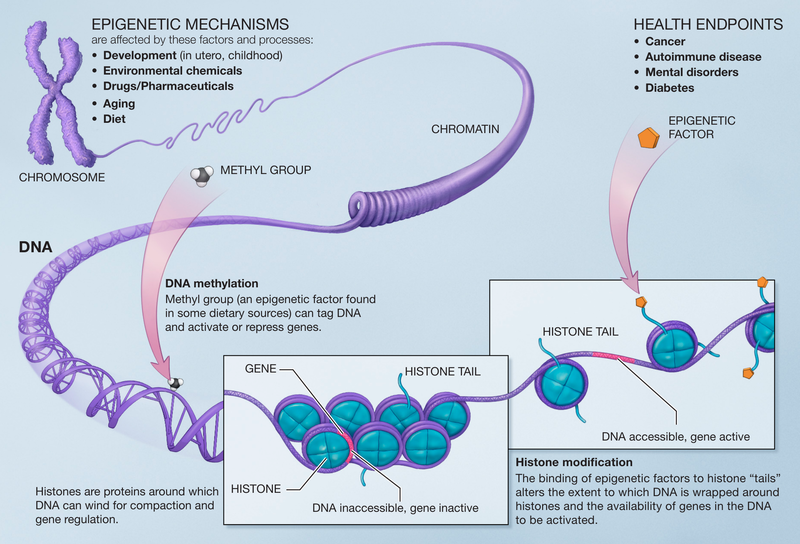
Illustration of methylation and histone modification (Wikimedia commons, NIH)

The researchers found that age affected mostly the transcriptome and methylome in the liver, while heart and muscle aging were more characterized by histone changes.

No shared footprint, then?

Hold on. Your footprint can change depending on the shoe you’re wearing. Or, in this case, the underlying genetic footprint can have different effects in different tissues.

And that indeed turned out to be the case. While each tissue had its own manifestation of the aging process, the researchers were able to identify several transcription factors — proteins that control gene activity — that played a role in all three aging tissues.

What’s more, these transcription factors are evolutionarily conserved, meaning that they occur in several species due to common ancestry. In fact, the researchers found several of the age-related transcription factors in human DNA. These transcription factors have additionally been implicated in the human aging process previously. Or:

We conclude that conserved modulators are at the core of the molecular footprint of aging, and variation in tissue-specific expression of some may affect human longevity.

Next step: regulate the regulators.

Science
Future
Health
Aging
Biology
Recommended from ReadMedium