
MINDFUL TRAVELING
The Magic of Connecting with Locals When You Are on the Road
Experience a new side of travel
We tend to gravitate to the company of other travelers when we are on the road. After all, we share a common bond. And we’re easy enough to spot. Just look for the familiar faces with backpacks in tow or guidebooks in hand.
But while taking in the sites with other travelers has a lot of appeal, it’s the times I’ve spent with locals that have been the most eye-opening and memorable for me. Because it’s the locals that have allowed me to experience a place in a way that only people with deep-seated knowledge and understanding of an area can.
Which leads me to Mount Hakkoda.
A Trip to the Summit
In the late 90s, I found myself in Aomori, Japan. For those of you not familiar with Aomori, this prefecture is nestled along the northernmost tip of Japan. It is also home to more snow than any city in the world. In fact, it’s not uncommon to see cars swallowed whole under mounds of white, fluffy snow and locals shoveling daily from their rooftops.
The area is sparsely populated, with less than 300,000 people across the entire prefecture. Literally translated, Aomori means “blue forest.” And it is home to some of the most beautiful lakes and mountains in Japan, including Towada Lake to the east and Mount Hakkoda, which looks down on Aomori City.
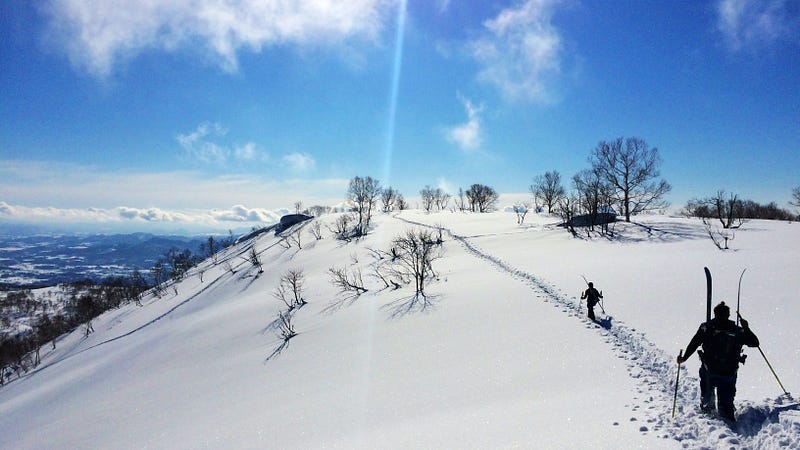
On this particular weekend back in the 90s, I found myself with a group of outdoor adventurers. We were all headed up Mount Hakkoda for a little winter camping and skiing.
In total, we had two Canadians, two Brits, and two Americans in our party. We strapped our skis and packs to our backs and snowshoed our way up the mountain one late afternoon.
The plan was to get to the top of the mountain just before sunset. There, we would stay in a little cabin that could house up to ten people. Some of our party (the ones that were gluttons for punishment) wanted to camp outside under the stars — fully exposed to the ruthless winter winds and the chilly night air.
The climb was fairly straight-forward, and as we ascended the roughly 700 meters to the summit, we were graced by fantastic views of Aomori City and the surrounding mountains and valleys. When we finally got to the little hut at the summit, the sun was just starting to dip below the horizon.
We stepped inside the little shack at the top of the summit, and there we found three elderly Japanese men sitting on their bunks getting their sleeping bags ready.
They nodded in our direction but looked rather afraid of what must have seemed like a foreign invasion. They also did not speak a word of English. So after giving us a brief nod, they turned their attention back to their belongings.
But as the night wore on and we set about preparing our dinner, we started to chat.
All of us spoke Japanese. The dialect of Aomori is a language in and of itself, but we all managed to converse freely.
And this conversation opened my eyes to Japan in a whole new way.
It turns out that these three men were children during World War II. We also discovered that they had never met or spoken with a foreigner before meeting us. We were their first.
The men told us tales about seeing the most beautiful fireworks of their lives over Aomori. In fact, they were sitting on top of the same mountain we were all sitting on that night when the fireworks began. It was July 28, 1945.
It turns out the beautiful lights the men saw were not fireworks at all. Rather, they were the lights of an American airstrike that was taking place across the entire prefecture.
Those air raids ended up destroying 90% of the city and claiming almost 2,000 lives that night. The men all lost loved ones. They saw their city decimated before their eyes.
They had carried this memory with them over the course of their lives.
And now, they were sharing this story with us — the first foreigners they had ever met or spoken to. And in sharing their story, they were releasing years of pent-up emotion. Two of the men broke down and wept openly.
We sat and listened. And somehow, our being there and our ability to converse and understand was a turning point for these men. It’s as though they were finally able to share a piece of themselves that had been tucked away for a very long time.
It opened our eyes up to a new side of Japan. One that we weren’t even alive to witness.
Previously, when I had looked at Mount Hakkoda, I had always seen its beauty. But now, on this night, I saw that beauty was marred by a history solely witnessed by these local men. And it was a history I now felt closer to understanding.
In this fleeting moment, I felt like I made a deeper connection to both the land and its people.
Connecting with Locals
We hadn’t expected to come across these three elderly men on the top of Mount Hakkoda that night. This happened purely by chance.
But chance encounters are not the only way to get closer to the local residents. You can seek these opportunities out on your own. After all, you can always find locals serving your food, helping on tours, and working in the places you are staying.
All it takes is a little bit of effort.
And if you are looking to improve your chances of having truly meaningful engagement with the people living in the places you are passing through, one of the best things you can do is learn the local language. The more you are able to converse, the more likely you are to get a window into the local culture, customs, and tales of the land.
But even if you can’t speak the local dialect — don’t let this hold you back. Simply engage. That’s all you need to do.
In the End
Travelers love to hobnob with other travelers. Being on the road tends to draw us together. But as you explore new countries and cities, be sure to reach out to local residents along the way.
They can take you places and tell you stories that will make you see the world in a whole new way. And you can do the same for them.
So, the next time you are on the road — break away. Engage a local resident or two. Have your own Hakkoda moment. You’ll be glad you did. And if you already have had moments like these, I would love to hear about them. Just drop me a note and tell me more.
© Courtney Burry 2021
Looking for more travel adventures? Be sure to check out more of Courtney’s work here:

Sign up for our newsletter to stay informed with up-to-date curations from our editors:👇