
The Magic of Changing Your Microenvironment: How Tiny Tweaks Can Lead to Immense Results
And how one choice creates a chain reaction.
“Insanity is doing the same thing over and over again and expecting different results.”— misattributed to Einstein, probably by Narcotics Anonymous
Most of our days, we do routine things in environments that don’t change. Some sources of how much of our behavior is habitual have their lower ends at 45%. Some even go as far as 95%.
Yet we continue diligently to read self-help books promising that this little tweak will do the trick and make us a millionaire
We read articles about productivity promising outlandish results.
We listen to podcasts, audiobooks, watch documentaries, and courses in the hopes that surely all this exposure will lead to some palpable change.
Yet, as you know, it rarely does.
If we were a powerplant, we’d be closed for good years ago because our yield is grotesquely disproportionate to the input.
So why is it that all our endeavors to reinvent ourselves are cut short? Why do we constantly underperform?
It’s because we do the same thing over and over again in the environment that hasn’t changed.
The One Tweak that Lies Beneath Everything Else
You see, we’ve been dealing with the weeds by cutting them, but the root of the problem stayed the same — our environment hasn’t changed.
A bit of elaboration here.
Habits are tied to our environment. The cues that we encounter prompt many of the behaviors we do repeatedly.
If you don’t change anything in your environment — no matter how many books or articles you’ll read — you’ll still remain prompted by the same old cues.
So the change in the environment is what we need. But how? I mean, how are you supposed to change your environment? Move? That’s probably not happening. Turns out you don’t have to anything that drastic.
Let me illustrate with a personal anecdote.
Weekends are for meta-thinking. I sit down, without anything preplanned, and think about what I want to accomplish the next week.
This usually takes the form of me looking into Notion and checking what needs to be done.
I’m going to state the obvious here because it’s important for the story: I do my planning on the computer.
It turns out, this one little detail affects the outcome of my entire day.
Let me explain.
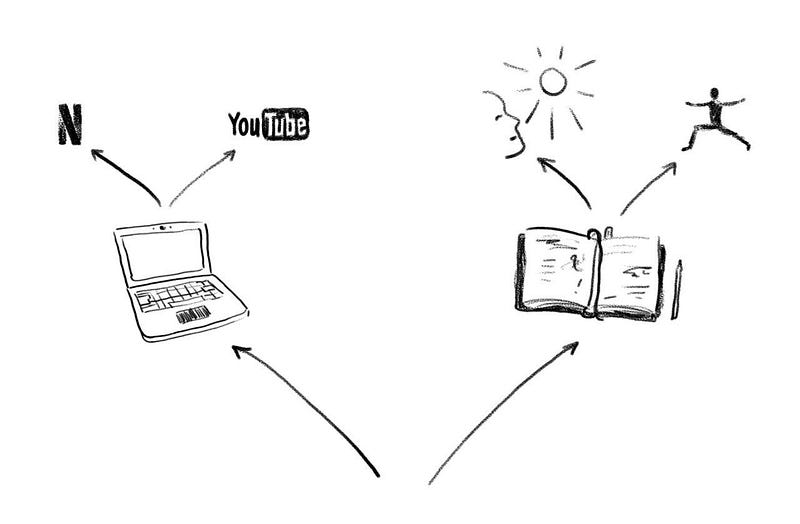
See, the computer can be viewed as a microenvironment.
While running, the computer becomes an extension of myself, another limb if you will. As a result, my thinking patterns shift to accommodate it.
I think in terms of what I can do within the set environment.
The Science behind Human Perception
This phenomenon is well known in neuroscience and cognitive psychology — our brains adjust to the tools we’re using and the environment around it.
In an ingenious experiment, the researchers wanted to know whether manipulating people’s body sizes would affect how they perceive the world. For that, they strapped participants with VR sets and manipulated their body size. Some people got a giant body, some just got a Ken or a Barbie doll-sized body.
Researchers then asked them to estimate how far objects in the VR environment seem to be (the environment was the same in all conditions). People with huge bodies estimated that everything is closer, whereas people with doll-sized bodies thought everything is much, much farther.
The brain adapted to the view presented to it and changed how people perceive their surroundings.
Likewise, the neuroscientist V S Ramachandran showed that we can cure phantom limb pain — the pain in the missing, amputated limb — by simply reflecting the healthy limb in the mirror.
This pain is no joke: some people have debilitating pain that leaves them unable to go about their days. Pain in a limb that they don’t have!
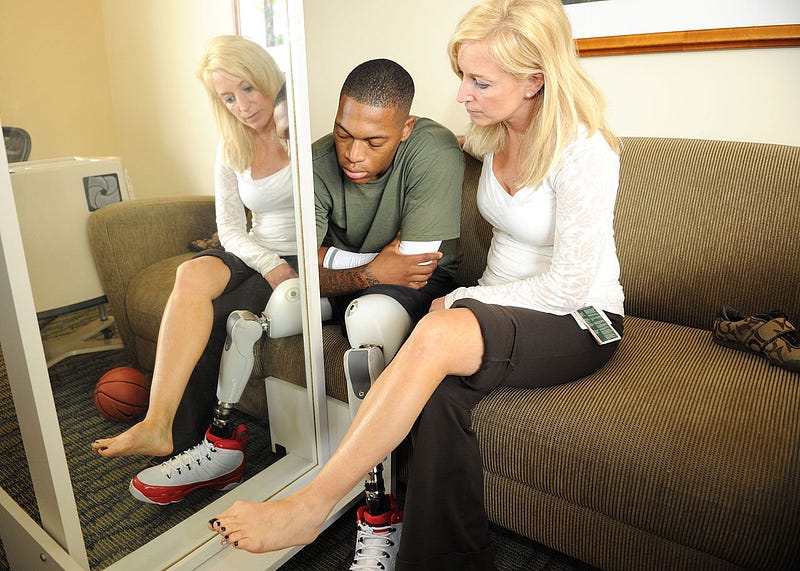
This works because our brain takes cues from the environment. And seeing your healthy limb reflected in the mirror tells the brain that hey, the limb is still there, stop the pain!
So our mind is incredibly flexible — whatever we feed it, whatever tool we’re currently using, becomes a part of it.*
We can use this knowledge to shape our environment.
And this is where we circle back to my planning story.
* Here we get into the Buddhist territory of illusory self, but that’s a story for another time.Tweak Your Microenvironment and the Changes Will Follow
This week I decided to go analog and plan with a pen in my hand. I didn’t turn on the computer.
And lo and behold, the whole structure, not only of the planning itself but also of the entire day, shifted.
Where I’d usually watch videos to celebrate hard work done, I’d instead look up from my notebook and grab a book.
Where I’d usually write an article on the computer, I’d instead jot it down in my notebook. The whole process of writing it shifted as well: where I’d usually do research to remove my writer’s block, I thought hard instead if I find any examples or other ideas in the dark, unused recesses of my mind.
I immediately thought about what the philosopher Friedrich Nietzsche wrote to his friend, the composer Heinrich Köselitz:
“Our writing equipment takes part in the forming of our thoughts.”
At that time, Nietzsche switched from pen and paper to a typing ball, an instrument that enabled him to write despite his debilitating pains and near blindness.
Like Nietzsche, I too changed my usual instrument: the other way around. And this little change in what I usually do triggered a cascade of causal events that completely altered the structure of the things that followed.
And here I am, sitting with my mind blown and furiously scribbling this piece into my notebook.
I think that after the decades of the blatant overuse and misuse of the said misattributed Einstein quote, it’s about time we make use of it in the light of something different.
We can do the same thing over and over again, provided we change something about our environment. That way, all that input will have a chance to root itself within a new environment. An environment that’s not cluttered with old habits.
So, to get the results you want from all that input, you must change your environment at crucial trigger points.
It’s not drastic, life-changing events that you must implement to nudge you on a different trajectory (although they help). Rather, it's comparatively small changes in the microenvironment that do the trick.
For me, it was going analog with my planning.
What will it be for you?
Taking It One Step Further — a Screen-free Day
If you do weekly planning, feel free to steal what I did and go analog with it.
But if you want to go one step further, do what Tim Ferriss does.
I don’t know where I read it — maybe it was even in his podcast — but Tim frequently does a screen-free day. He avoids the computer, phone, even the ebook reader.
This is in line with what I was writing about — Tim changes one aspect of his life and this aspect then influences everything else.
Suddenly, everything else you do is affected by this one restriction you placed.
Your mind is malleable. Whatever you feed it will show in how you see the world.
Find these crucial trigger points in your life, push down on them, and watch the magic unfold.