
The Mad Genius: The Relationship Between Intelligence and Mental Illness
Maybe we should stop stereotyping this stuff.
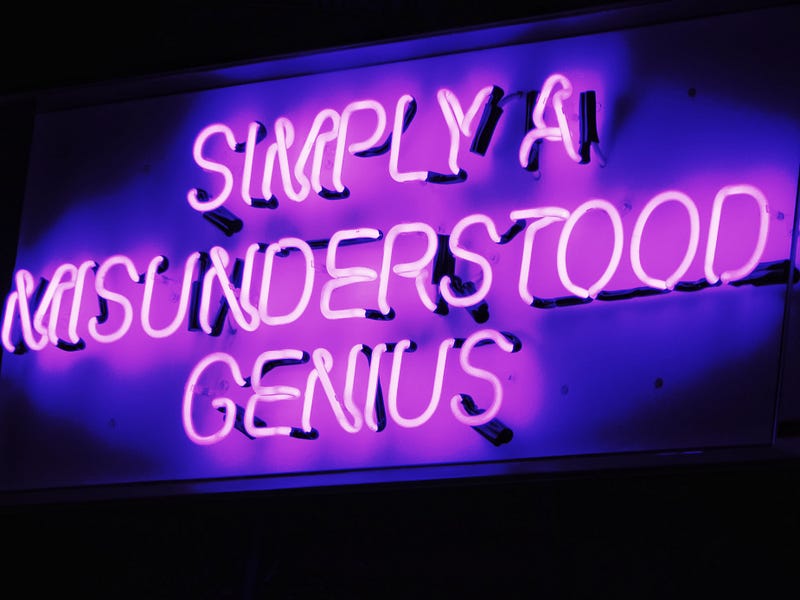
We all have this image of the tortured genius that society that the media has driven into our skulls. The man (it’s almost always a man) scribbling away on a chalkboard, filling it with arcane mathematical runes, only to have the realization that changes everything. This only comes after days of locking himself in his office, sleeping sporadically, eating occasionally, and peeing into a jar. But the moment arrives, and he’s done it! Our fundamental understanding of the universe is forever altered!
Or, it’s the homeless person, the savant who is a master classical cellist but can’t hold down his life long enough to have a set place to live. He wanders the streets, carrying his cello in a shopping cart, only to be discovered by the musician who heard from a guy who heard from a guy that some homeless dude is pretty good at the cello.
Or it’s the genius mathematician, who creates a new mathematical theory and is recruited to uncover hidden codes in newspapers, except maybe it wasn’t real after all. Or the engineer who designs a breakthrough device and spends 20 years obsessively pursuing the people who stole it from him at the cost of his happiness.
Generally, there are a few characteristics that go along with being a “genius” in modern society. You have to be at least a little weird. You have to not conform to the social norms of society. You have to be in some science or math field, or something related to economics or finance, or tech, or some kind of artistic pursuit, because there are apparently no genius burger flippers out there.
These things tie into the implicit or explicit understanding that, to be a genius, you have to be crazy — sort of the “suffer for your art” approach that society is infatuated with. What normal person does these things, after all? It takes an extraordinary mind to revolutionize particle physics, but no sane person has that kind of drive. That’s how we get mad scientists, after all.
We also look back at geniuses like Michelangelo, Da Vinci, Tesla, and a whole host of others and retroactively analyze their quirks and oddities to posthumously diagnose them.
In this way, mental illness and genius tend to go hand in hand in society, and studies support this to some extent. Generally speaking, people with higher IQs tend to be diagnosed with mental illness, anxiety, and other mental health disorders at higher rates than the general public.
Whether this is because of their higher IQ or simply correlated to them being more isolated and more likely to seek a diagnosis requires further research, however. Additionally, people with mental illness are not more predisposed to being geniuses, so it’s a one-way correlation.
The interesting thing about being a genius, however, is the sheer variety of people you tend to get. The older model is the middle-aged professor guy with frumpy clothes and unwashed hair. A more modern version is the tech guru who innovates every waking hour in his jeans and hoodie. There is also the slick successful businessman/investor type, and the starving artist. All a little weird in some ways, and not at all representative of geniuses throughout the world.
Ignoring the fact that, statistically, the typical genius is not a white guy but an Asian by simple virtue of population, meeting actual geniuses is a varied experience. They run the gamut from entrepreneurs to writers to people working manual labor just trying to get by to homeless drug addicts.
There are stuffy Baby Boomers in three-piece suits who have built seven businesses from scratch, bearded hipsters with tattoos and piercings and a taste for craft beer, quiet skinny 30-somethings in the corner lost in a book, teens playing six simultaneous games of chess with people around the world, and everything in between.
So what do these people have in common? Much energy is spent breaking this down. These run from breathy pieces extolling the virtues of geniuses to matter-of-fact lists of some huge number of traits to thinkpieces in business journals that pick a handful of lofty factors to focus on.
The consensus is that geniuses are curious, analytical, adaptable, abstract thinkers who mostly just want to be left to their own devices. They work on their own time and in their ways, and you either love them or you hate them, but you can’t deny their genius.
So, everyone wants to be a genius. Some studies link about 50% of IQ to genetics, so there’s the chance that you may come up short there. Your upbringing also contributes a lot to your IQ as well. Being encouraged to do new things and follow your passions as a kid can nurture curiosity and intelligence that sticks with you for life.
This is part of the “Tiger Mom” phenomenon that has bounced around American awareness in the recent past: the premise that if you practice for every waking moment, you’ll eventually get good at something.
That sort of feeds into the natural talent versus practiced skill debate. Essentially, one can become great at and even master something with enough practice, but it is unfortunately often overlooked in favor of the kid who picked up a violin when they were three and was a virtuoso by the age of six.
One of the interesting things I’ve noticed about the smart people in my life is that they are constantly seeking new things. Whether it’s new knowledge, new experiences, new people to talk to, or new drugs, they spend lots of time finding new ways to expand their consciousness. The status quo is not enough, and they need to find new neural pathways in their brains to feel good.
For me, this makes sense. When I was five, I tested into the gifted program in my grade school. All of the kids there were like me: they had a hunger to do new and interesting things, follow obscure pathways and read arcane books in search of a new fascination. Everyone read books way above their grade level.

There were a lot of nerds who fell deep into fandoms, whether it was Star Wars or Lord of the Rings (before the movies!) or the Wheel of Time series. The Hitchhiker’s Guide to the Galaxy was a must. The nerdy genius has, in some ways, supplanted the mad genius in popular culture, but the implications are the same: a weird person who doesn’t fit in but is capable of amazing things.
These days, most of my genius friends are nerds. I’ve been having great political debates with my veteran friend and another person he introduced me to who is literally an astrophysicist and whose wife was a political science major. My vet friend is no slouch, having worked with explosives in the army and having a deep understanding of chemistry and physics, as well as a degree in history.
They both have two decades of age on me and their intellects intimidate me, but when I mentioned that I was afraid to put my two cents in, they treated me as an equal and asked for my thoughts. Even though I judged myself inferior, they still sought my opinion, however ill-informed it may be.
For me, that’s one of the things that separates genius: the search for new things, the drive for improvement and updating one’s knowledge and opinions. Being flexible enough to learn a new skill or modify your worldview based on new information.
Some people are geniuses that don’t score high on standard IQ tests as well. My wife was average in school, but reads voraciously and once taught herself two advanced crochet stitches after 30 minutes on YouTube. She can craft just about anything if she puts her mind to it, even though she doesn’t have the head for some of the math required to do them.
Additionally, you have to be open to the fact that there are things that you don’t know, the willingness to admit when you’re wrong, and that the Dunning-Kruger Effect exists. Generally, when a genius says “I don’t know,” the next bit, whether spoken or unspoken, is “I’m going to find out, though.”
I like to think that we can all learn aspects of being a genius. The willingness to learn can be taught. Even for people who hated school, there are ways to make different topics interesting and relatable. Plus, not every topic is for every person.
I don’t know the first thing about raising cows, but I write for a living, while a farmer may be an absolute genius with his livestock but can only read at a sixth-grade level. As far as I’m concerned, those are both valid forms of genius. IQ and book smarts aren’t everything, and we need to stop pretending that they are.
So, what does any of this have to do with mental illness? Nothing, and that’s the point. I think that the “mad genius” trope needs to be put down. Trying to correlate genius and mental illness is not helpful to either group.
The truth is, there are many forms of genius that aren’t artistic or scholarly. Being a math genius and innately understanding how to raise kittens are both valid forms of genius, even though they are both considered “crazy” for different reasons.
In the same way, assuming that every person with schizophrenia is an inventor or musician isn’t constructive. People with autism aren’t all savants, bipolar people aren’t all starving artists, and being depressed doesn’t automatically make you a songwriter or poet.
Both geniuses and people with mental illness are people first. I know that we as humans like to classify things and put them in boxes, but trying to lump the two together in the same box is looking past the person and at two unrelated traits.
Yes, people who are geniuses have quirks and odd traits, but so do people who are not geniuses. People with mental illness can be smart, or good at art or music, but they can also just be a typical person just trying to get through life.
It’s estimated that one in five people, that’s 20%, will deal with mental illness in their life, while an IQ of 130 or higher (roughly high enough to get into MENSA, the high-IQ society) is present in about 2% of the population. You do the math.
Maybe, just maybe, people who are considered “geniuses” and people with mental illness are just…people. Maybe we should stop putting them in boxes or on pedestals or in movies about overcoming all odds to be the best.
In reality, they’re just living their lives, trying to get by. Having jobs, spouses, kids, lives, doing all the things that the “mere mortals” do. For the most part, they don’t want to be treated any differently. They just want to live their lives.
So, let them live their lives. Don’t treat them differently. People with mental illness and geniuses are aware that they’re different, and many of them embrace their differences, but sometimes, it’s nice to just…be. Not to stick out, not to be held up as a shining example of success or looked down upon as a menace to society. Just to exist in the world, passing without notice.
That’s all most people want, really, is just to be. Just to live their lives and exist without a fuss. Let’s just leave them alone.


