The Lord of the Rings: 20 Years On
Celebrating Peter Jackson’s monumental cinematic adaptation of JRR Tolkien’s classic novel.
Warning: Contains spoilers.
This month marks the twentieth anniversary of The Lord of the Rings: The Fellowship of the Ring being released in cinemas. As such, it seemed an opportune time to re-watch all three films in this magnificent trilogy, and once again wallow in their magnificence. Any excuse, right? They really are just as good now as the twentieth time I watched them.
First, full disclosure: The Lord of the Rings is my favourite novel of all time. I have regularly re-read JRR Tolkien’s epic masterpiece ever since I first encountered it at the age of nine. Regardless of the films, it is a must-read. I probably know my way around Middle-Earth better than I know my way around south-west England (where I live), which is perhaps a little worrying.
You can imagine my anxiety when I heard Peter Jackson was tackling my “precious” favourite novel. Even when the first instalment, The Fellowship of the Ring, was about to hit cinemas, to a chorus of outstanding reviews, I remained cautiously sceptical. After all, we’d been here before, with Ralph Bakshi’s 1978 animated version, which covered roughly the first half of the story. The best that could be said about that film was that it was a very brave attempt at an essentially impossible project.
Needless to say, when I finally went to the cinema to see Fellowship, ten minutes in I was completely sold. Peter Jackson had managed a brilliant adaptation of this allegedly unfilmable classic. The film succeeded on multiple levels. The essentials of the plot — evil ring must be destroyed — remained intact, whilst Jackson and screenwriters Fran Walsh and Phillipa Boyens stripped back everything that wouldn’t have worked onscreen, and emphasised everything that would. The result is pure cinematic magic.
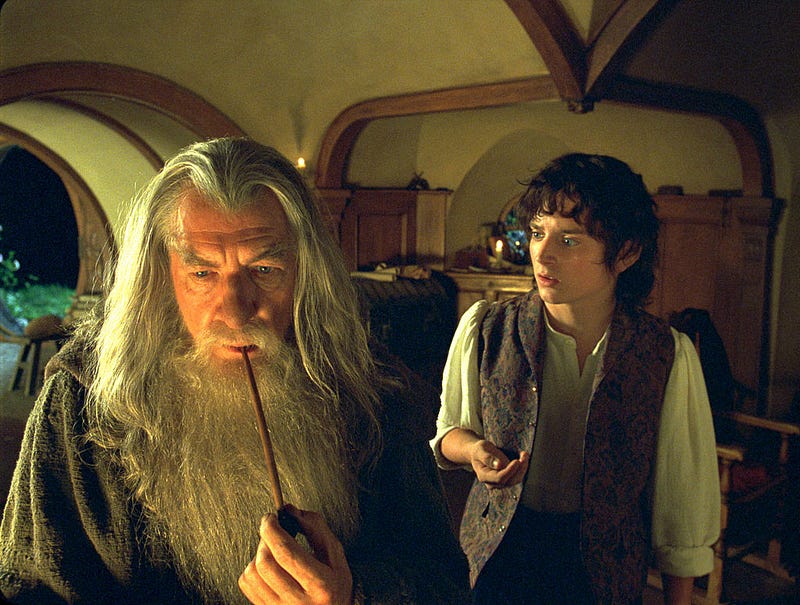
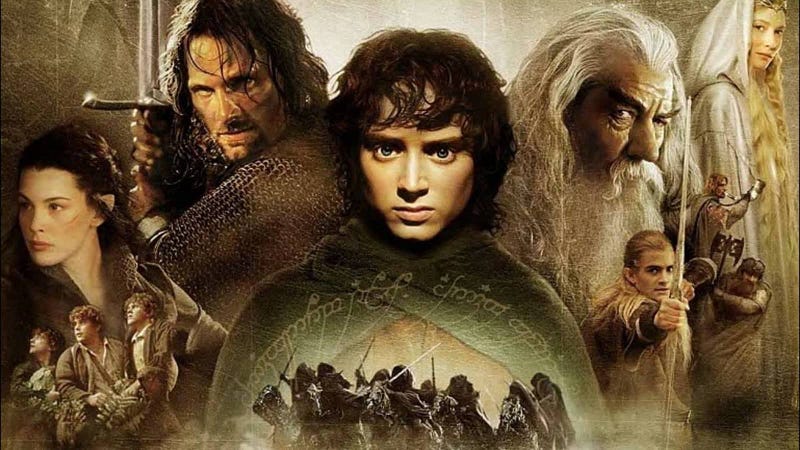
The casting is perfect to the point that meeting the characters is like meeting old friends. Elijah Wood is excellent as Frodo, the hobbit who inherits the Ring of Power from Bilbo. An equally excellent Ian Holm brilliantly captures the tragedy of the latter character. Sean Astin plays Frodo’s gardener and loyal friend Sam, another superb bit of casting. Dominic Monaghan’s Merry and Billy Boyd’s Pippin round out the hobbit cast; bringing not just comic relief, but in the later films unexpected heroism and pathos.
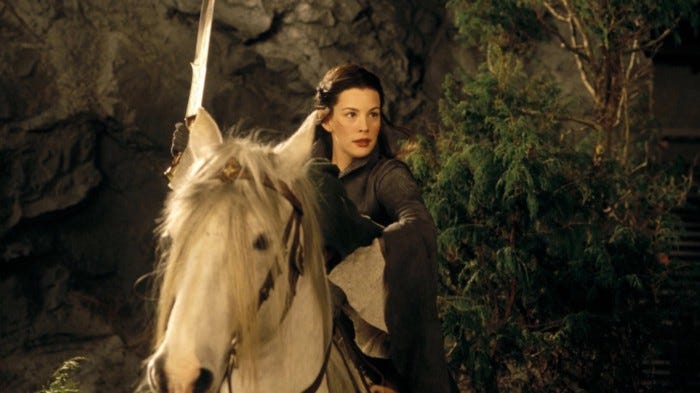
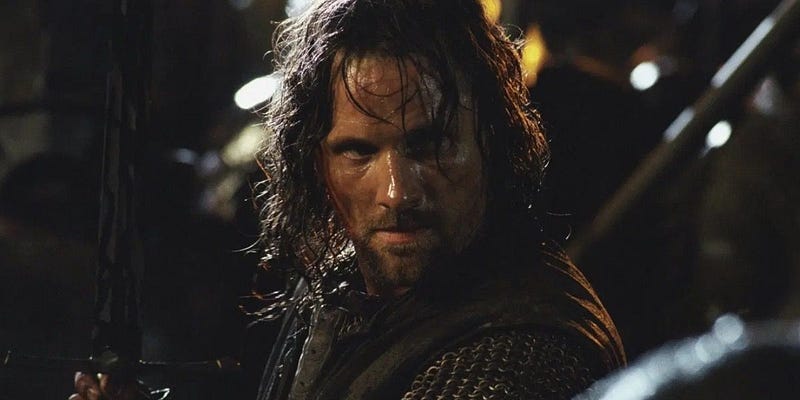
Uniting with the hobbits against the forces of the Dark Lord Sauron are humans; including hushed-up king Aragorn (a very memorable Viggo Mortensen) and valiant but proud Boromir (one of Sean Bean’s very best he’s-obviously-going-to-die performances). In The Two Towers, Aragorn joins forces with the people of Rohan, including their King Theoden (Bernard Hill), and warriors Eomer (Karl Urban) and Eowyn (Mirando Otto). The latter becomes part of a sort-of love triangle which also includes Aragorn and his Elven betrothed Arwen (Liv Tyler).
Speaking of Elves, the excellent Hugo Weaving crops up as Elrond, the equally excellent Cate Blanchett plays Galadriel, and Orlando Bloom, not an actor to whom I am generally inclined, contributes his one unquestionably iconic turn as Legolas. Oh, and I’ve forgotten to mention other humans that turn up in the later big battles, including Faramir (David Wenham) and his soon-to-go-mad father, Denethor (John Noble) in The Return of the King. Then there’s good wizard Gandalf (definitively portrayed by Ian McKellen) and turncoat wizard Saruman (Christopher Lee, in another iconic performance)…
As you can see, Jackson has quite a cast of characters to keep track of as the story progresses. But by listing them, I emphasise my original point: These actors genuinely own their characters. Perhaps most astonishing of all, Andy Serkis contributes a groundbreaking motion capture performance as Gollum; a creature tormented and twisted by long ownership of the Ring, played as a kind of schizophrenic drug addict. Gollum’s role in the narrative is pivotal, and more on that soon.
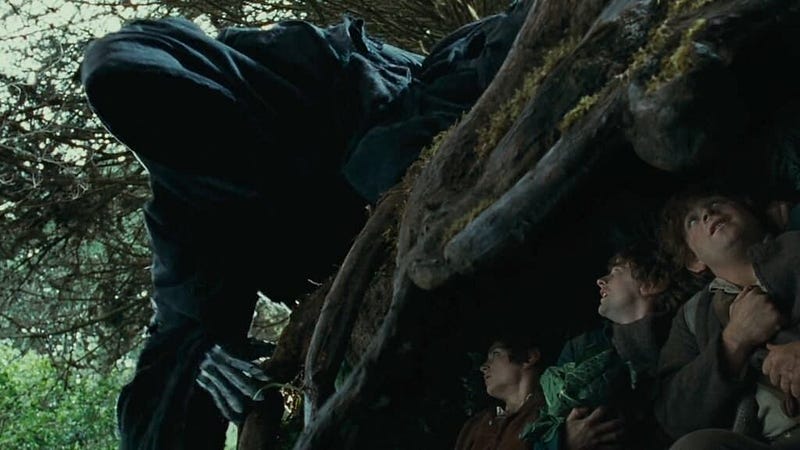
Suffice to say, the direction, production design, editing, sound, and visual effects look as outstanding today as they did twenty years ago. In set piece after magnificent set piece across three films, spectacular moments are vividly brought to life; from the rustic beauty of the Shire and the frightening appearance of the Black Riders, to the thrilling chase in the Mines of Moria, the mystical realms of Rivendell and Lothlorien, the surrealism of the Ents, the fierce battle of Helm’s Deep, the dazzling white city of Minas Tirith, the armies of the dead, the horror of Shelob’s lair, the fires of Mordor… I could go on and on.
The cinematography is staggeringly beautiful, making brilliant use of New Zealand locations, and Howard Shore’s music score for all three films is every bit as epic, magnificent, and stirring as John Williams’s score for the Star Wars films. In short, The Lord of the Rings trilogy is outstanding on every artistic level, and I will brook no argument to the contrary. Only someone with a clinical aversion to fantasy could fail to be captivated by it, and if that is you, I can only recommend seeking urgent medical treatment.
For me, as a Christian, the spiritual themes running through both Tolkien’s novel and Jackson’s films give real weight and timeless relevance to the story. Firstly, and most obviously, not counting the Bible, this is probably the greatest story ever written about the battle between Good and Evil. Yet this isn’t just about uniting against external evil, but more profoundly, about overcoming self-delusion, selfishness, corruption, and evil within oneself. The Ring is a brilliant metaphor for all such things, especially the corrosive lure of power, even when one wishes to use the Ring to do good. The lure of the Ring works differently with all who come into contact with it, promising absolute power but gradually bringing those who take it under the dominion of the Dark Lord, regardless of their good intentions.
Nowhere is this better demonstrated than in the character of Gollum, who does not gain the Ring through good intentions, but through murder. For five hundred years, his “precious” Ring is both an obsession and a torment. He both hates and loves the Ring, just as being a slave to addiction means being both drawn to it and repulsed by it. Perhaps the universal nature of this temptation and addiction metaphor is why the novel and the films have resonated so profoundly for generations.
Of course, Gollum’s own path in the story is crucial. Bilbo once had the opportunity to slay him, but instead took pity and spared his life (in The Hobbit; a masterpiece in its own right, but also a novel that essentially acts as a prelude to The Lord of the Rings). Frodo initially laments this decision, given the trouble Gollum causes subsequently, but Gandalf warns him not to be too quick dealing out death in judgement, and that his heart tells him Gollum has some part to play, for good or ill, before the end. “The pity of Bilbo may rule the fate of many” Gandalf says, and is ultimately proved correct.
Tolkien’s own faith, inexplicit but inherent in the novel, is even stronger in the films. For example, when Gandalf performs a quasi-exorcism on the possessed King Theoden, the Christian themes are even clearer onscreen than in the text. The Lord of the Rings is not an allegory, but it is possible to read certain characters as representative of the Trinity. For example, Frodo’s exhausting struggle up the slopes of Mount Doom, carrying the Ring, the ultimate evil, makes one think of Christ carrying his cross, bearing the weight of the sins of the world. Gandalf could represent the Holy Spirit; counselling, guiding, and leading (he also experiences his own death and resurrection). Most obviously, Aragorn’s return as King of Gondor makes one think of the prophesied return of Jesus Christ as King of the Earth.
Beyond all this, The Lord of the Rings extols cardinal virtues including courage, kindness, loyalty, sacrifice, and friendship. On the latter point, the films are intensely moving, showing the camaraderie and bonds that develop between characters throughout their many adventures. On another note, the films reflect Tolkien’s intense dislike of destructive greedy industrialisation ravaging the countryside, especially in the bizarre but brilliant, punch-the-air battle where the Ents attack the fortress of Isengard. Seeing trees come to life and take revenge against those who tore down forests for evil gain is oddly satisfying. As a child, I recall greatly lamenting when woodlands were cut down near where I lived so industrial estates could be built. Therefore, I’ve always had great sympathy with Tolkien on this issue.
Yet even more than that, for me, The Lord of the Rings is about growing up. The hobbits and their interactions with Gandalf are, to my mind, an echo of Tolkien’s relationship with his own children. Although Gandalf is, at first, their companion and guide, the hobbits learn to face the evils of the world without the aid of the wizard.
The narrative is also shot through with the bittersweet, universally relatable melancholia concerning the end of an era, especially regarding the plight of the Elves. Their magic will end either way, regardless of whether the Ring is destroyed. In addition, the inevitability that one day we leave this world behind looms like a shadow, even in moments of triumph.
Two decades on, as with the novel, The Lord of the Rings films grip, thrill, and frighten. They make me laugh, gasp, cry, and think. Yet ultimately, they break my heart. As Gandalf says in the finale: “I will not say, do not weep, for not all tears are an evil.”
Author’s note: I hope you enjoyed this article. For more about me and my writing on Medium, please click here. For information on my writing outside Medium, please click here. For a list of my published novels and other works, please click here.