
Logic Lens ™ Analysis: April 1922 Speech in Munich by Adolf Hitler’s
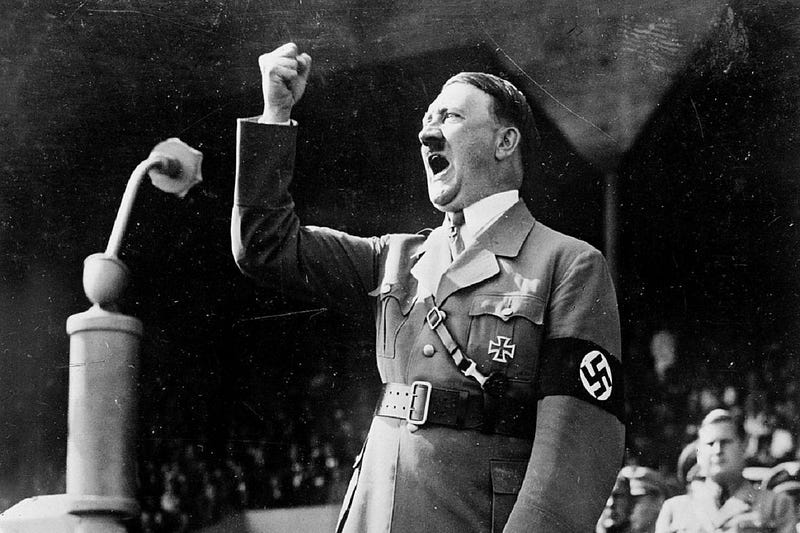
In 1922, Adolf Hitler was beginning to gain notoriety and influence as a key figure in the then-nascent Nazi Party.
Introduction:
In 1922, Adolf Hitler was beginning to gain notoriety and influence as a key figure in the then-nascent Nazi Party. At that time, he had already become the chairman of the National Socialist German Workers' Party (NSDAP), commonly known as the Nazi Party.
Hitler’s deeply concerning mental health issues, including his narcissism and extreme anti-Semitic beliefs, were projected onto millions of people through his speeches and policies. His regime’s policies led to the genocide of approximately six million Jews and millions of others, including Romani people, disabled individuals, LGBTQ+ individuals, and political dissidents, during the Holocaust.
Moreover, his aggressive expansionist policies and the initiation of World War II led to the deaths of an estimated 70-85 million people, including military and civilian casualties.
Analyzed: 557 Words
Reading Level: 11-12th Grade
“Every worker had to support another worker, the product of whose labor was commandeered by the foreigner. "The German people after twenty-five or thirty years, in consequence of the fact that it will never be able to pay all that is demanded of it, will have so gigantic a sum still owing that practically it will be forced to produce more than it does today.”
“What will the end be? and the answer to that question is Pledging of our land, enslavement of our labor-strength. Therefore, in the economic sphere, November 1918 was in truth no achievement, but it was the beginning of our collapse.' And in the political sphere we lost first our military prerogatives, and with that loss went the real sovereignty of our State, and then our financial independence, for there remained always the Reparations Commission so that 'practically we have no longer a politically independent German Reich, we are already a colony of the outside world.”
“We have contributed to this because so far as possible we humiliated ourselves morally, we positively destroyed our honor and helped to befoul, to besmirch, and to deny everything which we previously held as sacred.' If it be objected that the Revolution has won for us gains in social life: they must be extraordinarily secret, these social gains - so secret that one never sees them in practical life - they must just run like a fluid through our German atmosphere.”
“Someone may say "Well, there is the eight-hour day!' And was a collapse necessary to gain that? And will the eight-hour day be rendered any more secure through our becoming practically the bailiff and the drudge of the other peoples? One of these days France will say: You cannot meet your obligations, you must work more. So this achievement of the Revolution is put in question first of all by the Revolution.”
“Then someone has said: 'Since the Revolution the people has gained Rights. The people governs! Strange! The people has now been ruling three years and no one has in practice once asked its opinion. Treaties were signed which will hold us down for centuries: and who has signed the treaties? The people? No!”
“Governments which one fine day presented themselves as Governments, And at their election the people had nothing to do save to consider the question: there they are already, whether I elect them or not. If we elect them, then they are there through our election. But since we are a self-governing people, we must elect the folk in order that they may be elected to govern us.”
“Then it was said, Freedom has come to us through the Revolution.' Another of those things that one cannot see very easily! It is of course true that one can walk down the street, the individual can go into his workshop and he can go out again: here and there he can go to a meeting. In a word, the individual has liberties. But in general, if he is wise, he will keep his mouth shut.”
“For if in former times extraordinary care was taken that no one should let slip anything which could be treated as lèse-majesté, now a man must take much greater care that he doesn’t say anything which might represent an insult to the majesty of a member of Parliament.”
Confirmation Bias:
The statement seems to reflect a bias towards the belief that the outcome of certain actions (e.g., the Revolution) has been negative, potentially overlooking any positive aspects.
In-Group Bias:
There is a strong bias towards the speaker’s own group (“the German people”) and against others (e.g., “the foreigner”), which may color their perception of events.
Catastrophizing:
The language used suggests a tendency to magnify the negative outcomes of events, such as predicting a dire future based on current circumstances without considering alternative possibilities.
Overgeneralization:
The speaker seems to make broad, sweeping statements about the consequences of certain events (e.g., “we are already a colony of the outside world”), without offering specific evidence or nuance.
Slippery Slope Fallacy:
The speaker suggests that certain actions or events will inevitably lead to a series of negative consequences without providing sufficient evidence for this cause-and-effect relationship (e.g., the collapse leading to enslavement, loss of political sovereignty, etc.).
False Dilemma:
The speaker presents limited options, implying that either the current situation or some undesirable future is inevitable, without considering alternative paths or potential nuances in the situation.
Mental Health Impact Analysis:
The impact of using biases, cognitive distortions, and fallacies as a mental weapon can be significant on the reader's mental health. These tactics can contribute to increased anxiety, negative thought patterns, and a sense of hopelessness. Confirmation bias may lead to a skewed perception of events, potentially reinforcing negative beliefs and emotions.
In-group bias can foster a sense of division and hostility toward others, contributing to stress and conflict. Catastrophizing can lead to heightened anxiety and a sense of helplessness, as the individual may overly focus on worst-case scenarios. Overgeneralization may lead to a sense of despair and lack of agency, as the individual may feel that specific outcomes are inevitable.
Slippery slope fallacies can exacerbate feelings of fear and foreboding, as individuals believe that negative consequences are inevitable without evidence. False dilemmas can lead to a feeling of being trapped and powerless, reducing the individual’s sense of control and agency. Overall, these tactics can contribute to a negative impact on the reader’s mental well-being, potentially leading to increased stress, anxiety, and a sense of despair.
Interested in receiving your own Logic Lens ™ report? When you buy one of our ‘know thyself’ tees, you’ll get a complimentary report. It’s a perfect gift for the entire family. For further details, take a look at my store.


