
The Life-Changing Magic of Tidying Up Your Bum
5 steps to getting your (literal) $hit together
Look away now if you’re squeamish about body talk because we’re about to discuss a subject that makes many people squirm: “going to the toilet,” as the Brits say.
The reality is that everyone poops — including the Queen, presumably — but no one really talks about it. But we desperately need to talk about it, because, as I’ve discovered, we’re doing it all wrong.
Like 780 million other people globally, I suffered from crippling Irritable Bowel Syndrome (IBS) as a child… probably because I drank so much soda and ate two slices of wheat bread with every meal.
For much of my childhood, I oscillated between week-long bouts of crippling constipation, followed by convulsive diarrhea that caused so much blinding pain that it bordered on euphoria.
My Big-Pharma-sponsored doctor’s solution? Just get me hooked for life on laxatives and heartburn pills — including one with life-threatening side effects — both types of which I had to eventually wean myself off.
So, not a great start.
The reality is that our modern toilet game is terrible. Our digestion’s a train wreck, our mobility is minimal, our toilet structure is downright dangerous, we’re all walking around in an unhygienic state, and we’re destroying the planet in the process.
So… here’s how to get your $hit together like an adult:
Step 1. Get your digestion on track
If you’re one of the tens of millions of Americans who take PPIs or heartburn drugs, or if you suffer from chronic constipation or irregularity, the first step is to sort the plumbing system itself.
Stop snacking
According to the fascinating book Gut by Giulia Enders — yes, Enders, and she’s fantastic — you need five hours between digestion events (meals/snacks/drinks/etc) for your little gut janitors to clear your food. If you eat a bag of pretzels or drink a latte a few hours after lunch, the tiny sweepers go on break and only resume once you stop eating again.
What ends up happening is that most people eat breakfast, then a mid-morning coffee with sugar and cream, lunch, an afternoon snack, supper, and a bedtime snack… and so their insides only get one good scrubbing per night while they’re asleep. This can lead to a build-up of gunk that can cause constipation or far worse.
Give it a shot: eat breakfast or lunch and wait a full five hours before putting anything else besides water in your mouth. That growling sound you hear? That’s not a hunger pang. That’s actually your belly telling you the clean-up crew is through, and that you can go ahead with your next meal!
“Around an hour after the small intestine has finished digesting, a big, noisy, wave-like muscular contraction sweeps any leftovers from the stomach into the intestines to leave the stomach empty and clean.” — Giulia Enders
Take digestive supplements
Part of weaning myself off of horrible things like Proton Pump Inhibitors was to find some natural alternatives that could eliminate heartburn and aid my IBS-scarred system in the digestion process. Here’s what’s worked for me:
- Ginger root (It’s like having a bunch of little sweepers in your intestines. You can get capsules or grate some fresh ginger into a pot of ginger tea.)
- Iberogast (A magical flushing potion from Germany made of nine herbs. I take it for a week, 2–3 times per year.)
- Activated charcoal (These little black pills are like a Brita filter for your stomach. If I eat bad sushi or get diarrhea from contaminated water, this will typically clear things up within half an hour. I never travel without it.)
- Slippery elm bark (Creates a gel-like substance that can coat mucous membranes, which can decrease pain and inflammation)
- Magnesium citrate (taken before bed to aid sleeping and it has a mild laxative effect)
- Vitamin C (so good for you, and has a mild laxative effect)
- Deglycyrrhizinated Licorice (coats your lining and tastes delicious!)
Worry won’t help
Be anxious for nothing. Stress wreaks havoc on your enteric nervous system and its 100 million nerve cells. It’s just not worth it.
Drink your fiber
Chia seeds are amaze-balls. 25 grams of chia seeds — about three tablespoons — contain 6 grams of protein, 4 grams of Omega-3s, and 8 grams of fiber.
Right before lunch, I use a food scale to measure out 25 grams of organic chia seeds into a huge mug, then add 16 ounces of water. While I eat lunch, I occasionally stir the chia until it no longer clumps. Then I let it sit there all day so it reaches maximum absorption. (A word from the not-so-wise: It can be extremely constipating if you drink chia before it reaches full water-weight. Trust me on this!)
About six hours later, just before I begin to cook supper, I chug the mug. By the time I’m ready to eat dinner, about half an hour later, the chia appetizer has already started to signal my stomach that I’m starting to get full. This means I naturally start to feel full sooner and am less likely to overeat. Not only does this saves me an extra few hundred dollars per year, but all that good fiber helps blunt the insulin impact of the meal and keeps me going.
Step 2. Movement creates movement
Movement creates blood flow, and blood flow helps with regularity.
Walk
I walk first thing every morning and try to walk right after every meal. Walking is a like a massage for your digestive system.
Bounce and twist
If you’re a rebounder/Cellerciser person, bounce up and down while gently twisting from side to side… this will get you going in a matter of minutes. (I have ankle problems, so I just do it on the carpet at home and it really works.)
Never say never
If your body says “go”, listen. Don’t hold off, ever. Even if your friend’s restroom is close to their kitchen and their fan’s broken.
Stomach massage
You can use your hands or a small exercise ball, or if you really want to get things going, do what I do and use a percussive massage gun like Hypervolt.
Step 3. Squat
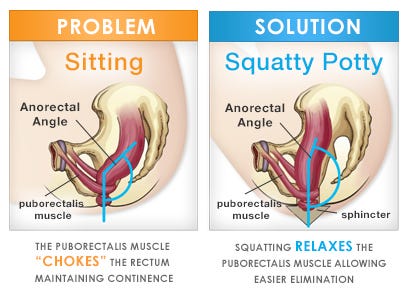
Seriously, stop procrastinating and get a Squatty Potty! Sitting while pooping is absolutely terrible for your insides, and you’ll make a much cleaner exit if you squat like your hunter-gatherer ancestors. If you’re straining, you’re doing it wrong. There should be no heavy pushing, no intense pressure, no tension. There’s a reason they call it an evacuation, not an eviction.
Step 4. Rinse like a European
My wife and I visited Ethiopia a few years ago for a docuseries Michelle was working on… and to find the source farm of our local fair-trade coffee shop… and to find Michelle’s childhood home. (Success on all three counts!)
Toilet paper is still expensive and rare in Ethiopia, but the toilet in our hostel was equipped with a spray hose. I’d seen various bidets before, but had been too nervous and snobby to try them. Now, out of necessity, I gave it a shot.
It was fantastic.
Ten seconds of water and you’re cleaner than any amount of wiping. After years of avoiding bidets out of fear and weirdness, I was immediately sold.
There are basically three levels of bidet game:
- Install an old-school bidet. (Basically a whole second toilet)
- Install a Tushy on your current toilet. (That link gets you $5 off)
- Buy a hand-squeeze portable bidet. (This is me, since I travel so much)
Americans have a major problem with bidets, despite the fact that they’ve never tried one, and that up to 90% of houses in South America have one. Like many issues, they’re just way behind the rest of the world and the rationale isn’t clear. Bidets certainly fit the bill. The reality is that they should get used to them now, because we need to get serious about saving trees if we expect to make it through this century alive.
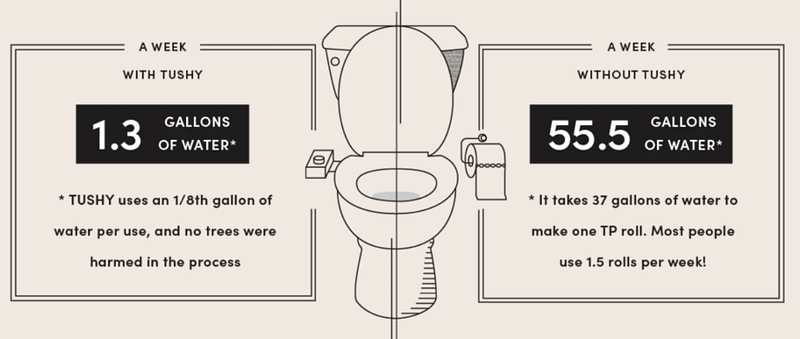
In addition to getting yourself unfathomably cleaner— and though it might seem counterintuitive — by using a bidet, you actually save water:
Step 5. Stop deforesting the planet
Once you make the switch to a bidet and let pure water do all of the actual cleaning, now all you need is a few squares of toilet paper to dry off. Unfortunately, conventional toilet paper is utterly horrible for the environment.
Considering that toilet paper destroys 100 million trees per year, I’m surprised the U.N. hasn’t already mandated bidets in every stall on earth.
In addition to widespread deforestation, the other issue with tissue is that it requires 1.7 trillion liters of water and 250,000 tonnes of bleach just to make enough TP for Americans alone. (FYI, Canadians, the Yankees are literally deforesting your country to wipe their behinds.)
Conventional toilet paper is ruining precious eco-systems, despite the fact that it’s an entirely unnecessary product. So our next step is to switch from conventional toilet paper to 100% recycled so that zero trees are harmed. Here are some of the leading brands:
- Seventh Generation
- Wholeroll Organic Tree-Free
- Reel Tree-Free 100% Bamboo (That link gets you $5 off)
- WhoGivesACrap.com (free shipping, zero plastic, and 50% of profits donated to help build toilets.)
“But I can’t afford that posh eco-paper!”
Now you totally can — by switching to a bidet, I found I could easily afford the fancy eco stuff because I’m using 1/5 as much paper as before.
In Conclusion
Our current toilet game is hurting our bodies, leaving us less-than-unhygienic, and destroying the planet. With a few simple improvements to our routine, we can improve our health, walk around clean, and give nature a break.
The only downside to this shift is that you’ll soon be at the point like I am, where you’ll absolutely dread having to dry-wipe after using a non-squatty potty. It will feel genuinely, disgustingly, and savagely backward — like you’re living in Louis XIV’s Versailles.
Don’t let it stop you. For the sake of our bodies and the planet, we need a restroom revolution ASAP. By fixing your digestive system, squatting like a hunter-gatherer, and rinsing like a European, you can heal your body, be more hygienic, waste fewer resources, save more money, and help the planet.
And that, my friends, is the life-changing magic of tidying up your bum.
New stories by Jared you might like:

You just read another post from In Fitness And In Health: a health and fitness community dedicated to sharing knowledge, lessons, and suggestions to living happier, healthier lives.
If you’d like to join our newsletter and receive more stories like this one, tap here.