
The Legendary & GOAT Bill Russell
How one man’s life and activism opened doors for many and changed lives with his 11 championships.
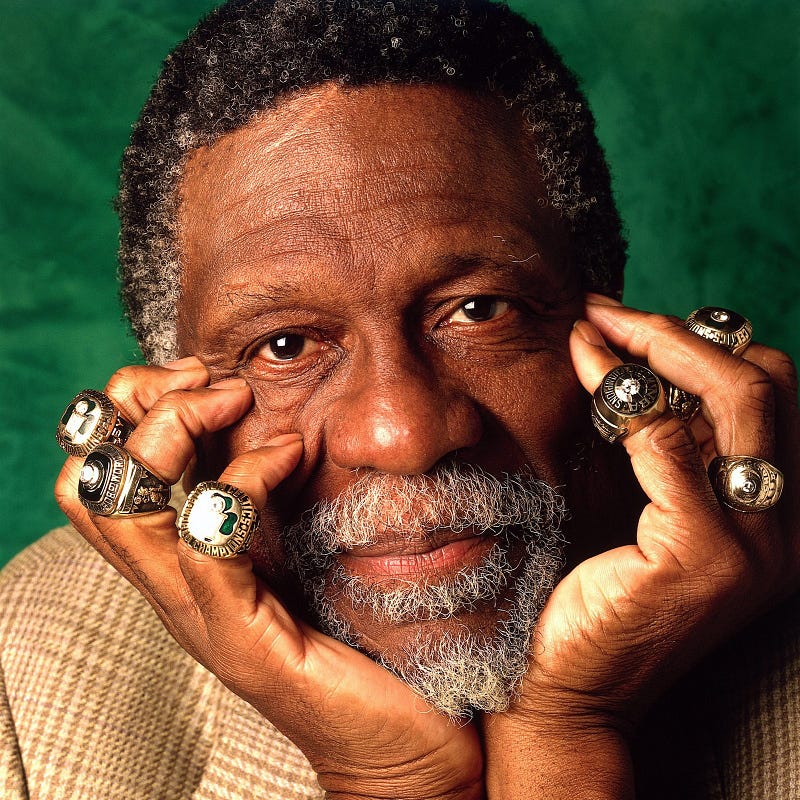
Bill Russell was a legend with a conscience and was impactful on and off the basketball court. He was the center for the Celtics and won 11 NBA titles becoming the league’s most valuable player and was inducted into the Basketball Hall of Fame in Springfield, Massachusetts in 1975, the first Black player selected. He did not attend because he felt the city did not embrace him because he wasn’t white and it was a racist institution. Later, he was named to the Hall as a coach, only the fifth person to be duly honored.
He had no problem with the team, his teammates, his coach, and the championship banners but the age-old systematic racism raised its ugly head because he was a phenomenal Black man. Boston gained notoriety because of him and his success with the Celtics. What has skin color got to do with talent and profession?
Russell was the first professional basketball superstar and game-changer who reinvented the center position with the Celtics during the 1950s and 1960s. Prior to him, the basketball players’ feet never left the ground, he changed all that. He orchestrated his plays to success, his way.
Not only was he a trailblazer on the basketball court but off the court, he was a champion of equality, respect, and inclusion for all people. He was a visible activist for civil rights and social justice. Just as basketball was in his DNA so was activism.
Russell’s fame before the Celtics was with the University of San Francisco leading them to get two national collegiate championships in a row, then onto the United States Olympic team to the title in the 1956 Melbourne Games. From this, he earned the distinction of having played on teams that won NCAA, Olympic, and NBA titles.
Life with the Celtics, he was named to the East All-Star team 11 times and won the league’s MVP award five times, later receiving the Presidential Medal of Freedom from President Obama. Toward the end of his playing career, he became the first Black head coach in any U.S. professional sport.
In the face of racism, Russell was a game changer who played basketball like no other before him and never allowed racism to stop him but saw it for what it was. Early on in the mid-1950s, he acknowledged that the NBA had an unwritten quota system that held Black players back. This quota allowed no more than three Black players on a team during this time.
Activism called him as he participated in the civil rights movement during the mid-1960s as he lent his support to the Mississippi Freedom Riders protesting segregation and participated in the March on Washington for civil rights in 1963. Even after the assassination of a civil rights icon, Medgar Evers, he conducted integrated basketball clinics in Jackson, Mississippi. What a statement this must have made to the local segregationists!
Also, he took a stand during a Southern swing of exhibition games with the Celtics, when they were refused lodging at a Kentucky hotel, all the Black players did not play that night and the coach was understanding.
Another racism he faced was at his home in the Boston suburb of Reading. When his teammates joined him in Boston as the town honored him as the Celtics’ captain. Months later, in retaliation for his honor, vandals broke into his home, smashed his trophies, defecated on his bed, and smeared excrement on the walls.
Russell’s activism included his protest against the Vietnam War, supporting Muhammad Ali when he refused to fight, and taking a knee with Colin Kaepernick. When he saw a worthy cause that he believed in, he stood with others or alone.
Simmon was born February 12, 1934, in Monroe, La, and was the younger son of Charles and Katie Russell. He recalled his early days of seeing how Blacks were treated in an inferior manner to whites and how his father took a stance against such treatment in the face of being possibly killed. Looking for a better life, his family moved to Oakland, where his father worked in a plant. Life was improved but racism prevented them from going downtown and was chased by cops when they did. Only the Black kids were chased.
He struggled during his early Junior high days playing basketball due to this lanky frame but continued and as he filled out, he gained poise on the court. Hal DeJulio, a former player at USF, noticed Russell’s potential and after watching him play in a game, was impressed with the long-armed center and later offered him a USF scholarship. Russell led USF to much success and they won national championships in 1955 and 1956.
Onto college, Russell developed in college and was pointed out to Auerbach, who coached the Celtics. It took some maneuvering and juggling on Auerbach’s part to bring Russell on the Celtics team. He helped them to win the first of their many championships.
Russell’s success with the team lead to him becoming the team’s player-coach after Auerbach decided to step away from coaching after the 1965–66 season. A position that Russell remained in until retirement. Thereafter, he was seen in movies and TV commercials and also was an NBA analyst. His jersey was retired in 1999 at a public Boston ceremony at FleetCenter as he received a standing ovation that brought him to tears.
Additional credits included the Lifetime Achievement Award and the Arthur Ashe Courage Award. Russell gave his best and stood for what was right and received the best as a result. Basketball players, such as Shaquille O’Neal and the late Kobe Bryant, followed in his footsteps and adored and honored Russell for who he was, what he had done for the Celtics, and what he stood for in civil rights activism.
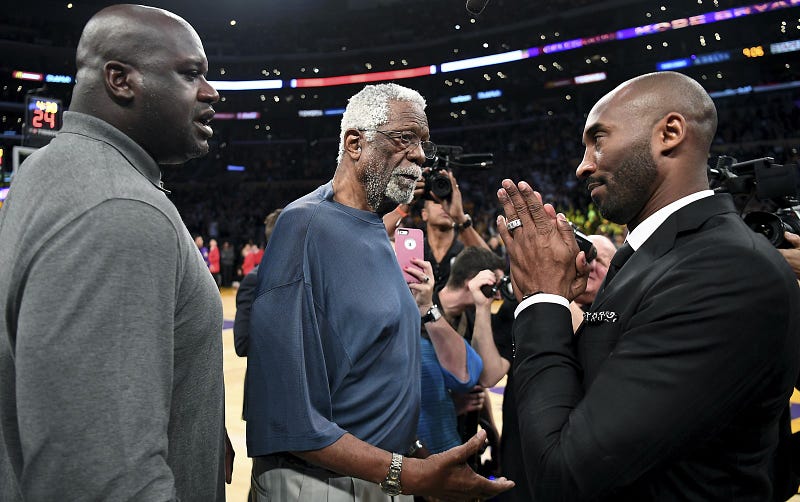
In conclusion, Russel change the game and according to him, developed a whole new philosophy of basketball. Something no one can deny as the facts, successes, and his basketball games spoke for themselves. He was known as a rare star athlete during his time as he spoke publicly about racism and civil rights issues. Bill Russell, 1934–2022, now Rest in Power!!
For additional reads: