
Mary McLeod Bethune, an Educator, Civil Rights Activist Immortalized at The U.S. Capitol
How one she-ro trailblazed education for Black girls.
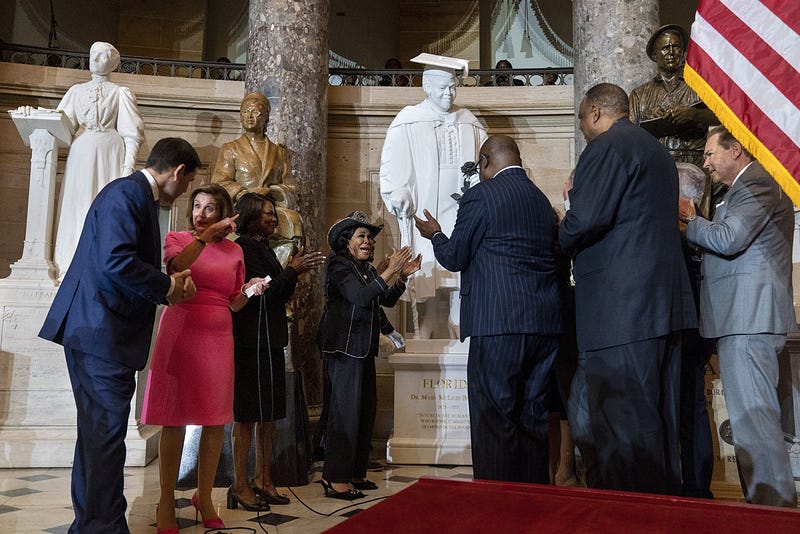
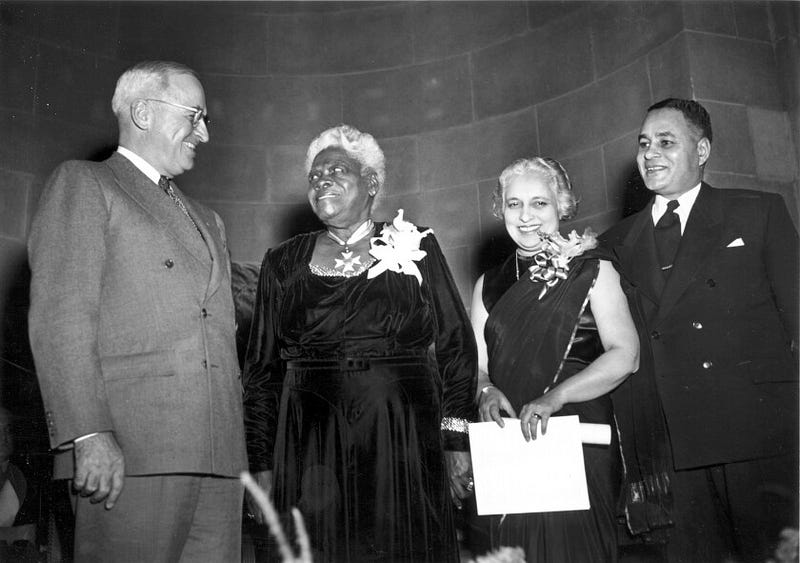
The above photo depicts, Ms. Bethune, leader of the Black Cabinet under President Truman, second from left flanked by President Truman after she drafted an executive order desegregating the armed forces.
Mary McLeod Bethune, a Civil rights leader, and educator get her day in the halls of the U. S. Capitol with a statue honoring her legacy. Her presence and walk in life earned her much recognition as all has finally culminated into a recognition statue. She is the first Black person elevated by a state recognized for her contribution to humanity in the U.S. Capitol’s Statuary Hall.
Thanks to the efforts of a Florida grass-roots campaign responsible for the removal of a statue of Edmund Kirby Smith, a Confederate general who surrender after the Civil War. Ms. Bethune’s statue as a viable replacement joins John Gorrie, a pioneer in air-conditioning and refrigeration.
Ms. Bethune was born in 1875 on a rice and cotton farm near Mayesville, South Carolina, and was the fifteenth of seventeen children born to Sam and Patsy McLeod, former slaves. Her parents saved their money and bought a farm and Mary used to accompany her mother when she delivered white people’s wash.
Being allowed to go into the white children’s nursery, Mary picked up a book as it was snatched away. It was that defining moment for her that the only difference between white and colored people was the ability to read. Thereafter she was inspired to learn.
She was the only one of her family to attend the Trinity Mission School, Mayesville’s one-room black schoolhouse, which was run by the Presbyterian Board of Missions of Freedmen. She walked five miles to and from school and taught her family daily what she learned in school. With the help of a mentor, Ms. Bethune attended Scotia Seminary on scholarship from 1888 to 1893. Thereafter attended Dwight L. Moody’s Institute for Home and Foreign Missions in Chicago.
In 1898, Ms. McLeod married Albertus Bethune and moved to Savannah, Georgia, and worked in social work before moving to Florida. A year later, the couple relocated to Palatka, Florida where Mary ran the mission school and began prison outreach.
Also, Bethune worked as a teacher at her former elementary school, Haines Normal and Industrial Institue in Augusta, Georgia, she became impressed by the works of others like Lucy Craft Laney, a daughter of former slaves, in the education field. She adopted her educational philosophies specifically focusing on educating girls and women to improve the conditions of black people: “I believe that the greatest hope for the development of my race lies in training our women thoroughly and practically,” per Wikipedia.
Upon her second marriage and moving to Florida, Ms. Bethune determined to start a school for girls. In October 1904, she rented a small house for $11.00 per month. She furnished the school with crates and charity items. She used $1.50 to start the Educational and Industrial Training School for Negro Girls. The assistance of the parents of her six students, church members’ donations, and making and selling sweet potato pies, ice cream, and fried fish afforded funds for the school continuance.
As the school’s success build and gained recognition, Ms. Bethune courted wealthy white organizations, such as the ladies Palmetto Club and requested influential white men to sit on her school board of trustees.
With the guidance of Booker T. Washington of the Tuskegee Institute whom she met in Washington in 1896, advised of the importance of gaining white benefactors for funding. John D. Rockefeller donated $62,000 and her friendship with Franklin D. Roosevelt and his wife gave her entry into a progressive network.
By 1931 with the help of the Methodist Church, Bethune merged her school with the boy’s Cookman Institute, forming the Bethune-Cookman College, a coeducational junior college that met all the educational standards of the State of Florida. She lobbied with the help of fellow Florida institutions for federal funding. Today the school is known as the Bethune-Cookman Univesity in Daytona Beach, Florida.
Ms. Cookman while lobbying for education was a civil rights activist who led the groundwork for the civil rights movement. Also, she was one of the founders of the United Negro College Fund, a financial backbone for predominantly Black higher institutions nationwide, a former director of the Negro Affairs Division for the National Youth Administration, and led the Black Cabinet of President Roosevelt which led to her drafting an executive order desegregating the armed forces.
In conclusion, Ms. Bethune died on May 18, 1955, and was born with a spirit to learn, help others learn, and to elevate the Black race via the education of the Black females. Her legacy is a testament to the many hats and labels she now sports, “Oprah of her time”, Booker T. Washington of her time”, Martin Luther King of her time,” the impossible possible maker, champion over ignorance, cruelty, and prejudice, A Black rose who called her students black roses and the embodiment of love, hope, faith, racial dignity, a thirst for education, courage and peace. Her statue in the halls of the U.S. Capitol will remind the world of her contribution to America. RIP.
For additional reads:


