
The Legacy of Nichelle Nichols, A Nasa Trailblzaer and Star Trek Phenomena
How one lady led the way for Black Women to enter NASA Program.
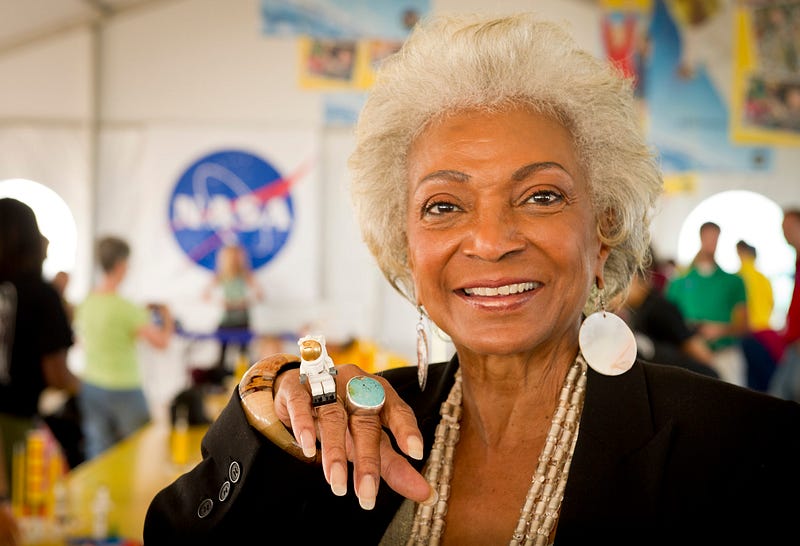
The entertainment industry and NASA have lost a key player and game changer, Nichelle Nichols, 1932–2022. She could be also known as a gentle giant who possessed classiness inside and out and was an activist for change for women and people of color.
Had the opportunity to have met her and was so impressed by how down-to-earth and approachable she was. Was in touch with her for a period of time. She was a great supporter, whenever I was performing, I would invite her, and I think she may have attended one of my shows. It has been so long, can’t exactly remember what show, when, or where. The only thing I truly recollect was that she cared about others dearly.
Nichelle was a dancer and actress who broke ground with her Star Trek role in the 60s. Interestingly, she contemplated leaving the show after its first season for a Broadway play. A chance encounter with Dr. Martin Luther King Jr. at an NAACP fundraising event in Beverly Hills ended up with her remaining on the show for three seasons of “Star Trek” on TV and in six “Star Trek” movies. A year after their chance meeting, she sang at Dr. King’s funeral.
As a fan of Star Trek and her pivotal and powerful role from the traditional norm for Blacks, Dr. King advised how important her role as Lt. Uhura, on the show was as he labeled, “groundbreaking” for other Black Americans. She remained on the show upon Dr. King’s advice, and her role became just as he spoke, “groundbreaking.” Her role led the way for her to work with NASA as a recruiter.
Embracing her fate on Star Trek as Lt. Uhura became a staple of her life as she attended “Star Trek” events throughout her life and became a welcomed and eloquent advocate for the U.S. space program. She led a successful drive to recruit women and minorities into astronaut training.
Also groundbreaking was Lt. Uhura’s interracial kiss with Kirk aka William Shatner, which many of her fans always asked her about as she appeared at many Star Trek events. The kiss was a game changer in Hollywood and the world. It was considered a potentially explosive scene given the state of affairs of that time between interracial couples.
One year earlier, the Supreme Court struck down state bans on interracial marriage. The producers of the show were on pens and needles, not knowing how the public would receive this groundbreaking moment. When filming this scene, a lot of back and forth, shoots and reshoots put the actors through mayhem trying to be politically correct with the kiss not to offend viewers. At the end of the day, they decide to go with the kiss and see what would happen.
Surprisingly to the studio, there was no backlash and the scene became more famous and life went on as usual. Nothing can change an event whose time has come. The color of one’s skin should not dictate an actor’s journey.
Nichelle Nichols was born December 28, 1932, Grace Dell Nichols, and adopted the name Nichelle as a teenager. She was a native of Robbins, Illinois where her father, Samuel Nichols served as mayor and chief magistrate of the small Chicago suburb, a haven for Black Ameican families since 1917.
Nichelle’s career started with her studying ballet and Afro-Cuban dancing. she went on to appear in a revue at Chicago’s Sherman House hotel, catching the attention of the renowned Duke Ellington. Thereafter, she sang and danced with Ellington’s touring company as a teenager and later performed with jazz great Lionel Hampton’s orchestra.
Her other credits included nightclubs throughout the U.S. and Canada, opening act for comedian Redd Foxx, dancing in Otto Preminger’s screen version of “Porgy and Bess, a cast of “The Lieutenant, written by Roddenberry, the creator of Star Trek. Roddenberry and Nichelle agreed to her Star Trek character’s name, Uhura, a variant of Uhuru, a Swahili word for freedom.
After her Star Trek days, in 1977, she led a recruitment drive for NASA and drew 2,600 applications from women and minority astronaut hopefuls. Sally Ride, the first American woman in space, and Judith Resnik, Ronald McNair, and Ellison Onizuka, the three astronauts who died in the 1986 Challenger space shuttle explosion.
Nichols recorded an album, wrote two science fiction novels, and created “Reflections” a one-woman stage tribute to Black Americans such as Ma Rainey, Bessie Smith, Josephine Baker, Mahalia Jackson, Ella Fitzgerald, Lena Horne, and herself.
Equally notable was her boarding the space shuttle Endeavor becoming the first Black American woman in space in 1992. Jemison, an astronaut and close friend of Ms. Nichols, began each shift of her eight-day trip with Nichols’s signature line from Star Trek, “Hailing frequencies open!”
Nichols died of heart failure at a hospital in Silver City, New Mexico, had suffered a stroke in 2015, and struggled with dementia in recent years. She was 89 years old.
In conclusion, Nichelle Nichols heeded her calling becoming a trailblazer on Star Trek, and for Nasa recruitment. Her legacy will live on into eternity in the hearts and minds of all her adoring fans. May she Rest in Power.
For additional reads: