
The Leavening
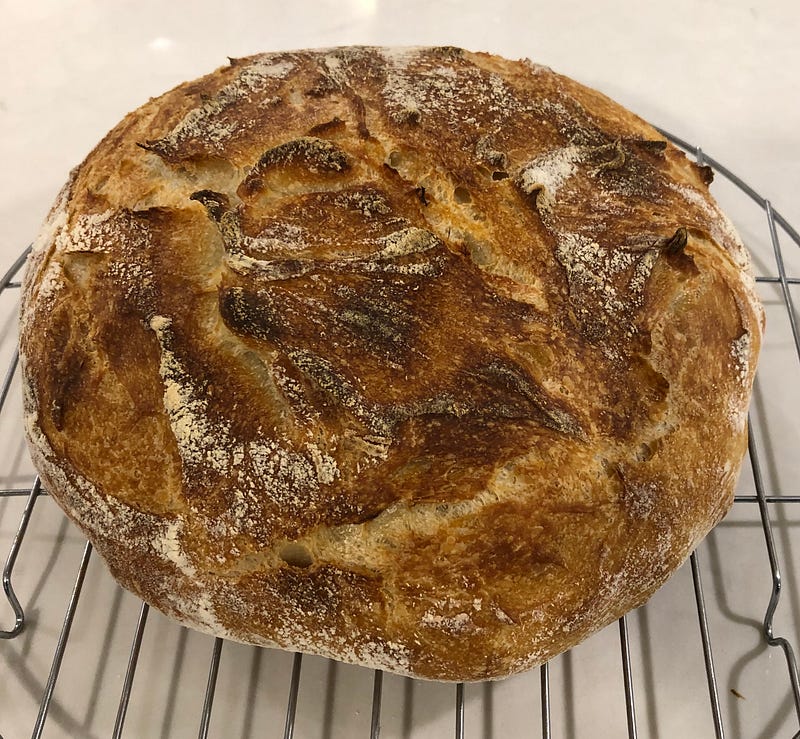
Try making bread, everyone said. Flour, salt, water, heat. Tap the veins of civilization and marvel at the primal embers of human creativity that still glow within you. Alright, Spenser thinks. It might be fun to try. Spinning it silently in his own mind as everyday alchemy right there in his tiny kitchen. Flour, salt, water, heat. Earth, Ocean, Fire and Air.
The instructions for the starter are too simple to believe. 5 tablespoons flour, 3 tablespoons water. Mix, cover, let it sit. How can this work? Discard all but a tablespoon of the starter the next day and repeat. 5 tablespoons flour, 3 tablespoons water. Mix, cover, let it sit. Discard. 5 tablespoons flour, 3 tablespoons water. Mix, cover, let it sit. This ends up as bread?
For a while when he looks at the jar on the kitchen counter and thinks of the microbes at work, he is more than a little repulsed. Sour venom of disgust pooling near the back of his tongue. A flesh-coloured swamp of yeast and gas, burping and frothing in slow motion as it gasps for life. But he gets over this, and soon the starter is initiating the rhythms of his day. 5 tablespoons flour, 3 tablespoons water. Mix, cover, let it sit. Sometimes it’s the first thing he thinks about when he wakes up.
Two months later the starter is regularly doubling in size over the course of each day. Discard all but a tablespoon of the starter and repeat. 5 tablespoons flour, 3 tablespoons water. Mix, cover, let it sit, and the next morning the fleshy goo has grown to the top of the old jam jar in which it sits. He doesn’t understand the chemistry or the physics at work (which one is it?), but the instructions tell him this is when he can start making bread.
All of the research he’s done warns that making sourdough is an all-day affair, so Spenser plans accordingly. He peruses the top row of his second-best bookcase, where he houses an ever-growing collection of books To Be Read. He pulls down Songbird’s Lament (Stonemason Publishing, 1978), the first in the Detective Passerine mystery series. He blows some dust off the top edge, writes his name in the front and brings it to the kitchen.
This will be his routine: when he makes bread he will put on a pot of coffee and read mysteries. He’s got the first four Passerine novels — the other three (Songbird’s Demise, Songbird’s Return, Songbird in Love) stand at the ready in chronological order. He can see himself in the murk of future memory waking with the sun, building his dough, blowing steam from his mug as he churns through pages. He’s never read a Passerine mystery and colleagues at parties express disbelief at this. He’s seen a bit of the first film adaptation so he knows the basics of the hard luck officer with a knack for solving cold cases in 1950s Hollywood. He knows Songbird’s Lament ends with an ominous description of a figure on the street, the man with the red scarf “like a bloody smile across his neck,” the man who in later books will become Passerine’s arch-nemesis. The man known only as Corbeau. This doesn’t bother him, starting a book and knowing how it ends.
The bread, the book, the coffee. There is something vaguely penitential about the way he lowers his head to meet the mug that he cradles in both hands. Coffee dribbles from his lower lip and he lets the oily bead slide down the side of the white mug and dangle on the base. Spenser spreads the book on the counter with one hand and gently stamps the mug on the verso leaf, the russet halfmoon marking his place in time and space and narrative. Counterfeit tracks of an impressive mind. Someone someday might open to page 42 and briefly wonder about his life and its distractions, think about the seriousness of a man whose readings survive, embossed. He knows he wouldn’t do this to a book he truly cared about.
They weren’t lying — it does take most of the day. Spenser doesn’t like how the pasty mass sticks to his hands as he folds it into the bowl. He is kneading every half hour for four hours, and he spends much of the time in between rubbing his fingers together and picking crusted flour from his nail beds. He reads much less than he had planned. At this rate, he is weeks and loaves away from ever meeting Corbeau (and everyone agrees the series doesn’t really get going until Corbeau becomes the main antagonist in Songbird’s Return). His first cup of coffee grows cold, unfinished.
There is the bread, and there is the book, and there is the coffee. A day in his life. And there is this memory, too, unbidden as his tongue works the pockets of his mouth. He is a teenager, walking the edges of a farmer’s field, alone, his thin shadow crenellated by barb-wire. At the top of a long and gentle rise is a copse of trees where Spenser stops and removes a pack from his shoulder. He takes out a bag of potato chips, a bottle of water, and a sandwich he had made that morning. He had cut the loaf himself, thick slices that he had spackled with butter and wedged with crumbly orange cheese. He sits in the shade of the trees and looks back the way he has come. Yellow fields stretching in every direction, wheatstalks awash with sun and gently bending in the breeze. An eyespeck of a tractor churns away, too distant for its sound to reach him. Piercing blue sky. A buckshot of grackles winging from field to fence and back again, warping purple, black, green. The thin path he followed up the fenceline. Spenser takes a breath and stretches his legs, allowing blades of light to fall across his shinbones. He thinks, in the memory and now remembering, that sandwich is the best thing he’s ever eaten.
←PREVIOUS EPISODE← →NEXT EPISODE→
To start at the first episode, CLICK HERE