
The Layer 2 Traders Toolkit: Empowering You To Overcome Hidden Risks
Although all Ethereum Layer 2s claim to have Ethereum Security, is that truly the case? Let’s reveal the hidden risks so you can reduce your trade risks.

Layer’s 2 share the following trademarks when it comes to promoting their strengths:
- Inheriting the security of Ethereum
- Being more scaleable than Ethereum
- Lower gas fees than Ethereum
Regarding points 2 and 3, this is simply measurable and has already been demonstrated. Already, Ethereum transactions are shifting to Layer 2 systems, which is in both parties’ best interests.
However, point 1 carries certain hidden risks for you as a trader, which you should consider when deciding where to conduct your trading.
Transaction Security Comparison
Currently, two different kinds of Layer 2 products are dominating the market:
- Optimistic like: Optimism (OP) & Arbitrum (ARB)
- ZK Proof like: zkSync Era & Polygon zkEVM
Both bundle a number of transactions performed within the Layer 2 but they do so in quite different ways, which will be discussed in a subsequent post, since it is not directly related to the risks.
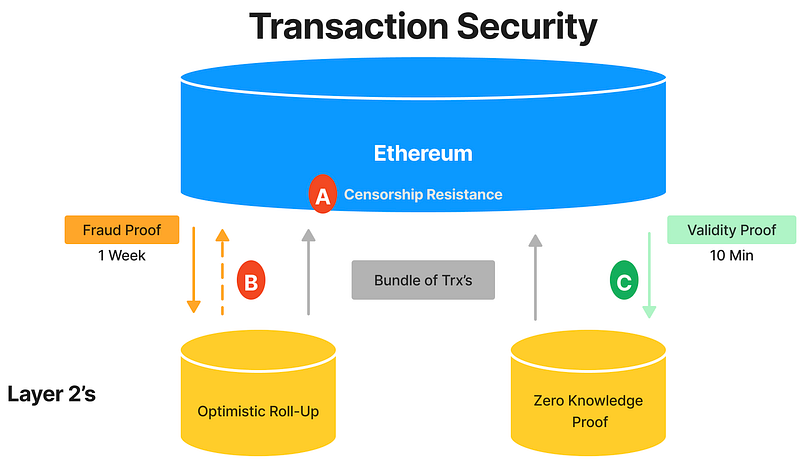
All Layer 2’s believe in the (A) Censorship Resistance of Ethereum and this is really what they refer to when talking about Inheriting the Security of Ethereum.
In a word, censorship resistance is the belief held by Layer 2s that their transactions would be accepted by Ethereum without modification. It is fair to say that Ethereum is regarded as powerful in this regard.
But this is where things start to diverge significantly.
Optimistic Roll-Up’s (B)
For Optimistic Roll-Up’s a (B) Fraud Proof Computation can be inquired (therefore the dotted line since it might not happen) within one week. Basically this means you can question the State of the Optimistic Roll-Up up to a week after a given transaction was performed.
Users could claim that their transaction was excluded or altered as follows: “I used my USDC stablecoin to buy 5 ETH, not just 0.5 ETH!”
If it is determined that a fraud was committed, all transactions on Ethereum and on Layer 2 — including the bundle in which this transaction was contained — must be reversed. However, this cannot be done without Ethereum’s consent.
It is highly unlikely that this would be carried out because it affects all transactions on Ethereum since the fraud transaction and is a big undertaking, if not almost impossible, with many Layers sending transactions to Ethereum. Ethereum has previously accomplished this (called a hard fork) once, but back in 2017. These are very different times.
Therefore, you could say that you need to be not just optimistic but super optimistic about the transactions you send to Ethereum!
Zero Knowledge Proof (C)
In this case, no fraud proof is necessary. A Validity Proof is always carried out in its place.
Ethereum recognizes that Layer 2 can use Zero Knowledge Proof to ensure that they have the transactions without having to display them. This validity proof may currently be completed within 10 minutes using zkSync Era and will be lowered in the future.
There is no justification for a one-week transaction quarantine, given the risk is significantly smaller than with optimistic roll-ups.
Transaction Security: Proof of superiority
How can we therefore demonstrate that transactions generated by Zero Knowledge Proof Layer 2 are less dangerous than those generated by Optimistic Roll Ups?
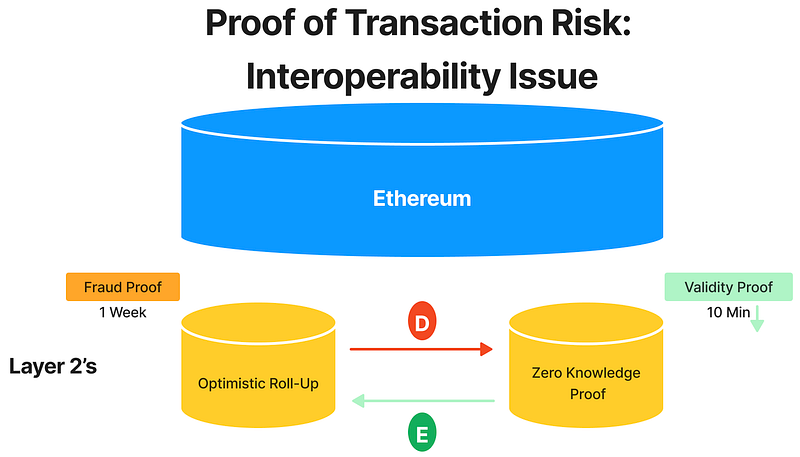
Blockchain specialists agree that optimistic roll-ups are too risky when it comes to performing transactions directly between Layer 2’s — the interoperability issue. ZK Proof Layers will not accept the (D) transaction and for good reason.
Consider this:
- Your car is up for sale, and an unidentified buyer (from Optimistic Roll-Up) wants to purchase it.
- The buyer offers you a snapshot of the money and says, “My money is in quarantine at a friend’s place, but he/she will surely get it within a week.”
Would you let the buyer drive off with your car?
In contrast
- The ZK Proof Layer 2 customer has the necessary funds in hand (E) and is prepared to make a purchase, but
- Now you have the car in quarantine for a week before he can get it.
Do you think he’ll buy the car?
Had this deal been between two ZK Proof’s, it would have been simple. Both can prove they own the assets and the trade could have been performed.
Withdrawal Security
Consider that a Layer 2 is preparing to perform a significant update, and you are against the upgrade because, as far as you can tell, it will permanently lock your assets to the Layer 2.
Time suddenly becomes of the utmost importance.
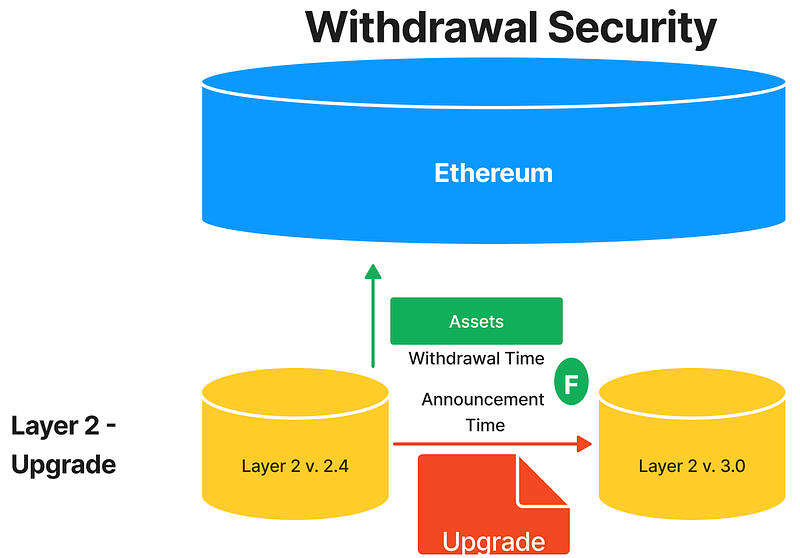
Take into account the following two scenarios for (F) with relation to the withdrawal time and upgrade announcement time:
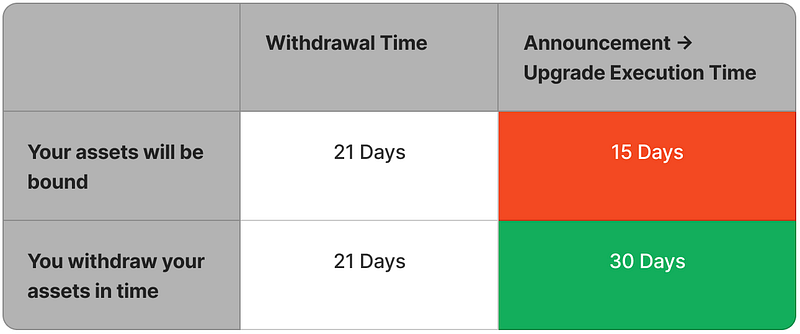
Some blockchains require you to wait 21 days after you stake an asset before you may access it. Your assets are bound if the update will be carried out in the next 15 days. You will still have time to withdraw your assets from Layer 2 and return to safety on Ethereum if it takes 30 days.
So look into your alternatives for how quickly you can withdraw your funds, and avoid taking any moves where the withdrawal period will surpass the window for the upgrade notification.
The following can ease this rule of engagement:
- The governance mechanism on the Layer 2 network is one you trust. It is decentralised making it difficult to install changes that would prevent you from releasing your assets.
- In order to manage catastrophic issues, the Layer 2 has a security council, and it has a history of solely performing these kinds of patches rather than bringing in significant updates.
Conclusion
There are 2 types of hidden risks for traders to be aware of:
- Transaction Risks: How are Layer 2 transaction proofs handled? The future is apparent to me. ZK Proof’s will win in the long term based on security and having the advantage when it comes to interoperability (trading cross Layer 2’s).
- Withdrawal Security: You have to able to withdraw your money back to Ethereum safety. In terms of both Transaction and Governance, Layers will introduce long-term consensus procedures, and those with the strongest track records will prevail.
Be sure to conduct adequate research before trading on a specific Layer 2.
Although there is still work to be done, Layer 2s will evolve in the coming years.
I highly suggest going to https://l2beat.com/scaling/risk to learn more about risk evaluation of various Layer 2's.
Disclaimer:
This article is for informational purposes only; it should not be considered financial, tax or legal advice. You can consult a financial professional before making any significant financial decisions.