
Loose 99% of your Transactions to Become Successful!
To prepare for mass adoption, Ethereum wants to lose transactions! Speed can be “outsourced” but Consensus can’t. Part 2 of the Consensus Series.

According to Vitalik Buterin (co-founder of Ethereum) you can only accomplish 2 out of 3 objectives in the Blockchain Trilemma. Solving all 3 was considered impossible! But since making that claim, what has Ethereum done?
- Built a community of developers outside Ethereum focused on completing the last objective that they are unable to complete themselves.
- A signification portion of Blockchain Layer 1’s are attempting to become “Ethereum Killers” by concentrating mostly on the one objective that ETH does not accomplish and having less focus on the two objectives that are ETH’s primary focus
I anticipate that Vitalik and friends did not design the second part intentionally, but one could still argue this is a masterfully executed strategy which narrative is still being “followed” by a lot of industry influencers and decision makers.
How can the blockchain industry keep doing this? Because it is so counter intuitive from a business perspective, that only the few believes it! We shall provide more insight into this “strategy” below!
The Blockchain Trilemma and Outsourcing
You can concentrate on two of them at the expense of the third, according to the trilemma. But what if you could outsource the third to others, who would then resolve it?
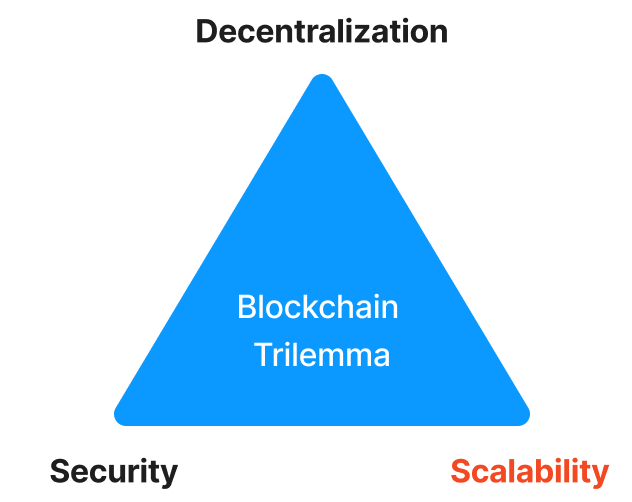
If you choose Scalability (speed) and Security, it comes at the cost of Decentralization. Simply put, you do not have time to reach approval from a lot of decentralized validators before executing a transaction. Your speed will decrease. Likewise, one always loses while playing the other combinations.
Let’s look at the justifications for giving up certain objectives in order to get to the point where ETH is prepared for mass adoption. Which two should be kept in-house, and which one should be outsourced, in other words.
Recall that ETH is a Layer 1 chain and is therefore regarded as being at the top of the “food chain” before moving on. Thus, if ETH were to outsource one of the goals, what should it take into account before making such a risky decision:
- It must be enticing for partners to participate in, giving them a profit possibility.
- t should allow for competition among partners, because it will encourage ongoing innovation, which will strengthen ETH’s position in the market
- It should allow for ETH to be the central hub which they all depend upon in order for their business to exist. In other words leaving the ETH chain should be expensive
What can be outsourced to achieve the aforementioned objectives?
- Decentralization: No. ETH will no longer be in control, consensus is reached outside the chain. Additionally, involving numerous partners will not scale.
- Security: No. It takes a lot of confidence to entrust another partner with keeping you safe. Leaving it to multiple partners even more. This is not scaleable. And if customers stop believing that transactions will go through without a hitch, your business will fail.
- Scaleability: Yes. For partners there are gas fees to collect. There is plenty of room for numerous partners to coexist if the market is large enough. The competitive parameters are accessible to users. It is simple to compare price and transactions per second (TPS).
But the side effect of this…..
Loosing 99% of the ETH Transactions
You’ll protest to the aforementioned tactic right away. It’s crazy!
By “asking” Layer-2 blockchains to handle your transactions, you are losing gas fees, which are the main source of revenue for blockchains. It is already happening that ETH is losing transactions and business.
Bad for business, right! It really depends……
Nobody is warning Vitalik that this is terrible business, even though it is freely recognized that ETH will lose more than 99% of its transactions. Why?
Simply put: A single database cannot grow effectively enough to hold the financial transactions of 5 billion users; especially when it is based on blockchain technology.
What is the business then for Ethereum
Consider the long term rather than the present. Even if you lose 99% of the transactions, the 1% that remain are extremely valuable and challenging for rivals to capture.
As to why:
- A decentralized control system involving a lot of validators (staking holders) makes it hard to tamper with transactions. Network consensus has to be reached amongst all these validators making the chain incredibly censorship resistant. The legitimacy of transactions are guaranteed.
- The consensus protocol is very secure. Performing a 51% attack by owing 51% of the validators demands unbelievable resources from a single power and it is only getting harder, if the current trend of staking ETH continues. It has only gone up in recent months. Ethereum has simultaneously shown that network stability is provided. Just keep in mind how smoothly the changeover from Proof of Work to Proof of Stake was handled. A huge undertake. This ensures that transactions are carried out and kept secure.
This results in a high level of trust in Ethereum, and it takes time to establish a network with many validators. In practice, it is challenging for rivals to replicate the consensus system.
As a small but important side kick. The decentralized consensus is what makes it hard to classify Ethereum as a security in the US by SEC compared to other major layer 1 blockchains.
High value data will be stored on Ethereum
Trust enables the willingness to store more sensitive data on the Blockchain. The Ethereum roadmap supports this clearly already. The ability to better store your digital identity and wealth under smart contracts as NFTs will soon be available. The most sensitive data private users can have! More on this in a future article.
In the long term this might enable ETH to gain more profits by:
- Controlling the price of gas fees. Low quantity but at a high price due to the value of the information stored safely.
- The Ethereum token became deflationary with the switch to Proof of Stake, meaning that the total supply of tokens is gradually decreasing. The token’s price rises as a result, increasing dollar gains.
Ethereum in my mind is executing a brilliant trust strategy by establishing itself as a the de facto central hub in a giant blockchain network where mass adoption will be possible through a multi-layer chain approach.
Disclaimer:
This article is for informational purposes only; it should not be considered financial, tax or legal advice. You can consult a financial professional before making any significant financial decisions.


