The Last Magic Road Trip - Part 2
Sometimes the most memorable portion of a journey is the simplest activity
This is Part 2 of two parts. Part 1 is here.
Down Historic Route 66 along Colorado Boulevard in Pasadena, we pass a variety of shops and the Rose Bowl Stadium. It’s dark as we view the lit-up skyscrapers of downtown Los Angeles along I-110 and take the Santa Monica Freeway on our final leg west. Since leaving Mount Rushmore five days ago, we have secured a pressed penny at Old Faithful in Yellowstone National Park, ridden a roller coaster in Vegas, and searched for gold at an Old West ghost town.
Now, the landmark Santa Monica Pier, with its own roller coaster and Ferris wheel, looms ahead. But that isn’t our destination. The sand of the Pacific Ocean is our draw, our Mecca.
Parking is $15 at the pier, but I tell the attendant that we have driven all the way from D.C. to get here and won’t stay longer than a few minutes. She lets us go without paying.
“Wake up, McKenna! We made it to the Pacific Ocean!” Preston yells after we park.
McKenna turns over in the back seat. “Let me sleep!”
“C’mon, Kenna. You can’t miss the beach.” I gently shake her.
She stirs and rubs her eyes. “I wish Toby was here,” she says.
I take out Li’l Dude, a two-foot-tall Little Tykes boy action figure Preston received as a gift when he was two years old. After Preston no longer played with Li’l Dude, McKenna adopted him — then Preston took him back because, after all, McKenna couldn’t keep his gift.
We usually take Li’l Dude with us on our road trips to “guard the car” when we aren’t in it, strategically placing him in a sitting position on the backseat. His perpetual, goofy grin and always-open eyes are a little spooky, a la the horror character Chucky. Though I doubt he really keeps burglars and worse away, I figure we need all the protection we can get, both real and imagined.
Preston gets concerned when he sees what I’m doing. “What are you doing with Li’l Dude?”
“He’s family. We need him for the we-made-it-to-the-coast photo.”
I place Li’l Dude on the CR-V’s roof rack, and Preston grabs him for the picture by the Pacific.
“Hurry, take the picture. I don’t want people to see me holding Li’l Dude,” Preston says.
I take my time trying to get everyone and everything in the shot, including our CR-V, which has held up better than I thought. We haven’t had as much as a hint of a breakdown, and she still gets 31 miles per gallon on the highway despite the wear and tear.
My slowness infuriates Preston. “Hurry!” he hisses.
After I finally snap one, he places Li’l Dude gently in the CR-V, then races off for the water, not hanging around for a backup shot. McKenna and I soon follow.
Though it’s dark, we can walk on the sand fine, with the aid of lights from the pier and moonlight. We make it down to near the water and watch the waves in the moonlight.
“That’s the Pacific. I can’t believe we actually made it,” I say.
“Yeah. That’s something,” Preston agrees.
“How long can we stay here, Daddy?” McKenna asks. “Can I go in the water?”
“No, McKenna!” Preston yells. “You’ll get sand all over the car!”
“Yeah, it’s late. We better not swim,” I say. “Maybe tomorrow.”
I look around for shells but only see a few rocks. Preston finds a small shell and a few smooth rocks worn down by the mighty ocean. A few months later during a show and tell at his school, Preston would pull out one of those rocks and explain how that — not the Hall of Fame football and other store-bought gifts — was his favorite memento of this trip.
Before returning to our hotel, we stop at Hollywood Boulevard. The Hollywood Walk of Fame contains the names of more than 2,700 celebrities, pseudo-celebrities, characters like Donald Duck, and corporations such as Victoria’s Secret immortalized on the sidewalk in terrazzo and brass stars.
“I don’t know many of these stars,” McKenna says.
“You’ve heard of Marilyn Monroe, haven’t you?” I say, pointing to the name of the star of such classics as Some Like It Hot. “And you know Johnny Depp from Charlie and the Chocolate Factory. His is around here somewhere. So is Harrison Ford’s, Preston.”
“He is?” Preston takes off looking at the sidewalk.
As McKenna and I walk down Hollywood Boulevard after him, we don’t see many stars who the kids know. Finally, I spy one. “Look, the Rugrats!” McKenna runs up and eyes the star. “The Simpsons and Bugs Bunny are around here somewhere.”
I wonder how Michael Bolton, John Tesh, and the Steve Miller Band have stars, but Bruce Springsteen, Mick Jagger, and Roger Daltry do not. Jamie Farr is the only one of the iconic M*A*S*H cast to have one, not even Alan Alda? No stars for George Clooney, Denzel Washington, Jane Fonda, Leonardo DiCaprio, Robert De Niro, Clint Eastwood, and Robert Redford, yet Simon Baker, Terry Bradshaw, Judge Judy, Vanna White, and Billy Graham have theirs?
It could be that some who should have a star don’t want to pay $55,000 for installation and maintenance costs, or don’t want to show up at a public unveiling ceremony. It could also be that the selection process is suspect.
Nominees have to fall under one of five categories — motion pictures, television, music, radio, or live performances. Graham was placed in the radio category, as judges must have considered evangelism to be pure entertainment and the man who regularly rails against the excesses of Tinseltown — his website still runs stories on Hollywood’s “immoral agenda” — is really one of those radio shock jocks doing an act. And why would Graham agree to have a star in the center of a place he and many of his followers condemn?
At his 1989 star ceremony, Graham was quoted in a Los Angeles Times story that he felt a little out of place, but he “couldn’t condemn Hollywood Boulevard any more than any other place.” He added, “We’re all sinners.” Perhaps he figured at that moment that he could reach some Hollywood sinners more easily by joining their ceremonies.
In a touristy memorabilia shop, I purchase one of those cheesy maps to the stars. It’s actually fairly informative, noting landmarks from the Ambassador Hotel where Robert Kennedy was assassinated in 1968 to the house where exterior shots of The Brady Bunch were filmed. I ask an employee in the store where the good Hollywood parties are.
“Just go driving up in the hills,” he says.
We navigate those hills for a while, passing mansion upon mansion along the winding, narrow streets. I push in a cassette tape of songs by Bob Seger, who earned his star in 1987. As Seger sings about the sometimes deadly lure of Hollywood, I can’t locate a home that looks crowded with enough parked cars to stop and crash it using my media pass. The kids fall asleep anyway.
Memento vivere
The following day, we had to try to track down some stars using our new map. If we couldn’t find them in person, we’d find their homes.
The first home we locate is supposedly where High School Musical star Vanessa Hudgens lived. It’s a few blocks from Warner Brothers Studios, which produced the first feature talking movie, The Jazz Singer, in 1927. The grandiose dwelling is connected to others, looking more like luxurious condos than mansions. Maybe she lives here for a few weeks.
We pass the supposed home of the Jonas Brothers, which has to be a former one, if anything. It’s more of an estate but still too plain and small to house teen idols for long. The Brady Bunch home is legit, though only exterior shots were taken here, with most of that show filmed at Paramount Studios and other sites. It’s a one-story rambler made to look like a two-story home.
“See kids, this is where part of The Brady Bunch was filmed. That was one of my favorite TV shows when I was growing up,” I announce.
“I thought they didn’t have TV back then,” Preston retorts.
“Can we go now?” McKenna adds. But she would start watching reruns of that show upon our return home. The Brady Bunch only ran for five seasons, but the producers milked it with more reunions and spin-offs than Hollywood High. Cast members Florence Henderson and Ann B. Davis, who played the housekeeper, earned their Walk of Fame stars through this show.
On the way to the hills near the Hollywood sign, I pull onto Highway 101. “Here’s where Justin Bieber went 100 miles per hour and was stopped,” I say, referring to a 2012 incident.
“I don’t care about Justin Bieber!” McKenna yells.
I ignore her. “I don’t get how he could go 100 in LA traffic. I’m only going 60.”
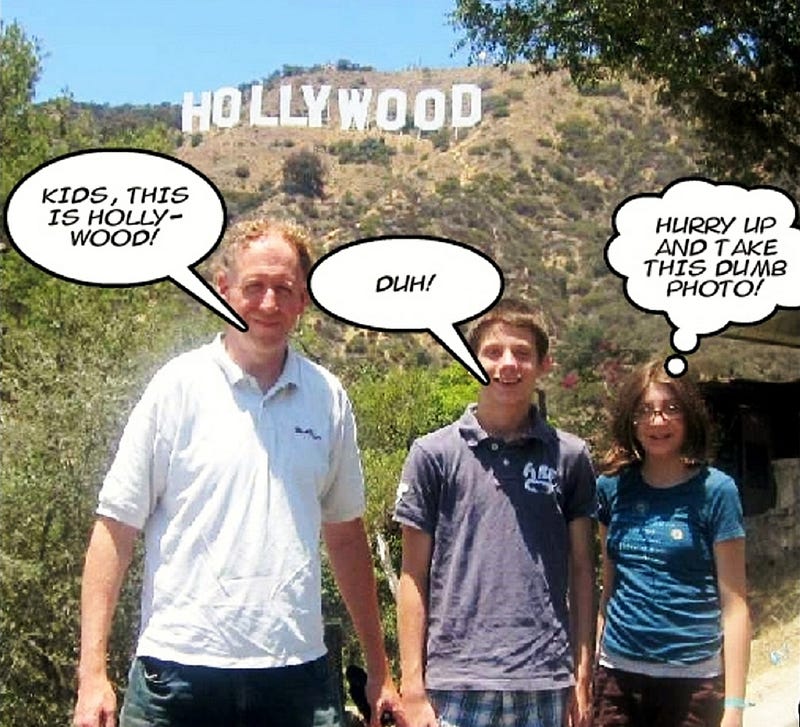
We soon get off the freeway and turn onto a winding, narrow road, heading for the hills. As we see the famous Hollywood sign well in sight, we stop and snap a few photos. Another tourist takes our photo for us before a security guard arrives to shoo people away. Two years later, we would locate the path to walk all the way to the sign.
We can’t quite find Walley World, or even Six Flags Magic Mountain, where the scenes of Clark Griswold forcing a security guard with a BB gun to open the closed theme park to his family after he drove from Chicago in National Lampoon’s Vacation were filmed. But we locate TCL Chinese Theatre, formerly Grauman’s and Mann’s, known for its outdoor courtyard of famous handprints and footprints. The venue also hosted the Academy Awards in the 1940s.
We tour the inside dressing rooms where Marilyn Monroe and others prepared for performances. We scan the construction in the theater, which is being remodeled to feature an IMAX screen. We get an up-close glimpse of practice concrete casts made of the signatures and prints of Jane Fonda and Jackie Chan, both of whom are recent honorees. Fonda is the first to depict a peace sign, our guide says. If you can’t get a star on the Walk of Fame, maybe this is even better.
Some critics say the selection process for TCL has also deteriorated and note how some ceremonies — which also come with a cost in the tens of thousands of dollars — are tied to movie releases. It seems to be more legitimate than the Walk of Fame. The honor is a big deal to Fonda, who writes on her blog that the ceremony was one of her “happiest days.” Her father made his prints here in 1942, and hers are next to his.
For the grand opening of this theater in 1927, more than 100,000 people reportedly showed up to gawk at the stars who paid as much as $32 then — more than $400 today — to watch Cecil B. DeMille’s silent classic The King of Kings. The theater also launched Star Wars in 1977, among others.
The kids enjoy comparing their hand and footprints to stars such as Johnny Depp and Matt Damon. “Look!” exclaims Preston. “My hand is bigger than Matt Damon’s!”
“That’s not a surprise.” About the only ones my hand or foot do not dwarf are John Wayne’s, Clint Eastwood’s, and Arnold Schwarzenegger’s.
There are imprints of the cigar of Groucho Marx, the magic wand of Harry Potter star Daniel Radcliffe, the face of John Barrymore, the legs of Betty Grable, and the noses of Jimmy Durante and Bob Hope. Trigger, the horse of Roy Rogers, left some hoof prints.
We try to tour the Dolby Theatre, where the Oscars have been held since 2002, but it is booked with the premiere of Pacific Rim that day. We walk on the outdoor stage that is being set up for the premiere, which is surrounded by columns and statues. We don’t recognize any actors but see some presumed wannabee actors.
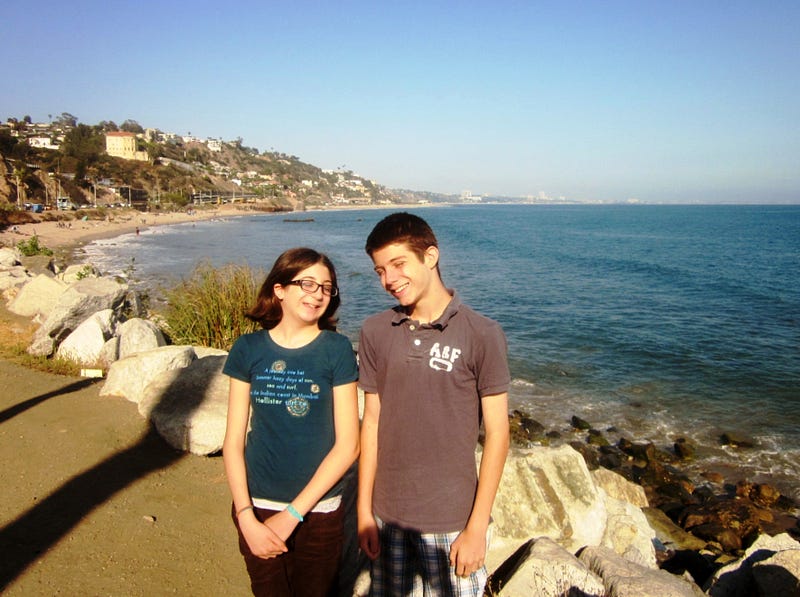
Finally, we tire of celebrity pursuits. We reach Malibu Beach and park along Highway 1 for another ocean shot. “Can we go swimming, Daddy?” McKenna pleads.
“Well, we have to get to Phoenix tonight.”
“C’mon. We’ve come all this way.”
I have to navigate rush-hour LA traffic on this Tuesday so might as well wait till it clears a little. McKenna wastes little time changing into her swimsuit in the vehicle, as Preston commands that she not get sandy.
“Yeah, that’s going to happen,” I laugh.
We find an uncrowded spot well away from the surfers. The water is cool, but not cold, refreshing. Again, there aren’t many shells, which the Pacific tends to devour, unless you reach a cove. Moonstone Beach in Cambria farther up the road is a decent place to find gems.
For an hour or so, we are free, without a care, suspended above the confines of schedules, deadlines, expectations, rules, and dreams. We splash each other and run along the beach, searching for nothing but a moment in the setting sun.
I don’t even worry about how I will get us some 400 miles to Phoenix that night. We’ve made it all the way across the country. We’ve exceeded our expectations for this trip.
We’re not famous for doing so. There is no welcoming committee to greet us, no paparazzi to record our deed and relay it to the masses. There is just the endless motion of the waves, the glimpse of the setting sun way out there past the edge of the ocean, the refreshing coolness of the water at our feet.
For now, it’s enough. We can afford to savor this moment.
Memento vivere, I think.
Over the next six days, I would drive through the night, stopping only to rest an hour or so, no less than three times on our way home. We would visit friends and family in Arizona and Texas. We would have a few more moments to remember at the Grand Canyon, Sedona, Cadillac Ranch. We would use our wits to fix a flat tire near Gatlinburg.
On ensuing journeys, we would visit new places, from the Vancouver clock, Seattle Space Needle, and Mount St. Helen’s, to the Denver Red Rock Amphitheatre and Burlington, Vermont, lakeside natural history museum. Though memorable, no moment would quite compare with the magic of reaching the Pacific Ocean for the first time after a cross-country odyssey.
Kevin Shay is a journalist and author of several books, including the U.S. travelogue-memoir, It’s a Mad, Mad, Mad, Mad Trip.