
The Last Magic Road Trip
Many people relax at a beach or mountain resort during annual vacations. I drive long distances with my kids, chasing a moment to really remember.
We do not take a trip; a trip takes us. — John Steinbeck, Travels with Charley: In Search of America, 1961
This is Part 1 of two parts.
It is almost dark as Dad drives the station wagon over the Texas border into Arkansas. We are on our annual long summer journey to visit relatives in Maryland and Pennsylvania. Why can’t we fly in a plane? I think. This is 1970, before most kids own a cell phone and portable DVD player, before even Sony Walkmans and Apple iPods. I can only read a map, observe the highway sights, and play the alphabet game using signs for so long.
So I do the remaining thing that makes sense to a bored boy. I tease my younger sister and brother. “In Arkansas, you have to be really careful,” I solemnly tell them. “There are ghosts and goblins and……..CRICKETS there.” Kathy, in particular, loathes crickets almost as much as spiders.
“Daddy! Mommy! Kevin says there are ghosts and CRICKETS in Arkansas. Is that true?” Kathy pleads.
“Knock it off, Kevin!” Dad yells in a somewhat stern, somewhat amused tone. “Hey, look at those deer!” He points to the side of the road, employing a diversionary tactic that I would adopt years later. At age 11, I don’t understand it is such a ploy, of course. I strain my eyes but don’t see anything unusual. Only pine trees. And the highway that seems to stretch endlessly.
By the next day, we are well into Tennessee and its more mountainous views. Whenever our sibling rivalry almost boils over, Dad continues with the diversionary responses, sometimes stopping the car at a mountainside or odd roadside attraction. We have a look and sign a temporary truce. Towards the end of the day, the station wagon sputters, and Dad steers it off the shoulder of the highway.
“You’re not out of gas?!” Mom demands.
“I thought I could make it to the next exit,” Dad replies, his eyes straight ahead. Then, he turns to us, with a hint of a twinkle in his eyes as if he almost enjoys this situation. “I’ll be back soon.” He climbs out of the car and retrieves a metallic portable gas can from the back near our suitcases. I watch him walk down the highway until he becomes a dot on the horizon, as cars whiz by. Eventually, someone stops to ask if we need help. Mom points in Dad’s direction and thanks the driver. I have no idea if the driver locates Dad.
About an hour later, Dad returns with the full gas can. He ignores Mom’s lecture about keeping the gas tank at least one-quarter full. “Life is not always smooth sailing,” he later tells me. “Sometimes stuff that you don’t like happens. And you have to use your wits to figure out what to do.”
More diversionary tactics
Now 54, I understand a bit more about Dad’s road trip methods and philosophy, though I stop short of playing the see-how-far-you-can-drive-until-you-run-out-of-gas game. I reside near where he and Mom met not long after World War II in Washington, D.C., having migrated there myself from Texas in the midst of a divorce. Son Preston is 13, while daughter McKenna is 10. Though we can easily fly to Texas to visit relatives each summer, I usually choose to drive.
On this 2013 journey, I seek to go beyond Dad and Mom’s trips. I want to drive the kids all the way across the country and back in roughly two weeks. I’m not sure why. Perhaps I like to search for something in the middle of nowhere, where relatively few people venture. Perhaps I chase that elusive family bonding moment in the sun, the one immortalized in a Norman Rockwell painting. Does that exist, or is it another Bigfoot-like myth?
We depart from close to the easternmost 18-foot-high Madonna of the Trail statue. In the 1920s, the National Society Daughters of the American Revolution created a dozen statues that were placed from Bethesda, Md., to Upland, Calif., honoring the pioneering women who traveled west with their mad husbands.
Our goal, like those pioneers, is to reach Western territory that we haven’t seen, though we don’t plan to start anew there. As we motor towards Frederick, McKenna looks up from reading The Reinvention of Moxie Roosevelt.
“Daddy,” she asks, “how far are we driving today?”
It’s a fair question. But I can’t be completely honest and say, “Oh, just 400 miles.” Even McKenna the Adventurous Traveler would want to bail out right there. So I say, “Just down the road a bit.” Then I point to an imaginary animal on the side of the road. “Look! There’s Toby!”
“I miss Toby,” McKenna says of her mixed-breed doggie the kids and their mom rescued from a local pound a few years back. That will become one of the most popular statements on this trip.
Somehow, Preston hears McKenna’s voice while listening to Bruno Mars, Macklemore, Nickelback, and more through earbuds attached to his MP3 player. “You’re stupid, McKenna!” he roars from the passenger side seat. It’s a good thing Preston can sit up front and not have to sit in the back seat with McKenna, as he did on previous long road trips.
Though not as physically strong as Preston, McKenna refuses to back down. “You’re stupid!” she retorts.
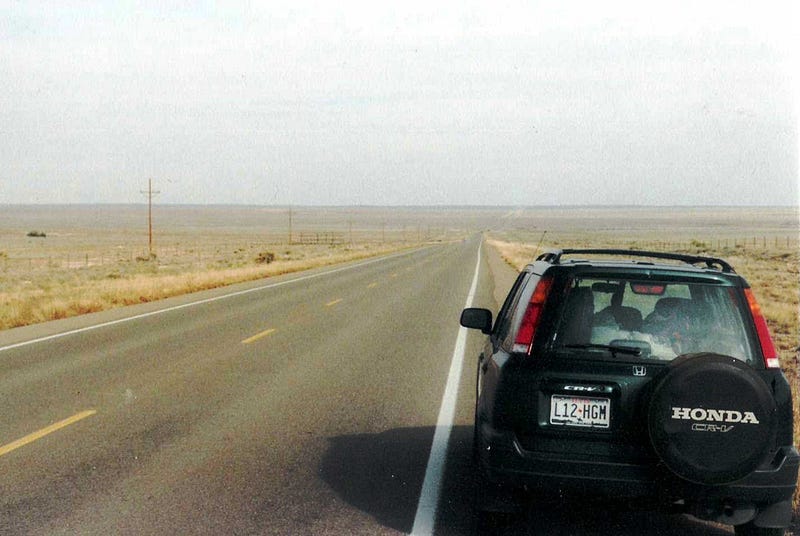
“Okay! No one is stupid!” I interject. That could be another dishonest answer. Am I stupid for wanting to drive my kids by myself all the way across the country and back in about two weeks in our trusty, beat-up 2001 Honda CR-V with 165,000 miles on it? Have I bitten off more than I can chew this time?
Preston tries to hit McKenna, and she sends a foot his way. It’s on. “Okay, okay! Stop fighting!” I yell. I then turn up the radio louder than they scream, which works better to quiet their argument. Preston changes the station from my favorite classic-rock one to an outfit that plays more modern hits. I sigh and try to tune out Icona Pop singing about crashing a car into a bridge before I somehow twist that idea into a good one.
McKenna soon interrupts the song. “Daddy,” she begins, and I gladly turn down the radio, “why are we driving again all the way to Mount Rushmore and maybe California? Why didn’t we fly out there?”
“Because Daddy’s too cheap to fly,” Preston chips in.
“No, Preston, that’s not it,” I sigh. I try to explain what I learned during the long road trips of my youthful summers and how I seek to recreate that experience. “You can see and learn about the country a lot more by driving than by flying.”
“Why on earth would we want to do that?” Preston asks.
I mentally debate whether to explain how a long road trip can help develop mental toughness. You are cooped up for long hours, forced to retrain your mind away from the temptations of instant gratification all around you. I decide to keep quiet and show them, instead. Onward.
Subtle changes
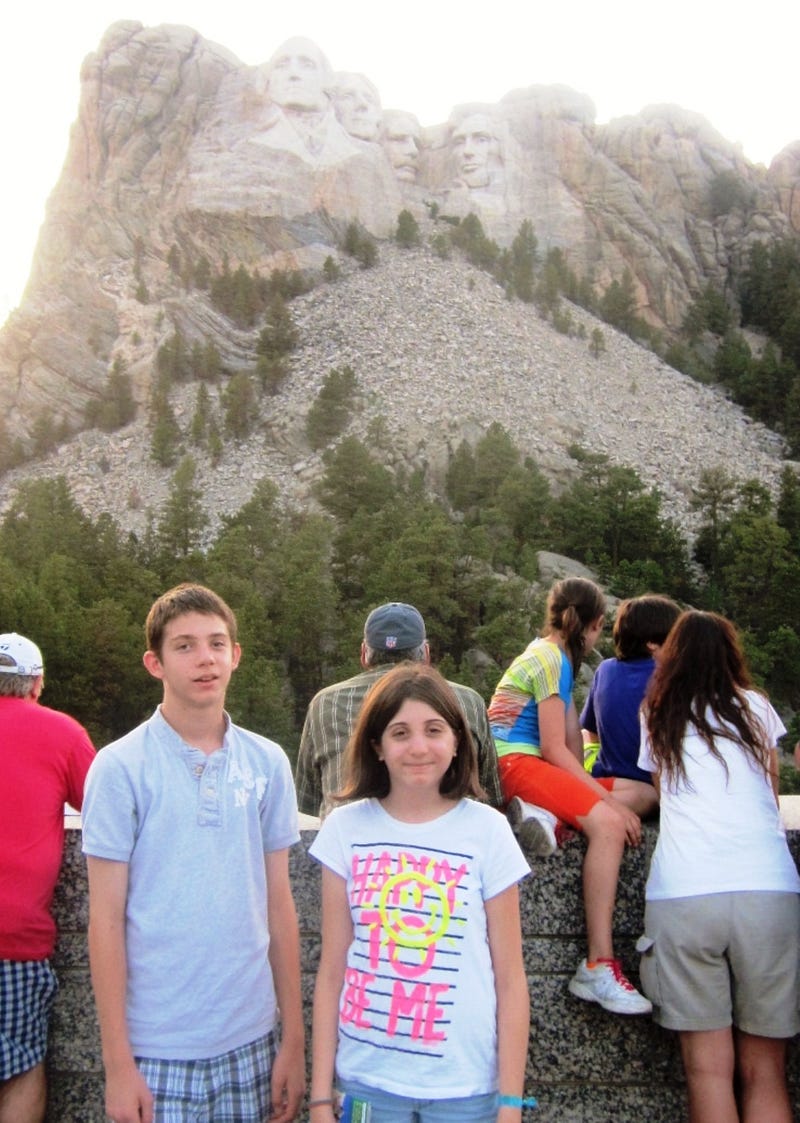
The 60-foot-high heads of George Washington, Thomas Jefferson, Theodore Roosevelt, and Abraham Lincoln cut in the granite appear majestic enough in the daylight, visible on a good day from 60 miles away. Lit up at night with laser beams and special lighting, they are a colossal sight. We are by no means alone here. Some 2.2 million people would trek to the somewhat isolated Mount Rushmore in 2013.
In the previous five days, we have checked off the Pro Football Hall of Fame in Canton, Ohio; the Willis Tower, the tallest building in the country in Chicago; a Wisconsin Dells water park; and the Badlands, among other places. I sense a subtle change in the kids.
“That was a cool film,” Preston says, as we exit the Lincoln Borglum Visitor Center theater on this fourth of July eve. The film tells the story of the 14-year construction process led by Danish-American sculptor Gutzon Borglum and South Dakota state historian Doane Robinson, who conceived the big-heads idea in 1923 to promote tourism in the area. Robinson enticed Borglum, who had worked on a carving at Stone Mountain, Ga., to take on the project.
At one point, Robinson wanted to see Western figures, including Lakota Chief Red Cloud, immortalized in stone. But Borglum convinced him the former presidents would perk more national interest and help secure important federal funding. They started dynamiting in 1927 after obtaining federal money, a couple of years before the onset of the Great Depression.
Many of the roughly 400 workers dangled on 3/8-inch steel cables in an open-air chair for hours using jackhammers and hand chisels to sculpt the artwork. They made about $8 a day for such dangerous work, a little more than $100 in today’s dollars. About 90 percent of the granite was first shaped with dynamite blasts, which removed about 450,000 tons of rock.
“Some of the workers admitted being uneasy with heights, but during the Depression, any job was a good job,” says a National Park Service report.
After dynamiting until three to six inches of rock was left on the carving surface, drillers made holes in the granite close together to weaken the rock so it could be removed more easily, a process called “honeycombing.” Workers then smoothed the surface of the faces with a bumper tool. These days, maintenance crews use silicone sealant to repair cracks in the faces.
Initially, Borglum hoped to carve each president from head to waist and even chisel the shape of the Louisiana Purchase and other artifacts into the mountain. But lack of funding and his death in 1941 brought the project to a close after costs rose to about $1 million. Behind the faces, workers blasted a chamber that eventually contained a titanium vault with tablets with the text of the Declaration of Independence and other documents. Borglum sought to preserve the documents for future civilizations, and the chamber is closed to the public.
Some of the movie, National Treasure: Book of Secrets, was filmed here and portrays a fictional account of finding Cibola, a legendary city of gold, behind Mount Rushmore. There is no real evidence that Cibola exists, but that doesn’t stop people from searching for it.
How the memorial was named is another story. About a decade after the gold rush into the Black Hills started, New York lawyer Charles Rushmore traveled here to inspect some mines that a client of his firm wanted to buy, according to newspaper accounts. Rushmore discovered the mines’ owner was allegedly having workers illicitly place minerals in there for easy discovery to make the mines seem more valuable.
While saving the client some money, Rushmore noticed the 5,275-foot stone mountain and asked its name. A local businessman reportedly said the mountain didn’t have a name. Rushmore soon claimed it. He donated $5,000 to the carving project in 1925, the largest single private contribution to that time. Five years later, the U.S. Board of Geographic Names formally recognized the Mount Rushmore moniker.
So the Eastern lawyer Rushmore essentially bought the naming rights to this national memorial, much like a corporation today buys a sports stadium’s naming rights. There have been campaigns to add presidents’ faces, including Ronald Reagan, but not any to change the name itself. Five thousand dollars was a hefty sum in 1925, but even today’s corporate stadium monikers have expiration dates. Rushmore, who also had a library in Highland Mills, N.Y., named after him, seems like a decent person from most accounts. But there has to be a more deserving person to carry the honor of being named for this valuable national memorial, such as Washington, Borglum, or Robinson.
We reach an outdoor amphitheater directly underneath the carvings, where the Rapid City Municipal Band plays patriotic songs for several hundred people. We join just in time to remain standing and sing “The Star-Spangled Banner.” Even when I’m riled up about Native American injustices, it’s hard not to feel a stirring of patriotism as several hundred voices attempt to merge in the crisp mountain air.
Sometimes there is a fireworks show above the presidents’ heads, but with the dry conditions, that is canceled. We climb up on stairs as high as we can and take a few more photos and videos. In 1960, Pulitzer Prize-winning novelist John Steinbeck drove some 10,000 miles in eleven weeks around the country with his French poodle, Charley, trying to recapture his youth and get reacquainted with Americans before he kicked the bucket. In his best-selling Travels with Charley book that some claimed was embellished at times, Steinbeck skipped out on surveying Mount Rushmore to write about meeting a Shakespearean actor in rural North Dakota. We hadn’t met any Shakespearean actors on this trip, but I suspect they are out there.
At the Rushmore plaza, we gaze one last time at the big presidents’ heads. “So what do you think about making it here?” I ask the kids.
“I think it’s great. I think it’s just rainbows and butterflies,” McKenna replies, waving a park brochure around.
“No comment,” Preston says, trying to escape.
We walk under a terrace with flags of each state. In the car, the kids are quiet, either fatigued by our voyage or moved by the day’s whirlwind of events. We have come some 1,600 miles, about halfway to the Pacific Ocean. Our feat seems small compared to this place.
At our hotel, we can see the president’s faces in the distance from the parking lot, beaming like a lighthouse beacon in a storm. “You still want to go to Hollywood?” I ask the kids, as we try to relax in the room. “We can just head south to Texas from here, instead of continuing west, if you don’t want to go that far.”
I sort of expect them to want to head straight to Texas, but they surprise me. I should not have been too surprised; we all chose Hollywood first in a ranking of places we wanted to visit that we did before leaving. They both chose Las Vegas second, while the Grand Canyon was my second choice.
“I want to go to Hollywood,” Preston says.
“Yeah, Hollywood,” agrees McKenna.
This is the second time that day they agreed on something. I pinch myself. Nope, not dreaming.
Kevin Shay is a journalist and author of several books, including the U.S. travelogue-memoir, It’s a Mad, Mad, Mad, Mad Trip.
Part 2 of this series is here.


