
The Real-Life Land With No Husbands and No Fathers
Not all modern cultures are patriarchal; not all socialization is the same
Some people seem to be under the impression that life around the world has largely always been pretty much as it is now, just without modern conveniences. They believe that men in all cultures have always had the most political and economic power, been the head of the household, the scions of their family line, and the upholders of business and industry. They imagine that women have always been second class citizens in all cultures, at least up until very recently when we’ve had some improvements in that department.
Besides the fact that patriarchy is really only about 10 thousand years old, and that many ancient cultures were egalitarian and matrilineal, there are cultures that exist in modern times which are not patriarchal societies. Most of these have distinct roles for men and women and in many instances, men do hold political power, although sometimes only with the support and consent of the women. But otherwise, there is a fair amount of balance between the sexes, and property, as well as family name, pass through the mothers in these cultures.
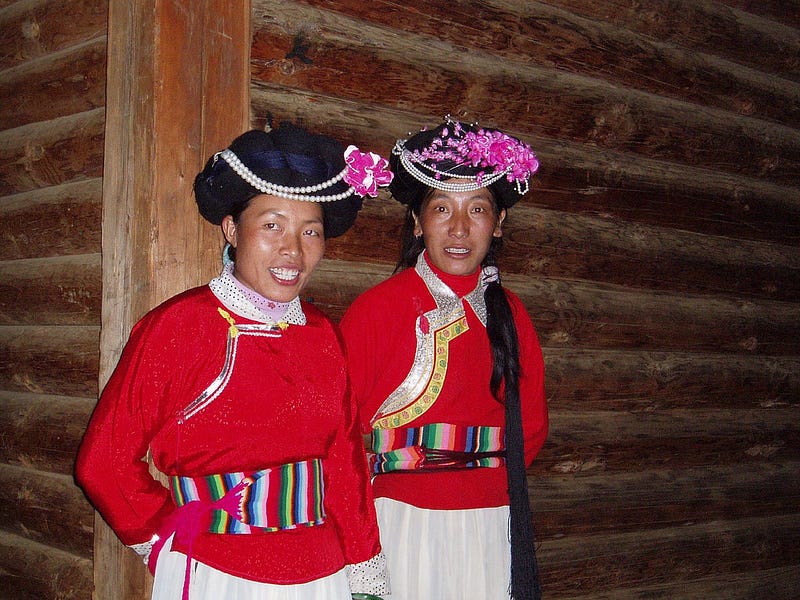
One of the most interesting of these is the Na (otherwise known as the Mosuo) of China, a small ethnic group of about 40,000 people who live near the border with Tibet. Although men hold political power, everyone lives in their mother’s or grandmother’s house and there is no institution of marriage. Women take lovers (who come and visit in the night) as they wish, but the partners never live together or establish their own household. A visiting suitor puts his hat on the door of the women’s quarters to let other men know she is not currently available.
Fatherhood is considered a largely irrelevant concept and is often not even known, although men do help to care for the children born into the home of their matriarch— the children of their sisters or cousins. Women are the heads of the household and also do much of the physical labor, including farming. Men build houses and are in charge of livestock and fishing.
The matriarchs (photographer Karolin) Klüppel met were “often very funny, and very active”, at odds with the German culture she is used to. “I saw an 80-year-old women carrying things I could no way carry myself,” she says. “Their bodies are really tense with power. I realized that physical strength really depends on what you do with your body — the women have more strength than the men!”
This is a culture that has been slowly eroding as tourism and modern influences encroach upon it, and it also has a downside. Because motherhood is so highly valued, women who cannot have children or who do not want them can have a difficult time. A woman is seen as complete once she becomes a mother, although men and boys are much more active in childrearing than in many other cultures, even though they are typically not raising their own children.
“Mosuo men are feminists by any standards,” says (author Choo) Waihong. “Boys think nothing of looking after their baby sisters, or taking their toddler brothers by the hand everywhere. I was once made to wait before talking business with an elderly Mosuo man until he had bathed his family’s twin baby girls and changed their nappies.”
The point is not whether or not matrifocal/matrilineal cultures are perfect or fully sustainable in the modern age. The point is that patriarchy is not the only social system that has ever existed, and not the only one in existence today. For some people, this is no doubt a profound disruption in what they have always believed to be the status quo, but it is demonstrably the truth.
The largest matrilineal society in existence today is the Minangkabau of West Sumatra, Indonesia — with about 4 million people. Mothers are considered to be the most important people in society and sons leave their wives early each morning to go and have breakfast with their mothers. Once again, this is a culture that is profoundly different from our own, and from most of the ones that we know.
What is considered desirable, acceptable, or normal has moved on a very different trajectory from patriarchal cultures, where men are still largely considered to be heads of households, even in modern times. These matrilineal societies have a belief in balance between men and women, which is demonstrated in a variety of ways. We do not live in a homogenous world, and differences in food and language are just the tip of the iceberg. Cultures vary in all sorts of ways, including whether or not being someone’s husband or father is one of the most important aspects of the society or the least important.


