
The Key to Happiness Is in Your Head… but, It’s Not That Simple
What’s in your head?
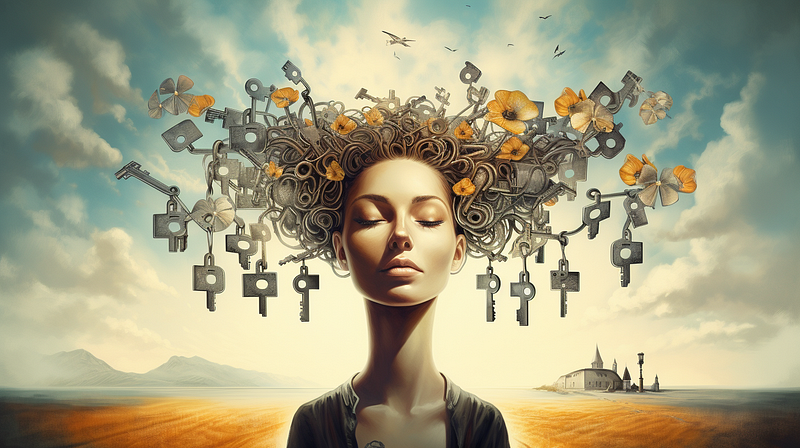
Since 1995, our brains have evolved at inhuman rates.
The invention of the smartphone has spawned the first generation of cyborgs — with present-day humans piloting this new relationship.
Today, with technology fused to our palms, some of us interact with our phones more than our thoughts.
I often feel lucky to have grown up pre-internet, as it has provided me with the mental tools to navigate our new world. But, as life rapidly evolves, so does the necessity for adaptation.
As we are pulled further from our roots, our mental health plummets. And, most modern-day problems exist primarily in our heads.
Here’s how you can take control of your life —despite the downpour of input we face each day.
By understanding your body’s natural brain drug — dopamine.
What is dopamine — and what does it do?
It’s silly, but anytime I see or hear the phrasing above, I think of Arnold Schwarzenegger’s character from the movie Kindergarten Cop,
“Who is your daddy and what does he do?”
And, although the inner workings of the human brain are far more complex than any 1990s action comedy, at times, you can feel like both the parent and child in your own head.
Dopamine is a neurotransmitter carrying information between your body and brain. It’s your natural pleasure drug — making you feel happy, excited, and motivated.
Dopamine controls your desire to do… well, everything.
Whether it be eating food, having sex, exercising, or working toward challenging goals, dopamine makes life worth living. And, when your dopamine levels are low, life feels like a constant struggle.
Humans are incredibly complex in many respects. We are able to empathize, imagine, and create beyond belief. But when it comes to our wiring, we’re just as simple as any other earthbound mammal.
We pursue what makes us feel good — and avoid what doesn’t.
Dopamine acts as a proverbial donut on a string, guiding you forward in life. But, if you’re not careful, your base instincts can lead you down a dark and unfulfilling path.
Your baseline for happiness changes every second.
There’s a concept in psychology known as functional fixedness. Essentially, it’s a mental bias in which we see the world as working in one, fixed way.
When you see a dark, cloudy morning you may interpret it as a depressing sight. Or, when feeling anxious, you feel as though you’ve done something wrong.
But in reality, physical feelings are nothing more than triggers — messages sent from your body to your brain. Neurotransmitters, like dopamine, control how the message is received.
They allow us to perceive the world in a painful or pleasurable way.
When your dopamine levels are high, you see the world in a completely different light than when they are low.
That dark cloudy morning is no longer interpreted as depression, but as motivation. And, your feelings of angst can be used as fuel to make progress in your life.
Perception is reality — dopamine paints the world with bright, uplifting colours.
And, like colours, dopamine is only perceived in contrast. You can’t feel happy without knowing what sadness feels like. And, the more dopamine you experience, the more you need to feel the same level of enjoyment.
It’s for this reason, modern life can feel like a roller coaster of emotions.
According to neuroscientist, Dr. Andrew Huberman, from a biological standpoint,
“A peak in dopamine is followed by [an equally-sized] trough in dopamine.”
In the past, dopamine was hard to come by. Only being awarded to us after accomplishing challenging tasks. For example, the taste of food after weeks of hunting. Or, the feeling of sun on your skin after a long, cold night.
But today, through technology, we have access to dopamine at any moment with a simple swipe of our finger.
Yet, we wonder why life feels unfulfilling.
Dopamine in the modern world.
A 2014 study gave mice access to unlimited dopamine, through a lever.
The results showed they were unable to control their addiction. According to lead researcher, Christian Lüscher,
“If after two hours we didn’t take them out of the cage, they wouldn’t eat, they wouldn’t drink, then they’d probably die quickly, but very happily.”
Today, the silent buzz of our smartphones is enough to lure us out of the present moment, in nearly any situation. With endless emails to check and impending social media pings, we find ourselves in a Matrix-like reality:
“A prison for your mind.”
And like the Matrix, it feels inescapable at times.
Constantly looking for your next mental checkpoint lowers your baseline of dopamine. Making life feel more painful, arduous, and perpetuating a need for that next artificial dopamine hit.
But, there is good news.
Much like unplugging from the Matrix gives you the power of free will, stripping down the walls of your subconscious allows you to think clearly.
And, control your reality.
How to maintain happy levels of dopamine.
There’s a great quote attributed to Bruce Lee,
“Long-term consistency trumps short-term intensity.”
Because dopamine operates on a roller coaster, with peaks followed by equally-sized troughs, it’s impossible to feel good all the time.
Much like our eyes can only perceive shapes and colours based on contrast, our brain can only feel pleasure from understanding what it means to know pain.
So, the key to happiness isn’t about chasing highs.
It’s about embracing both the peaks and troughs of life to build a healthy baseline of sufficient dopamine.
Here are a few habits to help you do just that…
#1. Pleasurize effort:
Humans will do just about anything for a taste of dopamine.
Climb tall mountains, conquer challenging tasks, face our deepest fears, the list goes on…
But, our brains don’t want us to have ultimate satisfaction — as that would mean we stop moving forward (and subsequently die). Instead, our brains want us to feel just good enough to complete our overarching goal (to stay alive).
And, upon reaching a goal we experience a dopamine crash to entice us to pick up and start again — much like running on a treadmill, chasing a donut on a string.
So, the key to maintaining healthy levels of dopamine is to stop looking at the donut as a reward. Instead, look at each step as a reward. Because ultimately, it builds a faster, better, more permanent you.
To quote Dr. Andrew Huberman again,
“Don’t spike dopamine prior to engaging in effort. Don’t spike dopamine after engaging in effort. Learn to spike dopamine from effort itself.”
#2. Minimize attention overload:
In the book Atomic Habits, James Clear describes a common practice known as habit stacking.
Essentially, we often combine habits to maximize the amount of enjoyment we derive from them. This builds a resistance to dopamine, over time.
For example, sitting down to eat was once a perfectly pleasurable experience for you. But then, you began eating while watching television. And over time, once that stopped being enough, you began pulling out your phone to scroll social media while eating, with the television on in the background.
These habits are incredibly common.
And, if you’re not careful can spiral out of control, lowering your ability to derive pleasure from the simple things in life.
You can ease into a dopamine detox, by unstacking these habits.
You can still eat, watch television, and use your phone. Just do them separately. Or, if you need, start removing one habit at a time until you are only engaging in singular actions.
I like to use the mantra, “Or, not and”. You can have it all — just not all at once.
#3. Understand your list of human needs:
In our increasingly virtual and detached world, we’ve become a high-strung, neurotic species.
One study shows anxiety rates have doubled in young adults (ages 18–25) in the past decade. This is largely due to:
- Social media and smartphone use: both elevate levels of stress and anxiety
- Social isolation: today, more life is lived virtually. And, there is less necessity to be around others, physically.
When humans interact with other humans, we release oxytocin — another powerful brain drug responsible for comfort and relaxation. It also is essential for building trust, loyalty, and a sense of kinship with others.
This is 1 of what Andrew Huberman calls the “5 pillars of mental & physical health”:
- Sleep
- Sunlight
- Movement
- Nutrients
- Relationships (with yourself and others)
Although the world is becoming increasingly virtual, and I began this article by calling you a cyborg, you are still human at your core.
And you must serve your basic human needs, first.
#4. Treasure is found in the details:
Modern life is not as simple as we make it out to be.
Although most of life’s answers can be found through ancient teachings and the wise words of philosophers, it’s all theory.
Modern structures make serving our basic needs more than challenging— it can feel nearly impossible at times:
- Sitting is unhealthy — yet, you may need to sit for long periods of time to earn a living.
- Sunlight is good for you — but, if you work indoors from 9–5 PM, adequate sunlight may be hard to come by.
- You should do what you love — in theory. Granted you are able to make enough money to survive.
Life is simple — but it's not easy.
The only way to truly be happy is to embrace where you are and strive to be a little better each day.
It may sound small, but I recently gave up food preservatives and have found myself just a little bit lighter and more energetic. It’s small steps like this that compile into giant leaps and ultimately a fulfilling path in life.
Forever learning — forever growing.
Final thoughts: it’s all in your head… literally.
As much as life is a personal journey, science is a hot knife cutting through decades of self-learning.
“We are what we repeatedly do. Excellence, then, is not an act, but a habit.”
So, if you want to live an excellent life, think excellent thoughts. If you want to lead a happier life, start living more fulfilling days.
It’s not about where you end up — or even where you’re going. But instead, learning to love each step along the way.
You can never control what happens in life. But, understanding what pulls the strings behind the scenes, makes the story that much more compelling.
And, gives you the tools to write your own.
To summarize — it’s all in your head:
- Dopamine controls everything we do, from physical movement to motivation, and how we perceive the world
- We are simple creatures — enticed by feelings of pleasure
- Make effort the reward to maintain healthy levels of dopamine
Hi, I’m Hudson. I write about living healthier, happier, and more mindfully. To see my stories pop up on your feed, I’d love for you to follow me (Hudson Rennie). And, to have stories sent directly to you, subscribe to my newsletter.👇
💸 Join 1,000+ people who enjoy getting free stuff (online store). 🧘


