
Discovering The Japanese Path to Longevity through Purpose (Part II)
‘Ikigai’ ‘生き甲斐’ (Part II — The unfiltered Japanese version)

Living in Japan for 25 years and having a Japanese spouse, I’ve been very fortunate to have been immersed in Japanese life and culture. More than what I could have ever hoped for when I was younger (and I had hoped given my love for all things Japan as a young boy).
But just because I’ve had all this exposure to Japan and its people, it has in no way ‘given me the keys to all their secrets and a deeper understanding of their culture’. I would never be that naive or presumptuous.
But it did give me a closer ‘seat to the game’ to do what I do best… And that is, to observe.
Observing good things is my superpower, sharing good things is my joy, and helping implement these great discoveries for others is my vocation.
These ‘loves’ collectively put me in a position to bring to you some of the amazing things from Japan and the Japanese people that I’ve seen and experienced. To share with you, my fellow Mediumians some great things in life that I have discovered from Japan.
I call this article ‘Part 2’, not because it’s a continuation of Part 1, but because it’s more aligned with the Japanese (non-Westernized) concept of view of Ikigai. The unlocalized ‘unfiltered version’ if you will.
I express Part 1 as the ‘Westernized version’ because the theories and teachings in it are how Ikigai has become generally accepted, given it is widely available on Amazon and around the internet in this form. Even if this is a somewhat distorted view, it’s still an interesting take on the philosophy.
It is the version accepted in the West because it's more palatable and easier for us to mentally digest when described this way in comparison with this ‘part 2’, the Japanese version. The Westernized version was written by Héctor García and Francesc Miralles and has been a best seller. Even if it is a distorted and unique view of it. I say bravo to them both!
To me, it doesn’t matter so much if Japanese teaching or philosophy is posted in its original form/content or localized for Western tastes. As long as it’s out there, there is a lot of value to be shared.
It’s a good book and I enjoyed it. It gives an easy-to-understand explanation of the concept of Ikigai. It gives some cool Ven Diagrams which puts it all together for a visual snapshot and explanation that anyone can understand. It gives us the ‘ah-ha’ moment of this very old philosophy.
But here’s the interesting part…
The diagrams and teachings are all new to Japanese people. I know, because I’ve shared with a bunch of them and discussed it. They have never seen or heard of all of this, and the explanation actually complicates a very simple philosophy.
I’m not denigrating the book, the authors or the way it’s presented, and it doesn’t mean it’s wrong. On the contrary, I think it’s great and the Japanese people that I’ve shared it with also think it’s great too. It’s just a new and unique interpretation.
But again, it simply doesn’t exist in Japan or to the Japanese people, and that needs to be said. So after I wrote Part 1, I felt unbalanced and realized that in hindsight, perhaps I should have written Part 2 first and followed with the Western version. But I’ll leave it as it is and hope you’ll enjoy and get value from them.
Defining Ikigai from the Japanese Point of View
Japanese will admit that Ikigai is hard to define. They will also tell you it means different things to different people.
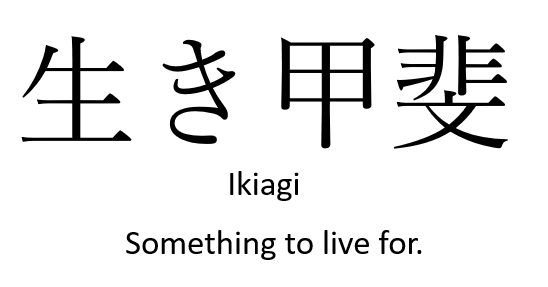
But this is common to hear because ambiguity is a common theme in Japan and that is by design.
Much to the frustration of Westerners, the Japanese are comfortable with having a ‘grey area’ for explanations of many things. The fog of ambiguity allows any topic to be open to different interpretations, and this serves an important purpose in Japanese society.
The Japanese respect each other enough to accept that all people have their own thoughts and opinions on matters. That they should not be pressured into accepting a specific interpretation of any topic and an individual’s interpretation is something they should have the luxury of forming themselves.
They will not push their own agenda or their own understanding of anything upon others. If you happen to hold a different opinion of something, then you are generally allowed to have that and it’s respected.
This group-minded conscious acceptance of allowing a system of flexibility with interpretations of concepts, leads to fewer arguments and increased harmony within their society. It’s peace and harmony in their lives that they deeply value and to achieve this they have developed and welcomed, ambiguity.
Western society on the other hand like to seek clarity. It encourages clear, concise explanations and reasoning for everything. The “let me be clear” opening line in the West is used much more sparingly in Japan.
So let’s unpack this new version, Part 2, which is without a doubt, surprisingly simple and in my opinion, the way it is supposed to be.
Putting a Number On It
110.
That’s my favourite number. It both scares and excites me to look at.
Why?
Because that’s the age I want to reach in this life.
“But why not a nice even, more realistic 100” I hear you ask?
Good question!
It used to be that number but then I put on a few years and didn’t like the closer proximity that I had in moving towards that 100 goal. So, I pushed it back!
It’s hard to find a person that wouldn’t want to be fitter, healthier, and live longer.
According to the World Health Organization, the Japanese have the highest life expectancy in the world, with an average life expectancy of 84.6 years. Additionally, they have the highest concentration of centenarians than anyone else. In the world!
Do you know what’s interesting though? The Japanese don’t consciously set the goal of living the longest.
Yet, they live the longest.
To me, this is fascinating and it’s still not a proven fact about the why and how. Yes, there are lots of theories but they have not been proven.
One of the theories is my favourite and the one I believe to be the biggest contributor to their longevity.
And that is ‘Ikigai’, or ‘reason for being’.
They have the collective belief that if you have something that gets you up in the morning, something to live for, then you will live, and for a very long time.
So in essence, this is the secret. Ikigai. ‘To always have an Ikigai in your life’
This point confused me for a long time and I misunderstood it.
I thought it meant having a significant and impressive (to other people) lifetime goal that would define me. I thought that this was something I needed to identify and then work towards every day. But I didn’t have that. Nor did I really want it.
I’ve already lived half my life and I don’t have a big impressive goal!
Fortunately, that’s not what it is. So if you’re like me, take a breath and relax because Ikigai can be a simple thing.
This is the beauty of Ikigai. It can be anything. It can be simple. It can change. You can have more than one simultaneously.
It's simply identifying something in your life that makes you wake up excited. It’s something that makes you happy to be alive and want to live.
Ikigai is often the same for many people. A love, a family member, a pet, a job (lucky you!), or travel. For most Japanese people, it will be a living thing. A person, a spouse, a child, a partner, parents or even a pet. Or it could be a hobby or something else you love.
When I’m asked why I went to Japan in the first place, my answer has always been the same.
“Because I’m fascinated about how fascinated the Japanese all seem to be about everything, all the time”. It’s like they are on a mission to learn, explore, and live.
I didn’t realize it until recently, but the Japanese people I had observed that fascinated me were simply in tune with their Ikigai, and that’s where they draw their energies from.
Think about it. When you’ve had something in life that had you jumping out of bed each morning, it’s wonderful, right? You feel like your life has a purpose!
A new person you fancy. A new friend, a new hobby…reading and writing on Medium!
Whatever it is, we all know that feeling and the energy levels it brings us.
That is the feeling of having an Ikigaki, and that, if tapped into will carry you to 100 and beyond just as it does for Japanese.
My Ikigai(s)
So let me share with you what my Ikigai is. I have more than one, and they have changed many times in my life.
One of them is my son Noah. He is 12 and the apple of my eye. My love for him is immeasurable and he’s one of the reasons I love waking up in the morning.
The other is writing. Although I’ve always written and always enjoyed it, it’s never been regular, and it’s never something I would call an Ikigai. But now it is, and now I’m always thinking about my next article.
Because writing isn’t really writing. Writing is thinking and I know this will help keep me young mentally and help with my goal of living to 110.
I encourage you to read Part 1, but don’t get too caught up in it is all I would say. Just choose something that you love and that makes you happy and that makes you look forward to waking up in the morning.
I feel privileged to share my Ikiga(s) with you.
And I would love to hear yours.


