
Ikigai. ‘Finding Your Life’s Purpose’ The Japanese secret of longevity (Part 1).

110.
In Japan, that’s the number equivalent to America’s ‘911’ and the number to call for emergency services.
But because of Japan’s influence in my life, its become my favourite number for a different reason. It’s the age I seek to live to in a healthy, happy way. It’s my ‘Ikigai’.
“What is Ikigai?”
Ikigai is simply something that gives us a sense of fulfilment and purpose in life. Our ‘Reason of wanting to exist’, … Its literal translation is ‘life value’, but it can be interpreted in many ways such as one’s ‘life’s purpose’, or ‘something that gets us up with joy each day’.
I want to talk about the association between Ikigai and longevity.
The Japanese people live longer than any other nationality on earth, and many Japanese themselves believe one reason for this is that they enjoy having ‘something to live for’.
To many Japanese, having a sense of purpose = living longer, in happiness and good health, and their word for this life purpose is ‘Ikigai’.
I recently was invited to speak at a Young Leaders summit in Mississauga, Canada about the topic of Ikigai (and also Japanese secret success formulas), and this post looks at some of the points of that talk.
To Japanese people, Ikigai is often something simple and central in their lives, such as:
-Children
-Pets
-Family
-A combination of the above
-Music
-Delicious foods
But recently there has been a more complex discussion of Ikigai which is placed in a Venn Diagram. This is a more Westernized perspective of Ikigai, but definitely has merit and is very interesting. I call it the ‘professional’ version of Ikigai.
Some examples of a professional Ikigai are:
-Making an impact on the lives of others
-Owning your own company
-Becoming a Professional sportsperson
-Becoming a professional anything that satisfies the 4 elements
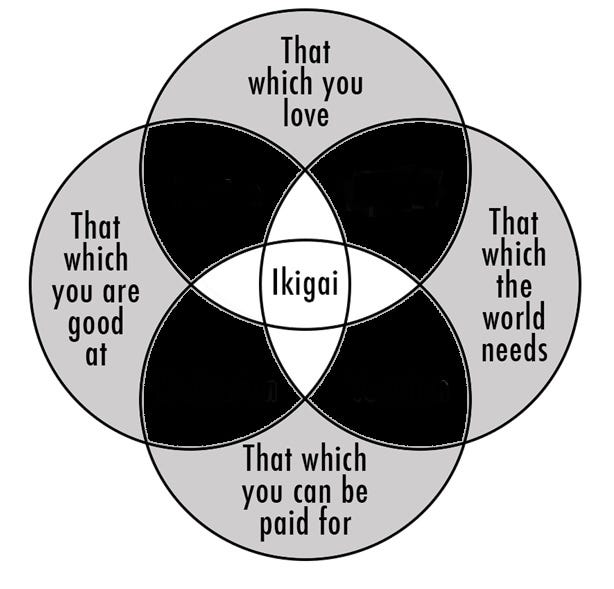
A professional Ikigai is at the union of four elements:
1. What you are good at.
2. What you love.
3. What the world needs.
4. What you can be paid for.
The professional Ikigai Venn diagram below, as indicated by Garcia, Hector (2016) Ikigai, New York, NY: Penguin has the 4 elements. If your work has all these elements, then you are considered to have your professional Ikigai.
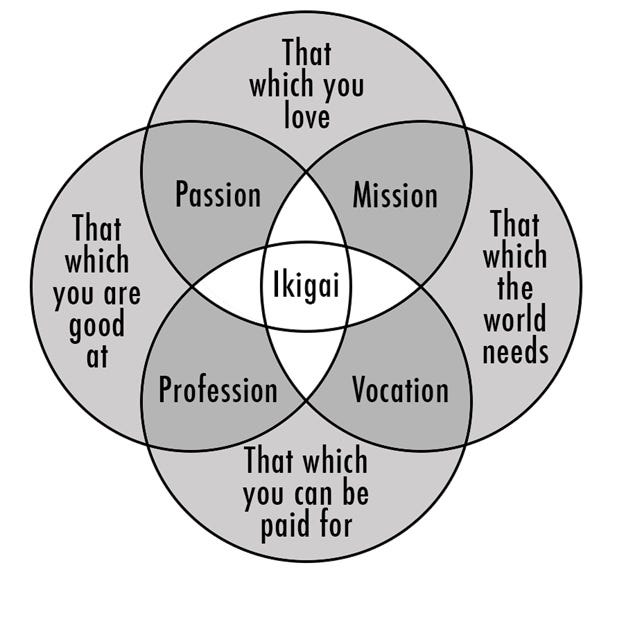
But what if you only have any of the following 2 of these? Well, you can see that you have either a passion, a mission, a profession or a vocation. You’re halfway there, but it’s not considered your ikigai.
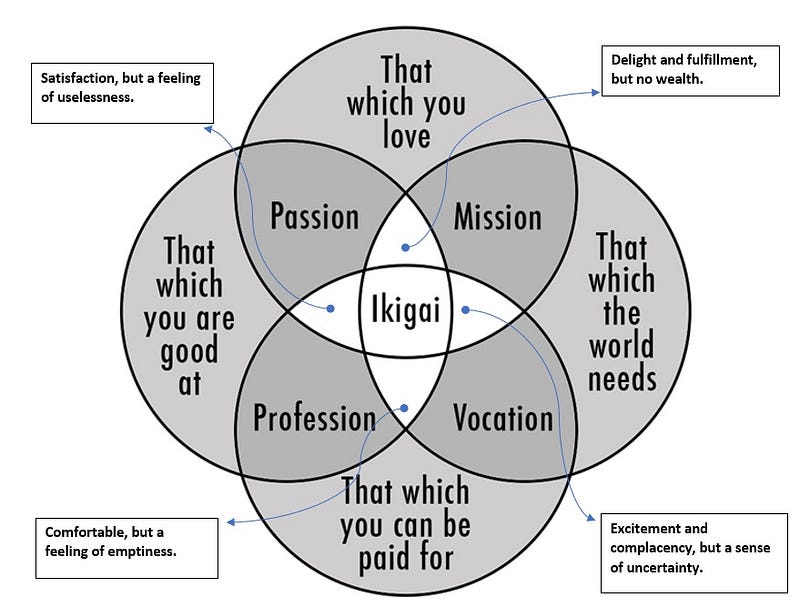
But what if you have 3 of these? Let’s look at them:
A. If you have work that you love, you’re good at and can be paid for: It leaves you with satisfaction but a feeling of uselessness because you’re not contributing something that the world needs.
B. If you have work with you are good at, you love and the world needs: You have a sense of delight and fulfilment, but lack wealth because you’re not getting paid for it.
C. If you have work that you love, the world needs, and you can be paid for, then you have excitement and complacency but a sense of uncertainty because it’s something that you’re not too good at.
D. Lastly, if you have work that you are good at, you can be paid for and the world needs it, then you’ve been comfortable, and have wealth but left with a feeling of emptiness because it’s not something that you love.
But Ikigai to the Japanese themselves is a little different. It’s different because there is no direct translation for this in English or any other language. Japanese also don’t always seek clarity on things like we do in the West and because we seek clarity, this venn diagram and explanation of Ikigai was developed.
So to discuss the Japanese interpretation of Ikigai, I encourage you to also read the below which I call ‘Part 2’.
But when it comes to longevity, my observations from living in Japan for 25 years, point to reasons in addition to having an Ikigai and here are 10 of them.
10 other traits believed to contribute to Japanese longevity:
1. ‘Retire from work, but don’t retire from life’. Japanese always are active, mentally and physically. They maintain a perpetual sense of curiosity about the world and want to learn.
2. Take it slow.…you have 100 years!
3. Don’t fill your stomach (80% rule). My favourite one! Maintaining this habit will help with your body’s digestion and general health.
4. Surround yourself with good friends.
5. Get in shape by your next birthday (the body requires good maintenance to keep running for the long time you’ll live).
6. Smile: Not every moment and every day is great, but we need to remember what a privilege it is to be alive here and now.
7. Reconnect with nature (Shin-rinyoku 森林浴): We live in man-made cities and we need to return to nature sometimes to nourish our spiritual batteries. Get out there and walk!
8. Maintain a sense of gratitude.
9. Live in the moment.
10. Follow your Ikigai!
I hope that this brief will give some clarity to Ikigai, what it is, and how it can help you live a better, longer, and more wonderful life.
Short story #2 from the series ‘7 Secrets of Japanese Success’.
Get more great stories and become a member of Medium! Use my referral link to sign up for Medium You’ll get access to great content and I’ll receive a small fee as a thank you at no cost to you. And I do say thank you!


