
The Insecurity that Drives Misogyny
Because in the end, bullies are always motivated by fear

Yesterday I read a part of a story written by a popular Medium “guru.” Although this guy has a huge following, which includes a lot of women, he decided to offer this little gem up as a part of one of his “good advice” lists:
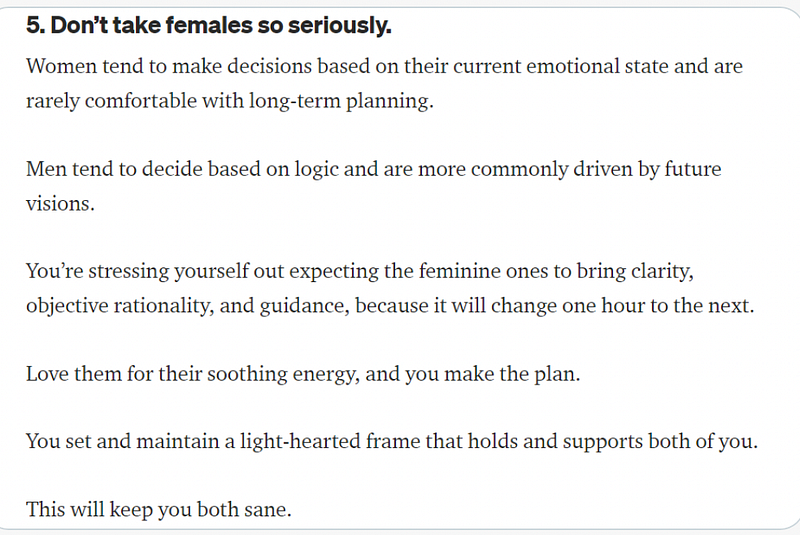
After I got done shaking my head that anyone who wasn’t a part of an evangelic Christian community would say something so blatantly stupid out loud, I started to wonder what was really driving this narrative. After all, there is ample evidence all around us of women in leadership and positions of competence of all sorts — from politics to the military, to business, and beyond — who are clearly just fine with making long-range plans and dealing with life in clear and rational ways. Why try to pretend that this isn’t the case?
The thing about misogyny is that it isn’t really about hate. Misogyny is the fear of women getting out of their patriarchally assigned lane and perhaps taking up space for things previously coded as “male only.” But why be afraid of that? If you are truly someone who is confident and competent, you shouldn’t be threatened by other people getting an opportunity to shine. Why would a man need to go out of his way to characterize women as sweet, but ineffectual and to encourage other men to buy into that?
Limiting the power of those who are lower on the pyramid of the social hierarchy helps to legitimize the power of those who are closer to the apex. A dominance-based hierarchy like patriarchy reinforces social stratification and keeps people “in their place” by preventing them from competing with those with more traditional power. This helps to bolster the illusion that those at the top have earned their place there through their own hard work and diligence rather than by some accident of birth.
Boldly affirming to your readers, and even to your female readers who apparently aren’t sufficient people to be concerned about, that it’s best to just pat women on the head and let them make you feel good, is such a transparent admission of insecurity that I almost feel sorry for this guy — almost, but not really.
Masculinity as it is envisioned in a traditional, patriarchal context, is something that can never be claimed outright. A man has to constantly prove his status and his worth as a “real man.”
Because masculinity is a relative status, a man can only really know how masculine he is if he compares himself to all the people around him. That’s part of the reason feminine men are so reviled: if you mock a man for being feminine, it proves you don’t have any of those traits within yourself, and hence are even more masculine. And the form this competition takes — this masculine status game — is searching for power.
And since a dominance hierarchy like patriarchy is a zero-sum game where only one person can win by making sure the other person loses, life in this dynamic is a never-ending competition for value, status, and power. Self-worth doesn’t come from within, it comes from external validation that is achieved by putting someone else down or otherwise making it clear that you are superior to them in some way.
How pathetic is that? But honestly, my dudes, you don’t have to buy into that crap.
Bullies aren’t tough, they’re insecure or wounded people trying to make themselves feel better by making someone else feel worse. Misogynists are bullies who are afraid of what might happen if the advantages that they experience by being male in this culture were to suddenly go by the wayside. One of the traits most demanded of “a real man” is that he be in control. So what to do if you feel like you don’t have all the answers that you should have or you don’t actually know the first thing about how to make a relationship work smoothly without being condescending? Talk big about how intelligent, rational, and clear you are and contrast that with outdated stereotypes about people who ought to be below you in the social hierarchy.
What a big man!
In a world where women are increasingly gaining ground and garnering respect in previously male-dominated arenas, it really is just a kind of wishful thinking to invoke old patriarchal stereotypes. It’s hoping that saying it will make it true in order to ward off the threat of a world of women where you are no longer definitely above them — a world where your insecurities can’t be masked by marginalizing them as a distraction from your own shortcomings.
It may feel good in a coping mechanism kind of way to think like that, but declaring it out loud wasn’t a very savvy strategy. As I understand it, this guy was so barraged by indignant comments that he finally removed the offending paragraph. As if that makes it all OK now. But honestly, I’m more astounded than angry. This guy isn’t just posing as a competent coach, he’s posing as a confident and happy human being and I almost feel sorry for him, because he’s very clearly not.
Happy people don’t bully; self-assured people don’t constantly compare themselves to others; and smart people don’t publicly denigrate a whole demographic with baseless stereotypes that are easy to disprove.
As Hogan Torah comically commented, “Wow. Great advice for men. Bitches be crazy so don’t trip. So wise.”
© Copyright Elle Beau 2022