
The Infinite Scroll effect — How design can hack your brain
And why tech companies want to get your attention
You might not know what Infinite Scroll is. But you have certainly used it — in a daily basis — as it is everywhere. You finish an episode on Netflix, and the next one starts right away. You watch one Tik Tok video, and the next one pops out before you can quit it. You listen to one song on Spotify — and the next… you already know. Infinite Scroll is here to block any slight chance to consciously think about if you still want to consume any content. You opened up Instagram just to check what your friend posted — Oh god… half an hour is already gone — or maybe you’ve fallen down the rabbit hole of kitten videos and lost an hour — or three.
In today’s digital age, social media is an increasingly important part of our daily lives. It has revolutionized communications, to the extent that it is now our preferred medium of everyday communication. Social media has completely changed our modern societies. From the early launches of barely sketched digital services as Messenger or Facebook to their modern successors, there has been a significant leap in quality. The digital services have been improved and enhanced in every single feature one can imagine —connectivity, speed, design or utility among others. However, most of them have failed us — people.
These early improvements were mostly led to contribute to a better society while democratizing technology and enhancing our performance. Yet, at some point, this wish for social-centered improvements turned into income and user-engagement boosting ones. Since then, all apps and algorithms are trying to get our attention by implementing some specific design techniques to retain our attention from a sea full of possibilities.
Infinite Scroll is one of the most successful ones — ever.
Never before have a handful of tech designers had such control over the way billions of us think, act, and live our lives. — The social dilemma in Netflix.
Infinite Scroll
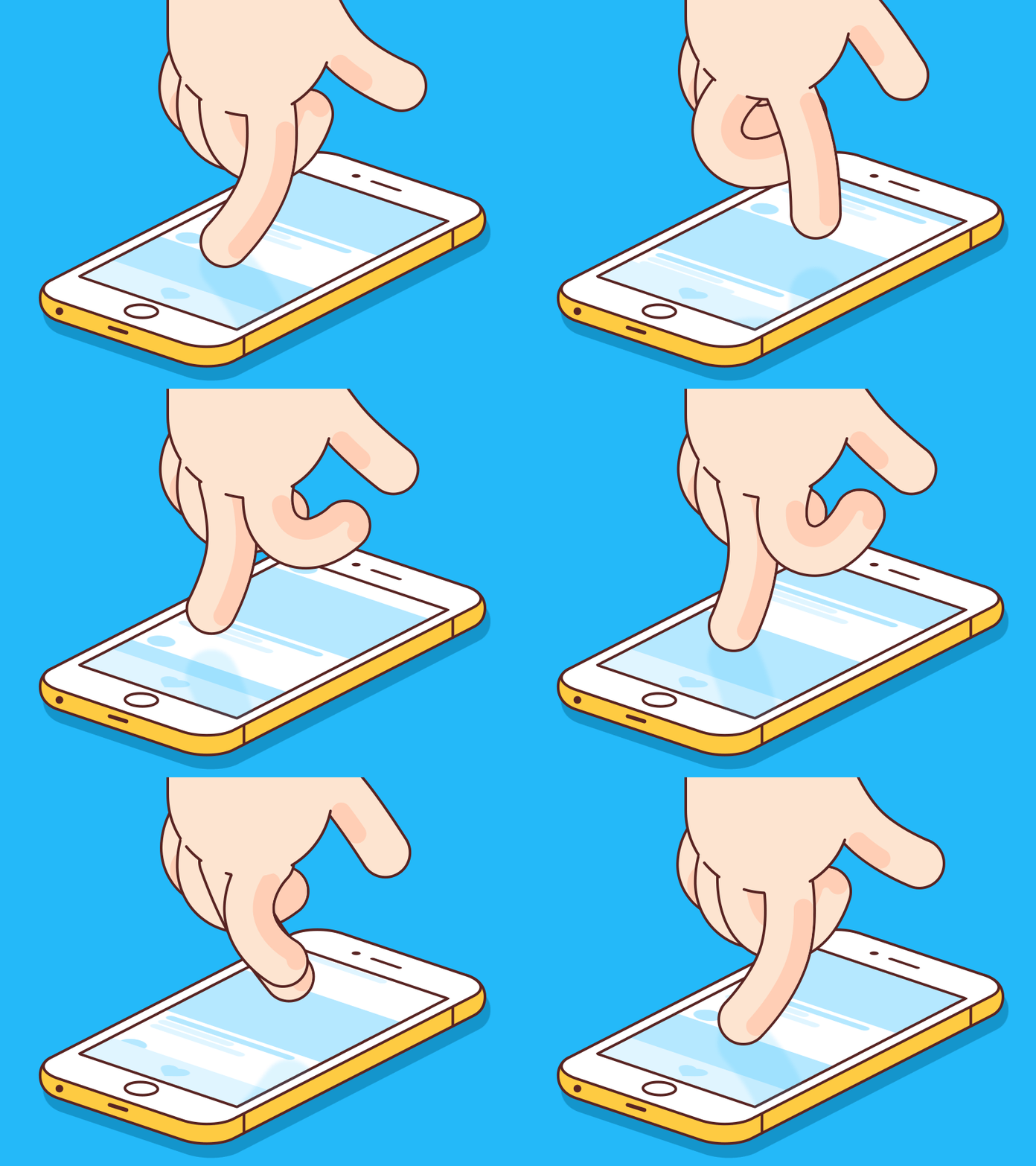
Infinite Scroll is a technique that loads more content as a user scrolls down a page, making it seem like it has no end. It is used by some modern digital — and popular — services such as Twitter, Tik Tok or Instagram. It allows you to continue scrolling indefinitely and it is usually referred as endless scrolling as it continuously loads more and more content — and never stops.
Infinite Scroll — Origins
Infinite Scroll was first devised and developed by Aza Raskin in 2006 whilst working at Humanized, a small user-interface company. The original article of its implementation can still be found here. It was later refined and further developed into a JavaScript plugin by Paul Irish. The idea was to replace a layout known as pagination, which is a traditional approach that breaks down large lists into several smaller pages which are typically numbered, with a more intuitive one. This pagination usually allows users to select individual and specific content — however, this concept is quite toilsome — as forces users to think too much about what to see. Actually, Raskin’s intention was to further humanize interfaces and make them easier to use with the Infinite Scroll — enhancing the user experience.
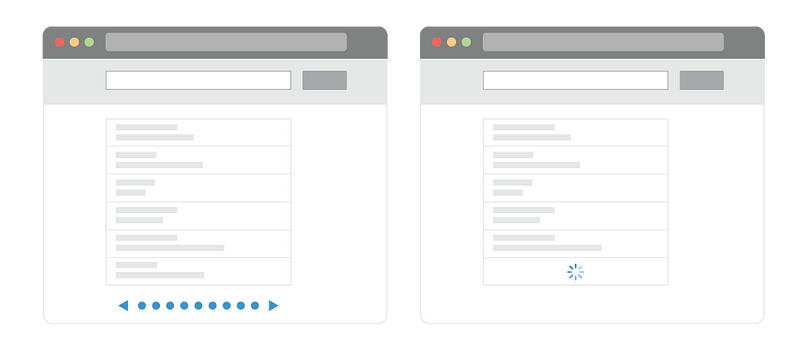
With this convenient feature, users can scroll seamlessly through posts or articles, rather than clicking through pages. Hence, it allows eliminating the need for page clicks, making content way more accessible to users.
He never foresaw the consequences this change would have.
With great power comes great responsibility
Pagination was a way to make users realize how much content they have consumed. The enhanced capability of the Infinite Scroll is totally opposite — it allows users to be consuming a digital service without realizing how much content they have already consumed. And this is one of the golden features of this brand new Infinite Scroll. Just like casinos do not allow natural light in — current social networks prefer not to remind you there is a life out of the screen. Raskin was featured in Netflix’s The Social Dilemma, which discusses how social media companies try to tweak their algorithms to squeeze out more engagement from their users. As Aza Raskin says, “if you don’t give your brain time to catch up with your impulses, you just keep scrolling down”.
A simple feature meant to enhance the online experience quickly became more than that — it turned into a persistent, widespread problem. The Infinite Scroll has become one of the best performing enhanced features to retain users attention — as it keeps on feeding new content, it encourages users to consume more and more. You can scroll endlessly without ever reaching an end.
Of course, the endless scroll itself is just one small enabling factor. Social media addiction would exist without it, but it would most likely be less pronounced.
Why is it so addictive?
The Infinite Scroll exploits a mental shortcut that many people naturally use — the unit bias. According to this theory, we humans are naturally motivated to complete a unit of something. We do believe that whatever amount we are given of something — it is just the right amount, so we finish it to gain satisfaction. The exact same thing happens with the Infinite Scroll — since the amount of content offered is endless, we continue browsing to consume it all.
Another important factor is that human nature seeks predictability and patterns. In their absence, we search for them as well. So, we pull to refresh. Rewards aren’t guaranteed, and most of the time, we don’t get anything remarkable. Just as we gamble, we keep refreshing in hope of a quick rush of dopamine. This rush is exactly what keeps you scrolling down through the content. It’s exactly the same as any addiction, be it drugs, alcohol or slot machines. One hit leads to another, and then to another — like a cycle where users are hooked on the continuous flow.
Research shows that creators intentionally design social media platforms to trigger addictive behaviors. These platforms aid habit formation by using the Hook model, which basically is made up of four phases — a trigger, action, reward and investment. And they do work. Hook models generate addictive feedback loops that keep users glued to their phones. When you see a notification, you’re prompted to check your social media, where you’re rewarded with a like or comment, so you’re motivated to keep watching for them.
Find Freedom at the end of the scroll
All in all, Infinite Scroll was first meant to be a huge leap forward user experience — and ended up becoming an addictive feature that increased dramatically users engagement — at the expense of their well-being. This shows perfectly that designing user experiences does come with a great responsibility — influencing people’s time and behavior is not something to take lightly. Infinite scrolling is still widely used in many applications, even though it’s proven to be addictive at best and harmful at worst. Hence, companies that use this kind of techniques to retain users’ attention, should be responsible for it and offer effective ways and tools to raise awareness among them.
For instance, both IOS and Android had performed some steps in this direction launching the Use Time and Digital Wellbeing respectively, which allow users to motorize and understand how much time they spend glued to their phones. However, without a previous user awareness about the problem, these improvements are not much of a help.
This is why, the next time you find yourself stuck in a digital consuming loop — be it on Instagram, Tik Tok or any other — just try to be aware of the amount of time you are spending. Try to ask yourself if that is worth it — or if it was your original intention. If the answer is a No, close the app and try to stop the loop. With a little mindfulness and self-control, you can break free from the Infinite Scroll’s grip and reclaim your time and attention.
Feel free to share your thoughts and experiences in the comments! ✨
Did you like this article? Then you can subscribe to my DataBites Newsletter to stay tuned and receive my content right to your mail!
I promise it will be unique!

You can also find me on X, Threads and LinkedIn, where I post daily cheatsheets about ML, SQL, Python and DataViz.
This is the first story of the series How design can hack your brain to share with you different ways and techniques that are usually used in modern digital services to increase users engagement, making us be glued to our phone — today’s turn was for The Infinite Scroll .
You can go check now the following stories about the Hook Model, Your Personal Slot Machine and Triggering Addiction.
Some other nice medium related articles you should go check out! :D


