
The Important Connection Between Instinct & Sexuality
Why we let Big Bad Wolves talk us out of what we know to be true
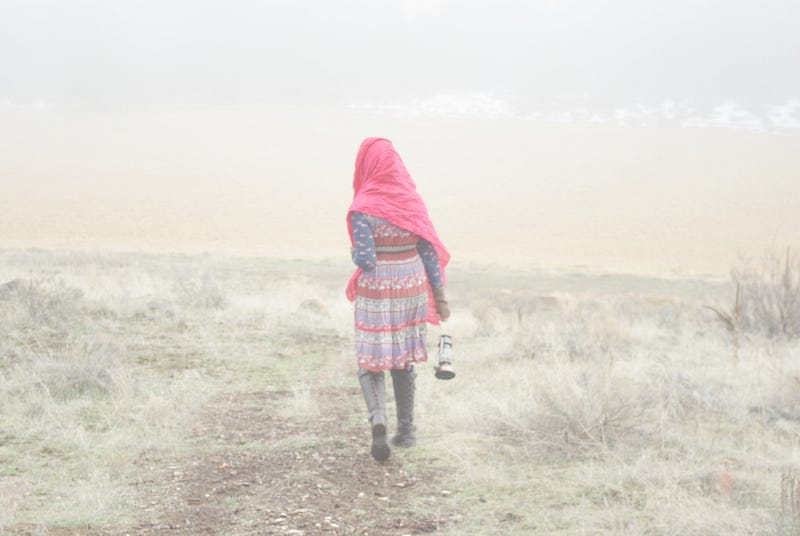

It is dark in the woods. Even though the sun has not yet fallen below the horizon, even with the full moon that is already rising in the sky, there are shadows everywhere.
She can see the path at her feet, but only a little ways ahead. The path to Grandmother’s house seems so far. So scary.
With determination, she pulls up her red hood and begins walking, her basket tucked at her side.
The darkness grows with every step. Very soon, she thinks she might have lost her way. The path seems unclear now, as if the greedy vines of the forest have tried to conceal it. A gentle fog rolls in.
A movement catches her eye and she takes in a frightened breath. A creature emerges from the shadows of the trees. Is this him? The fabled Big Bad Wolf?
Perhaps not, she thinks, as her eyes take him in. His coat is smooth and almost shiny. He moves without hurry, an easy sway to his gait.
“Can I help you find your way, young lady?” he asks, his voice smooth, not gravelly and severe as she would have guessed.
Something deep within her resists this. She doesn’t want his company. She’s not sure he can be trusted. “No, thank you. I know the way.” She says this with a tremble in her voice, for suddenly, she is not sure she knows the way, at all.
“Even so, surely you must know that there are dangerous creatures in these woods, always looking for easy prey. A lovely young woman like yourself would make them a fine meal. Wouldn’t you prefer to travel with a trusted companion? A protector?”
She keeps walking, that sick feeling inside her growing. She imagines what might be hiding in the shadows. She wants to tell this creature that she doesn’t trust him. How could she? They only just met. But she says nothing, for he has made such a generous offer and carries himself in such a dignified manner.
Perhaps, she thinks, she’ll remain silent, allow him to walk beside her. Just for a little while. What harm can it do?
A lovely young woman like yourself would make them a fine meal. Wouldn’t you prefer to travel with a trusted companion? A protector?
“There is a safer route,” he says, when they come upon a fork in the path, a path that seems ever harder to follow in the underbrush, in the fog. “It’s true that way is a bit faster, but it’s filled with the most terrifying creatures you can imagine. Filthy, violent animals that might — forgive my indelicacy — rip you to pieces.”
“I don’t know this path,” she objects, that feeling inside her swelling now, her whole body thrumming with it. She wants to lie down on the ground, cover her head with her arms. She wants to be left alone. But how can she say such a thing to a companion who has been so patient and kind, who has been looking after her so well?
“I know it well,” he whispers, reassuring. “Do not be frightened by the darkness. I will see you safely through it.”
She doesn’t want this. She doesn’t want it.
But he takes her hand and leads her into the shadows.
Perhaps, she thinks, she’ll remain silent, allow him to walk beside her. Just for a little while. What harm can it do?
It is so dark down that path. She can’t see anything but the shadows that shift and bend, as if reaching out toward her. There are strange sounds here. Soft whooping noises, shrieks, growls, and caws. The wind makes an ominous sweep against her body, pulling at her cloak.
“I don’t like this,” she says, pulling her hand away. She’s desperate. Afraid.
The creature reaches out for her again, blocks her retreat. “My dear, you have nothing to fear. I told you, I will protect you. Your destination is just ahead.”
Her body is screaming. Something is wrong. But she can’t quite figure out what it is. She dares to speak — dares to share her feelings. “I don’t know if I can trust you.” It is the one thing she knows she should not say.
He doesn’t seem offended, though, and he smiles, his sharp teeth white and shiny. “The woods can be a confusing place. So many shadows. So much darkness. It’s easy to lose your way. It’s easy to lose sight of what’s real. Can you not trust what your eyes see? Can you not trust what your ears hear? Can you not understand that I am helping you?”
She feels ashamed now. What is wrong with her? Why is this feeling of discomfort growing in her belly when all evidence would have her believe that she is safe? That this creature is her protector?
“I’m sorry,” she says, forcing herself to master her body, to control the queasiness that refuses to subside.
“Come now,” he says, holding a hand out to her.
Her body is screaming. Something is wrong. But she can’t quite figure out what it is.
They walk in silence for a spell, the path becoming ever more imperceptible. Eventually, the underbrush conceals it, entirely. She looks to the creature at her side, uncertain, but he walks purposefully forward, elegantly navigating the uneven ground, smiling with reassurance.
Eventually, they come to a briar patch. The way is blocked.
She feels so sick now, she almost wants to throw up. But still, she refuses to be overcome by emotion. She refuses to behave rashly.
“We have to go back,” she says, unable to hide the dismay from her voice. She tries to keep a hopeful edge to it to make sure her companion knows she is not without gratitude, even though inside, she is angry that she didn’t insist on taking the path she knew.
She turns and finds the creature stretching in a low crouch. His once-friendly eyes now glint threateningly in the light from the moon. His smile has transformed into what looks like a snarl.
“What are you doing?” she asks, the fear in her stomach now overcoming her, making her voice tremble. She stumbles backward into the briar patch.
“Don’t worry, my dear,” he says in a low voice. “This will only hurt for a moment.”
Little Red Riding Hood is my favorite fairy tale. Though there are many variations on this story, to me, all of them describe the relationship a woman has with her sexuality.
In this version, a slight spin on the Charles Perrault version entitled Le Petite Chaperone Rouge, our young heroine ignores warnings about predators and her own instincts and becomes the victim of the Big Bad Wolf.
This is a story that every woman knows — because we have all lived it. Our culture has systematically tried to distance us from our instincts. This has been accomplished by the manipulation of female sexuality. Our sexuality is shamed and demonized in one moment, then demanded and expected in another.
When a woman’s sexuality becomes a tool of patriarchal manipulation, when it is taken from her and used to control her and other women, it creates a schism between a woman’s body and soul. When that happens, we start to forget our instincts and intuition.
Our culture has systematically tried to distance us from our instincts.
Even more tragically, when we are able to recognize the most primitive messages our body gives us, we are talked out of our own knowing — and often even shamed for expressing that knowing. When we dare to speak and say that we know, despite all evidence to the contrary, something is wrong, we are laughed at, dismissed.
Nothing is so dangerous as that moment in which a woman chooses to ignore her instincts.
In my work, I have rewritten Little Red’s story many times. In my stories, Little Red is strong, confident, and deeply connected to her sexuality. To me, her wandering and her trust in the wolf are not just the actions of a foolish young girl. They represent her curiosity, her passion, her desire to merge the wildness outside her with the wildness within her. In that version, I see her seeking out the Big Bad Wolf, becoming his lover, exploring who she really is, and growing into a powerful, wild woman.
But I have one other version of that story that is, perhaps, my favorite. I believe Little Red is the wolf. In the traditional tales, she has been separated from her wild self and the wolf eating her represents her becoming whole again — the return to her wild state. In my own version, the Big Bad Wolf is scared of her — because she’s bigger and badder.
There is no one, after all, wilder and more beautiful and terrifying than a woman who knows her own wildness, who trusts her own instincts, and who follows her own path.
This article was written for Howl by Yael Wolfe, a weekly column. © Yael Wolfe 2020

More instinct from Howl by Yael Wolfe:


