
The Hollow Promises of Online Readership
Exposing the Disparity Between External and Internal Views

Did you know that despite the captivating allure of online readership and viral fame, there’s a hidden truth that shatters our expectations? In today’s ever-expanding digital landscape, where the pursuit of these consumes the aspirations of many writers, a troubling truth hides beneath the illusory surface, exposing a significant gap between the number of people who discover our content from external sources and those who engage with it internally on the platform. This revelation challenges the misleading allure of online readership, revealing its inability to meet our expectations.
Let’s go back to January 24, 2022, when I published an article titled,
The article seemed poised for success. Its catchy title and thought-provoking subject matter, resonated with a broad audience, resulting in a significant number of external views.
However, as we delve into the cold embrace of statistics, a disheartening reality emerges. Out of the total 2.4k views, only 46 readers accessed the article internally, representing a mere 2%. In stark contrast, a staggering 98% of the views were driven externally.

In this realm of digital smoke and mirrors, the discrepancy between external and internal views exposes the harsh reality of online readership. Despite the illusion of massive exposure, the internal readership on the platform fell dramatically short, leaving minimal engagement and earnings.
But the injustice doesn’t end there. Adding insult to injury, is the article’s confinement behind the platform’s paywall, denying any recognition or benefit for the 2.4k viewers it enticed to explore its content. These readers aren’t even presented with my referral link. A general sign-up option is provided instead.
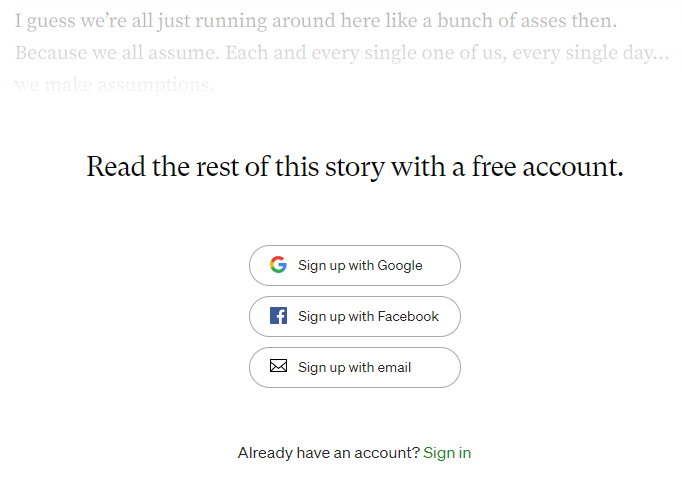
The platform reaps the rewards while my efforts to attract new members go unnoticed and unrewarded, leaving a bitter taste of injustice.
In today’s digital market, where online success is often measured by numbers, a troubling reality emerges. It’s a world where writers work tirelessly to attract readers to platforms, but receive no recognition or reward for their efforts in bringing potential new subscribers.
This obvious disparity raises important questions about the fairness of relying solely on external sources for content distribution. It highlights the injustice of a system that benefits from writers’ hard work. It raises fundamental questions about the value placed on writers’ efforts and the recognition they deserve.
As we delve deeper into the challenges of online readership, it becomes apparent that these issues are not isolated to the digital realm alone. The struggles faced by online writers mirror the ongoing writer’s strike in other domains, such as the entertainment industry. Both scenarios involve writers striving for fair compensation, recognition, and improved working conditions. The writer’s strike, driven by the Writers Guild of America (WGA), is a tangible example of collective action taken by writers to demand their rights.
By exploring the similarities between the online writing industry and the writer’s strike, we gain a comprehensive understanding of the systemic issues plaguing writers in various fields. It is through this lens that we can further advocate for change and strive for a more equitable ecosystem that benefits all writers.
Historically, writer’s strikes have had a significant impact on the industry. For instance, the 2007 strike lasted for 100 days, while the 1988 strike endured for a record-breaking 153 days. The current strike, driven by the Writers Guild of America (WGA), aims to secure a deal that ensures the viability of writing as a profession.
The WGA has expressed its preparedness to continue the strike until their demands are met. Industry analysts have even suggested that the strike could last for a minimum of three months.
Negotiations between the WGA and the Alliance of Motion Picture and Television Producers (AMPTP), which represents the studios, broke down on May 1. Since then, both parties have released statements highlighting the significant differences in their positions on key issues, including the adoption of artificial intelligence (AI) in the industry. Currently, there is no scheduled date for the resumption of negotiations.
The strike’s duration could have severe consequences. If it extends until at least September, it would significantly impact the fall television season, resulting in the postponement of popular shows. Additionally, studios may exercise a provision called force majeure, allowing them to cancel deals disrupted by events beyond their control. This could lead to the termination of contracts and further financial strain on writers.
The situation remains uncertain, and the duration of the strike is subject to various factors. The outcome could range from a resolution in mid-July, presenting the best-case scenario, to a protracted strike lasting until fall or even into the holiday season. The involvement of other unions, such as the DGA and SAG, could also influence the trajectory of the strike.
Should online writers consider joining the WGA writer’s strike? Participating in collective action may help raise awareness of the challenges they face, demanding fair compensation, improved working conditions, and greater recognition for their craft.
While such a decision is not without its complexities, joining a writer’s strike can serve as a powerful statement. It can shed light on the systemic issues plaguing the online writing industry, challenge the status quo, and push for meaningful change that benefits all writers. By standing in solidarity with fellow writers, online writers can advocate for fairer practices, demand transparency in platforms’ algorithms and revenue-sharing models, and ensure that their hard work and dedication are duly rewarded. Together, they can shape the future of online readership and foster an ecosystem that values and supports writers.
The glaring contrast between external and internal views exposes the need for a more equitable approach. Writers deserve acknowledgment and fair compensation for their ability to attract and engage new readers to the platform. It’s time to shift the paradigm and create a system that values and supports writers, ensuring they receive the recognition they deserve for their efforts.
While it may be challenging to determine the best solution, it’s undeniable that the current process is leaving many writers dissatisfied and frustrated as I continue to come across more and more articles complaining about the current system. How can we bridge this gap and foster an environment that guarantees writers fair compensation and recognition? What changes would you like to see implemented? By engaging in open dialogue and collectively taking meaningful steps, we can ignite a transformative conversation and cultivate an ecosystem that is truly equitable and supportive for all writers. Together, let’s pave the way for positive change.
If you enjoy reading my Flights of Fancy, or as I like to call them, Flights of Phoenix, and want to support me as the entertaining writer that I am, please consider leaving a tip or signing up to become a Medium member. It’s only $5 a month, giving you access to unlimited stories on Medium (and all of mine). And if you sign up using my link, I’ll even earn a small commission. Woohoo!
Love you all !!


