
The historical collapse of the “Black Gold”
The demand shock created by the pandemic has seen Crude Oil slide but today’s move was one for the history books
Crude Oil, which is often referred to as the “Black Gold,” has driven the industrialization of the global economy in the late 19th and most part of the 20th century. Continued heavy reliance on fossil fuel, however, has not only raised environmental concerns but rapid automation in the last two decades had set in motion a paradigm shift towards a more sustainable future powered by renewable resources.
Countries mostly reliant on the commodity had begun to move away from it too, but nobody could have predicted such a collapse for Crude Oil as we saw today. A case in point is the Kingdom of Saudi Arabia, which had recently launched the IPO of its mega oil company — Aramco. Four years in the making, the move was precipitated by the 2030 vision of the kingdom diversifying the economy away from its over-dependence on oil.
What an ironic turn of events for Aramco — the World’s most profitable and the third-largest company by revenue. After becoming the first public company in the world to reach a $2 trillion valuation, it saw the underlying asset plummet to almost zero today.
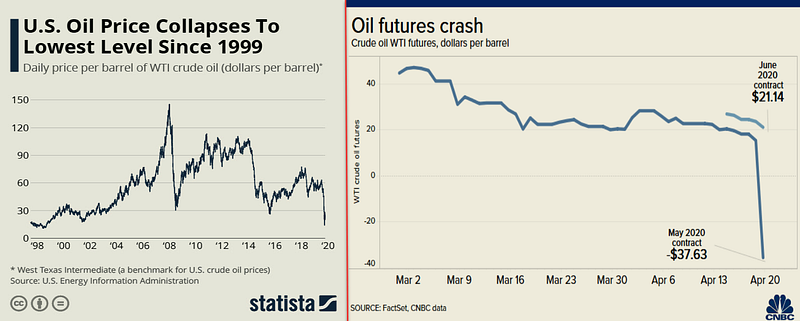
While Oil has been on a steady decline ever since it peaked just before the last financial crisis of 2008 (left chart below), nobody could have predicted that a black swan event would eventually provide the final blow to the commodity. Now, I am not presuming that this is the end of the story for Oil, but it’s certainly the beginning of the end.
“The real problem of the global supply-demand imbalance has started to really manifest itself in prices. As production continues relatively unscathed, storages are filling up by the day.”
~ Rystad Energy’s head of oil markets Bjornar Tonhaugen
The recent downtrend in Oil prices started as the COVID-19 pandemic started to spread aggressively across the globe, shutting down economies. As the demand sank for the commodity creating a supply glut, a price war between Russia & Saudia Arabia on top, further complicated the problems for Crude. Although the OPEC+ group was able to resolve the differences by announcing a production cut of 9.7 million barrels/day, it was too little too late.
Today was the day when the drama was set to unveil. Early Asian trading saw Crude prices losing 25% of its value. As the North American markets opened, it started to shed further before going into a free fall and dropping to zero in the afternoon session. In fact, future contracts of West Texas Intermediate oil (WTI) fell more than 100% to settle at negative $37.63 per barrel (right chart above) — which meant that producers would pay traders to take the oil off their hands!
These future contracts in question were set to expire tomorrow, however, the problem is that there’s literally no room to store the oil that will accumulate unused next month, so no one is willing to pay to store it. They’d rather pay you to keep it. But don’t envision a fossil fuel apocalypse just yet as October WTI futures contract sold at $34 per barrel today — a clear sign for the demand of the commodity in the Fall.
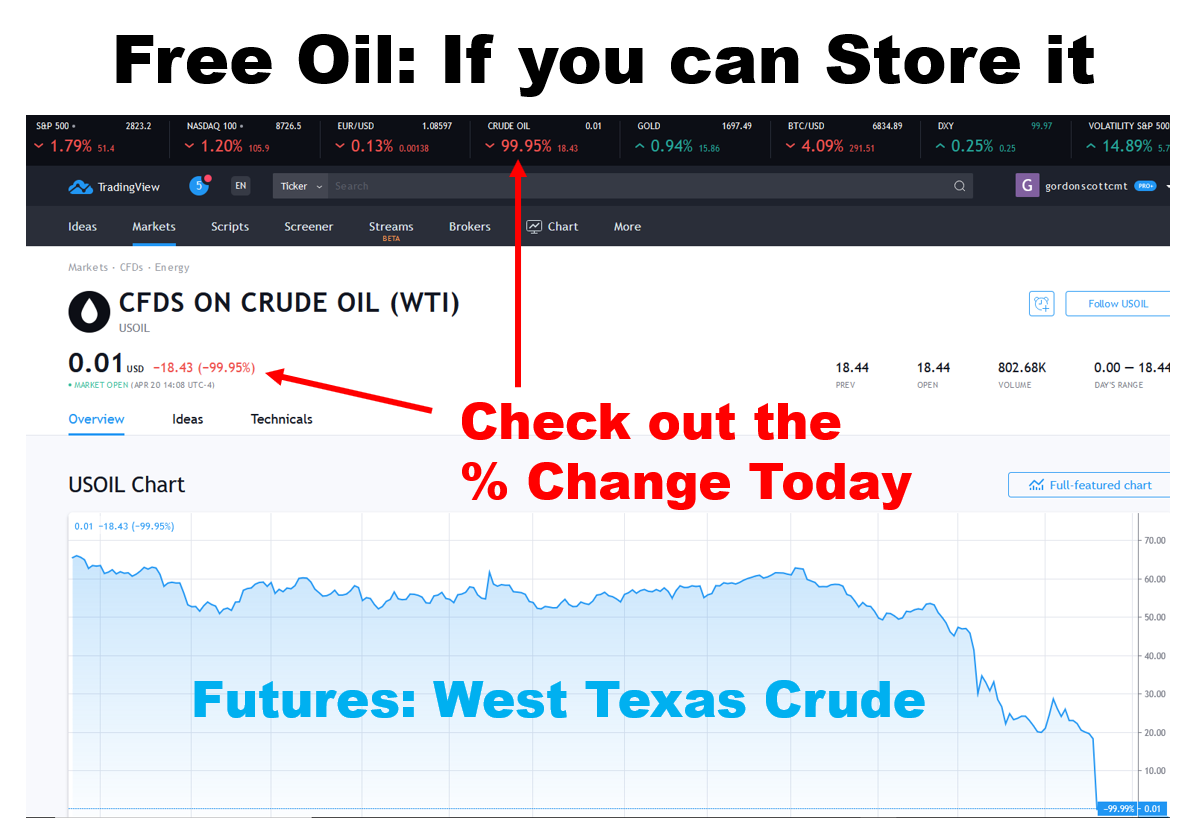
Despite being a shocking and unprecedented event, the extreme price action in Crude oil was more of a market anomaly. The event was big enough though, to drag the whole market with it as U.S equities lost all the momentum from last week with a jump of 15% in volatility.
Current price action with the hope of resumed economic activity later this year has created a market condition called contango — which dictates of higher commodity prices in the future than they are in the present. While this may be a sign of relief for the commodity in the short term, the recovery would be slow and painful with a lot of unknowns in the way. The Long term prospects for the commodity still remain bleak.
:max_bytes(150000):strip_icc():format(webp)/Contangojpg-76a2b4fec0ed4f78baf145461ff033f6.jpg)