
The Higgs Boson: A Key Part of the Standard Model of Particle Physics
Understanding the “God Particle” and Its Role in the Universe
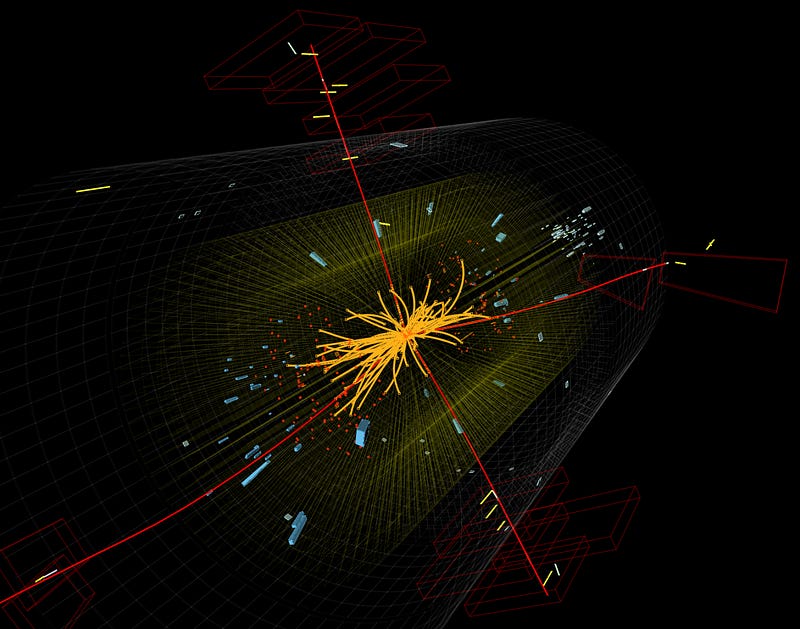
The Higgs boson is a subatomic particle that was discovered at the Large Hadron Collider (LHC) at CERN, the European Organization for Nuclear Research, in 2012. It is named after physicist Peter Higgs, who proposed its existence in 1964 as a way to explain why certain particles have mass.
The Higgs boson is a key part of the Standard Model of particle physics, which is a theory that explains how the fundamental building blocks of the universe interact with one another. According to the Standard Model, the Higgs boson is the carrier of the Higgs field, which is a field of energy that permeates all of space. When other particles pass through the Higgs field, they acquire mass.
As Higgs himself stated,
“The Higgs field is a bit like a snowfield. You can walk easily across a snowfield, but if you try to push a snowball through it, you have to push harder because the snow offers resistance.”
The Higgs boson was famously referred to as the “God particle” in the popular press, due to its central role in the Standard Model and the fact that it took many years and a massive international effort to discover it. The LHC, which is the largest and most powerful particle accelerator in the world, was built specifically to search for the Higgs boson and other exotic particles.
Detecting the Higgs Boson
Finding the Higgs boson was a major milestone in the field of particle physics, as it confirmed the existence of the Higgs field and helped to validate the Standard Model. However, the Higgs boson is just one piece of the puzzle, and there is still much that scientists do not understand about the universe. For example, the Standard Model does not account for dark matter, which is thought to make up most of the matter in the universe, and it also cannot explain the observed asymmetry between matter and antimatter.
Despite its importance in the Standard Model, the Higgs boson is not easy to detect. It is extremely short-lived and decays into other particles almost immediately after it is produced. This makes it difficult to measure directly, and scientists have to rely on the signatures left behind by its decay products to infer its existence.
At the LHC, the Higgs boson is produced in high-energy collisions between protons. When these collisions occur at the right energy, they can create the conditions needed for a Higgs boson to be produced. However, these conditions are rare, and the Higgs boson is produced only a few times per billion collisions.
To detect the Higgs boson, scientists at the LHC use detectors that are designed to measure the particles produced in these collisions. By analyzing the data collected by these detectors, they can determine whether a Higgs boson was produced in a particular collision and how it decayed.
The Significance of the Higgs Boson
The discovery of the Higgs boson was announced on July 4, 2012, and it was a major milestone in the field of particle physics. It confirmed the existence of the Higgs field and helped to validate the Standard Model, which is the most widely accepted theory of particle physics.
However, the Higgs boson is just one piece of the puzzle, and there is still much that scientists do not understand about the universe. For example, the Standard Model does not account for dark matter, which is thought to make up most of the matter in the universe, and it also cannot explain the observed asymmetry between matter and antimatter.
Despite these limitations, the discovery of the Higgs boson was a major achievement that has helped to deepen our understanding of the universe and the fundamental building blocks of matter. It is a testament to the power of science to unlock the mysteries of the universe and to make new discoveries that have the potential to revolutionize our understanding of the world around us.
In the words of CERN director general Rolf Heuer,
“The discovery of a particle consistent with the Higgs boson opens the way to more detailed studies, requiring larger statistics, which will pin down the new particle’s properties, and is likely to shed light on other mysteries of our universe.”
As we continue to study the Higgs boson and the Standard Model, we may uncover new insights into the nature of the universe and how it works. Who knows what other amazing discoveries are waiting for us on the horizon?


