
The hidden true identity of Christopher Columbus
He went down in history as Christopher Columbus. However, this was not his name. He also did not come from Genoa, but from the Greek island of Chios. He hid his identity because he was afraid of… assassins sent by the Sultan!
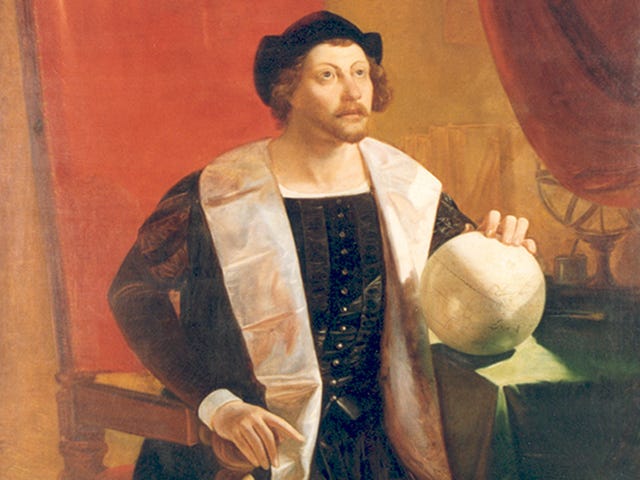
Surprisingly, among the earliest sources on Columbus’s life — and these included letters, chronicles, and studies by as many as 26 authors who were contemporaries of Columbus or who lived shortly after his death — none wrote where exactly the explorer came from. And yet at least a few of them knew him personally and corresponded with him.
Chroniclers describing where he came from often give conflicting information. Once that he came from Italy, or perhaps from Ligeria. It is also often said that he came from the Genose nation.
Who was Christopher Columbus: a Greek clue
The fact that in 1493 the Pietro Martire wrote about Columbus “the man from Liguria”, and later others repeated it, created a pride in the people of the region. They erected monuments to the explorer in town centers, boasting of the famous sailor. Not surprisingly, the information given by Martire went around the world — documents show that many families with the surname Colombo lived in Genoa. However, there is no reason to believe that they were related to the famous sailor. Oberto Foglietta, in a 16th century chronicle containing the names of prominent families from Genoa between 1100 and 1527, does not record any important Colombo (although there are now forgotten sailors like Admiral Biagio D’Assereto and Captain Lazaro Doria).
The historian Agostino Giustiniani, in his “Psalter” (1516), maintained that Columbus was “a Genoese, born of parents of low estate.” This formulation was not accepted by the sailor’s son Ferdinand. He criticized Giustiniani that he was a “false historian, known as an imprudent and biased scholar and a malicious one”.
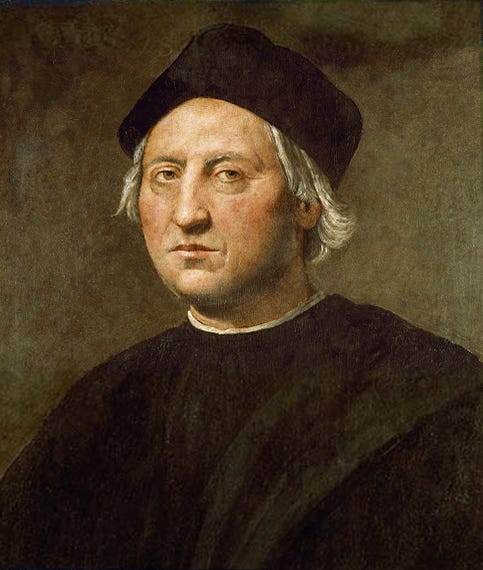
Ferdinand decided to find a family himself. However, he met with disappointment when he began to scour Liguria in hopes of reaching his relatives. He found no one, although at the time of his visit, for example, Bianchinetta Colombo, daughter of the aforementioned poor weaver Domenico — that is, Ferdinand’s supposed aunt — was living in Genoa. Not only did Columbus’ son not look her up, but he looked for relatives in other regions: neighboring Emilia-Romagna and even further afield in Veneto. Without success.
The Genoa authorities themselves seemed confused by the fact that there was no evidence of the famous explorer’s ties to the city. Indeed, in a letter to their ambassador to Spain in 1586, they argued that Columbus came from the nearby village of Cogoleto. But this, too, turned out to be an unconfirmed clue.
Yet Columbus’ contemporaries, who wrote of him as a Genoese, may have been somewhat correct. The sailor might have come from the Greek island of Chios, which was under Genoese control for two centuries (1346–1566).
Chios: “The Right Eye of Genoa”.
The arguments in favor of this theory were collected — analyzing the sailor’s notes and other historical documents of the time — by Professor Ruth Durlacher-Wolper, director of the New World Museum San Salvador in the Bahamas (author of the book “A new theory clarifying the identity of Christophoros Columbus”). According to the researcher, Columbus is actually the son of Byzantine nobleman John Paleologus Dishypatos, born in 1439. The mother of the discoverer of America was Maria Sacoma-Colom of a merchant family from the Catalan city of Girona, who moved to Chios in the early 15th century. This Colom is a Catalan form of the surname Colon, like the Italian Colombo or Greek Kolombos.
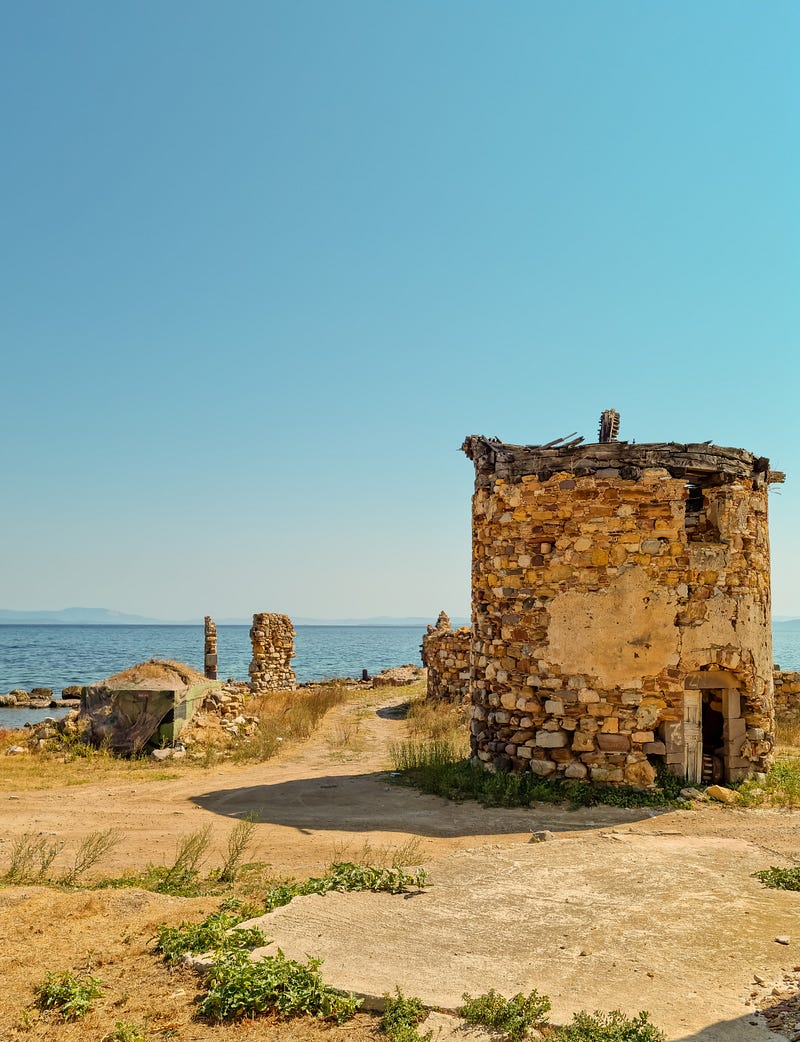
The tradition about the origin of the sailor from Chios is cherished by the inhabitants of the village of Pyrgi in the south of the island. They even show the house where the discoverer lived. I should add that the sailor’s tomb in Seville bears the inscription that he came “from Terra Rubra”, or “red soil”. His son Ferdinand explained in his “History of the life and illustrious affairs of the Admiral don Christopher Columbus” that he “saw the same words in don Christopher’s signature before he obtained the title of Admiral”. As it happens, the lands of the southern part of the island of Chios near Pyrga are indeed red… Just why would Columbus conceal that he was of Greek descent?
A secret to save lives
The reason was the fall of Constantinople on May 29, 1453, when most of the courtiers and nobles, fighting alongside the emperor, died defending the city walls. Others were massacred by the triumphant Muslims.
Among those who died after the incursion of the Ottoman army were many members of the Dishypatos family — related to the Paleologian dynasty that ruled Byzantium. The last emperor Constantine XI had no direct heirs. However, the sultan wanted to make sure that all male members of the family were either under his control or had been eliminated from the game beforehand. After all, relatives of the Byzantine dynasty would have been ideal candidates to lead the crusade to retake Constantinople from Turkish hands. This would explain why Columbus had to hide from the sultan’s henchmen. Many Paleologists changed their “personal information” in 1453 to avoid death or capture by the Ottomans. Columbus changed them too, about which his son Ferdinand wrote: “He thus inadvertently adopted the name Colón, renewed [after his ancestors]”. After his ancestors, actually his mother, Maria Sacoma-Colom.
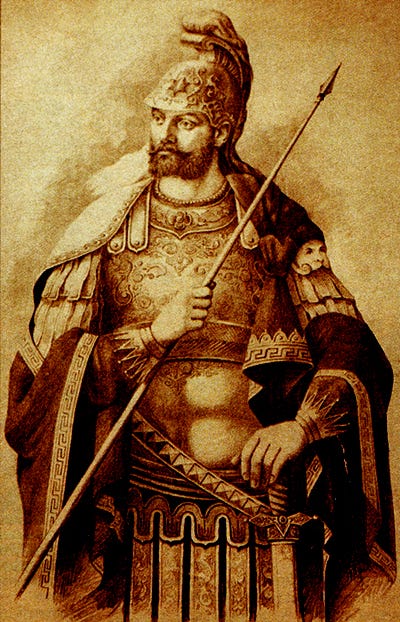
Ferdinand was aware that his father had changed his name, but he was unaware of his roots. He knew about his ancestors that “they were noble people and only because of wars (…) they fell into poverty and deprivation”. The words of the chronicler Bartolomé de Las Casas — whose father accompanied the admiral on his second voyage — that the sailor’s parents were “people of noble birth, wealthy at one time, who had to engage in maritime trade and make a living from it” can be interpreted in a similar way. This fits with the stories of John Paleologus Dishypatos and Maria Sacoma-Colom. Unfortunately, historians do not know what happened to them on Chios, there the trail is lost. Columbus, on the other hand, left the island and joined a sailor who, it turns out, also came from a Byzantine family.
Colon meets Colombo
Ferdinand wrote in the “Acts of …” that after leaving Chios his father found himself under the care of a certain husband “of excellent name and family, named Colombo”. This sailor, with whom Columbus sailed for a long time, “was called ‘Colombo junior’ to mark the difference between him and another Colombo, who had previously been famous on the seas.”
Let me put in order those sailors with similar names and nicknames. We have three of them: Columbus, his protector “Colombo junior” and the older one “senior”… Today we can say that the “junior” was a certain George the Greek, or rather George Paleologus de Bissipat. He is a relative of the discoverer of America, because Bissipat is a Gallicized version of the Greek name Dishypatos. However, the nickname “Colombo junior” probably came to him not because of any connection with the Colom family, but because of his friend, the French corsair Guillaume de Casenove, with whom he served in the rank of lieutenant. The Frenchman used the nickname “Coullon”, from the name of one of his ships — “Colomb” (French for “pigeon”). The corsair “Coullon/Colomb” and his second-in-command stuck together. Thus, the French commander could become “Colombo senior” for observers, while the Greek lieutenant became “Colombo junior”.
Columbus, or Colom/Colon, fit into this group like a glove. As a relative of George the Greek, he could count on his help. Besides, identification with a Byzantine family gives new meaning to Ferdinand’s recorded thought of the discoverer of America: “I am not the first admiral in my family”. Because then he would have among his ancestors such great sailors as George Paleologus (who commanded the Byzantine fleet in the late 12th century), Emmanuel Paleologus (who defeated the Turkish fleet in 1410), Messih-Pashas Paleologus (who converted to Islam and became an admiral in the Turkish fleet), or Dimitrios Laskarys Leontaris (who remained in the service of Emperor Manuel II Paleologus).
The riddle of a ruler’s confidence
Such a pedigree and fate for Columbus would explain why, in 1472 — twenty years before his discovery of the New World — the French king René of Andegavia had taken advantage of his services. “On one occasion it happened that King René,” Columbus admitted, as quoted by his son in the “History of…” — “He sent me to Tunis to arrest the galleas of Fernandina”. Capturing an enemy ship does not seem to be a mission for some descendant of a poor man from Genoa! In the 15th century, a career in the American style of “from pony to millionaire” was possible (if only for merit on the battlefield), but Columbus literally jumps out like a rabbit from a magician’s hat. He hasn’t accomplished anything yet, and he is received by the king of France, and soon after at the courts of the rulers of the Iberian Peninsula! It’s as if today some average American got in front of Barack Obama at the White House and offered to settle the pole.
And if Columbus had only let his imagination run wild in his memories, how would he have managed to marry into one of Portugal’s most prominent families, the Bragança-Norona, in 1487? If this marriage had occurred after the discovery of America, one could understand the misalliance of an aristocrat with the son of a Genoese weaver. But this was 5 years before the successful first expedition to the New World! Only Columbus’s good ancestry — e.g., blood ties to the last emperor of Byzantium, revealed to the chosen one and his family in the most secret way — also explains this mystery.
The secret method
Columbus’ Byzantine roots may also be indicated by the fact that during his expedition to America he measured with a certain — as he expressed himself — “secret method”. For a long time no one was interested in what he meant. Later it was assumed that he simply double counted the distance: one true for his own use, the other false for the crew — so as not to frighten people that they sailed so far from land. That was the secret. But because he overestimated the speed of his ships, his “false” data was closer to reality than the “real” data — at least according to the sailor’s biographers.
After checking the real logbook of the First Voyage, it was found that Columbus’ calculations of the distances travelled were exaggerated by 9 percent on average. A mistake?
Not necessarily. If we assume that Columbus did not use the Roman mile (1480 m), which was common at the time, but instead used the Greek mile (1388 m), then his calculations were correct! And the use of such a measure by a navigator coming from a Greek sailing environment is logical. In the Middle Ages there was a lot of confusion and arbitrariness concerning measurements. Here is one of many examples. According to Giovanni da Uzzano and his “La pratica della mercatura” of 1442, 4 small nautical miles constitute a legua, which was therefore 4800–5000 m. However, according to popular opinion, the legua (leuca — lieu) at the time of the great discoveries was 5920 m and consisted of 4 Roman miles of 1480 m each.
If Columbus assumed that someone would take his Greek mile for a Catalan mile (after all, he was sailing under the Spanish flag), he would have made his way to the New World even more confusing on purpose. In this way, he not only protected himself in case the diary fell into the wrong hands (e.g. Portuguese), but also secured his position at the court of the capricious Spanish rulers.
Truth in the margins
Interestingly, Columbus sometimes made notes in the margins of the books he read in Greek (his supposed “native” Italian was not even used in his correspondence with his brother, although it was used for that purpose at the time). And also the Greek origin of the explorer is indicated by the way he signed his name. In many letters Columbus put the Greek letter X at the bottom right of the page. It could stand for the island of Chios — in Greek spelling Xio.
It was not an abbreviation for Christopher, because he spelled it in another strange way, like a rebus.
: Xpo FERENS./
It is a Latin-Greek combination that can be read as Christoferens Kolon. The first segment is a weirded out form of writing the name Christopher. It emphasizes that it means “bearer of Christ.” Saint Christopher carried little Jesus across the river — perhaps Columbus considered it his mission to carry the Christian faith across the ocean. The second part of the rebus, the surname after the mother, is expressed by punctuation marks on both sides — the symbols of a colon and a period with a slash, called colons in Greek.
Who was Christopher Columbus? The explorer deliberately concealed his true identity. This is confirmed by his son:
“Our Lord willed that (…) the Admiral’s homeland and his origin should be so much less certain and known, as that his person should be more meritorious and honored with all that was due to it for such wonderful deeds.”
The conclusion? Columbus did not pretend to be Greek, he was.
A forgery?
The document in which Columbus admits one and only once that he was born in Genoa is not an original. Probably it is a copy of the “will” allegedly made by Columbus in Seville in 1498. However, the name of the notary is not to be found on this copy, and yet with the sailor’s inheritance a fortune was at stake! Meanwhile, no one has certified that the copy is a true copy of the original. There is not even the signature “Christoferens”, but “El Almirante” (The Admiral). And as researcher Manuel Rosa notes, Columbus was always very concerned with legal formalities. There is only one conclusion: the “will” was fabricated by someone to maintain the non-existent relationship between Columbus and Genoa when the game of the sailor’s inheritance began.
Cool that you made it to the end of this article. I will be very pleased if you appreciate the effort of creating it and leave some claps here, or maybe even start following me. Thank you!


