
The ‘Hidden Figures’ Of Quantum Mechanics
Physicists whose contributions to the development of modern quantum theory are often overlooked
We’re not going to talk about Bohr, Heisenberg, Einstein, or Planck. This article tributes those brilliant scientists who are often overlooked, or at least, whose contributions to the modern quantum mechanics are often overlooked, especially in the domain of science communication and media. Quantum physics is the science of the very small, where the rules of classical physics no longer apply and new phenomena emerge. It has revolutionized our understanding of nature, from the structure of atoms and molecules to the origin of the universe. Quantum physics is also the basis of many modern technologies, such as lasers, superconductors, semiconductors, and nanomaterials. However, the discipline is also notoriously hard to grasp and interpret, as it challenges our common sense and intuition about reality. Physicist Niels Bohr once said, as mentioned by Werner Heisenberg in his 1971 book Physics and Beyond,
“Those who are not shocked when they first come across quantum theory cannot possibly have understood it.”
Quantum physics is inherently probabilistic, meaning that it does not give definite answers to physical questions, but only probabilities of possible outcomes. It also implies that physical systems can exist in superpositions of two or more mutually exclusive states, such as an electron being in two places at once, until an observation is made and the system collapses into one definite state. This phenomenon, known as the wave-particle duality, challenges the classical notion of reality as objective and deterministic.
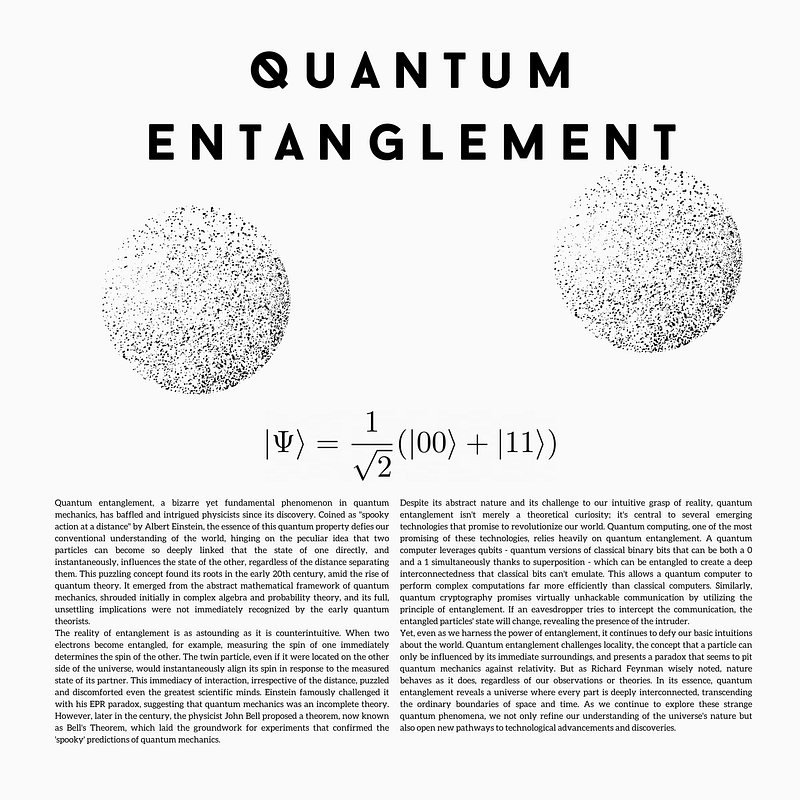
Another difficulty is that QM predicts that two physical systems that have interacted in the past can remain entangled, such that their states are correlated even when they are separated by large distances. This phenomenon, known as quantum nonlocality, violates the classical principle of locality, which states that physical influences cannot travel faster than light. Quantum nonlocality also raises questions about the nature of causality, information, and reality in physics, and has led to paradoxes such as the Einstein-Podolsky-Rosen (EPR) paradox and the Schrödinger’s cat paradox.
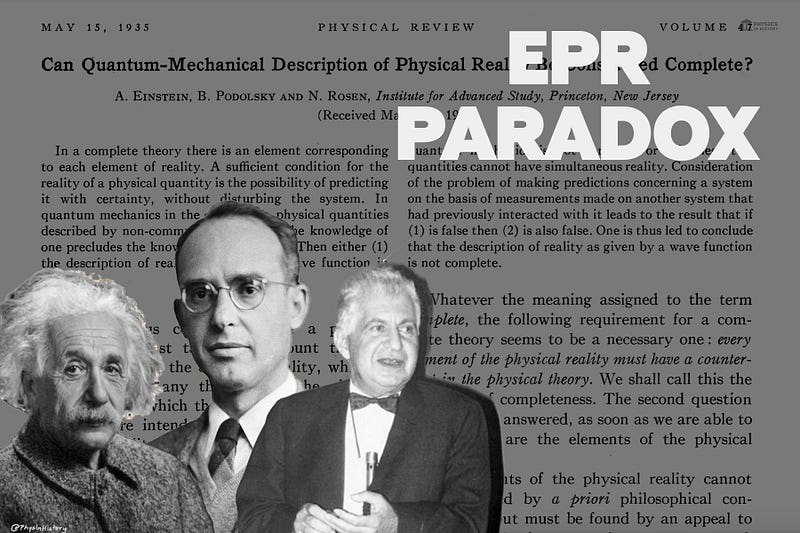
Given these difficulties and paradoxes, quantum physics has been the subject of intense debate and controversy among physicists and philosophers since its inception in the early 20th century. Different interpretations of quantum physics have been proposed to resolve these issues and to provide a coherent and consistent picture of the quantum world. Some of the most prominent interpretations are the Copenhagen interpretation, the pilot-wave theory, the many-worlds interpretation, and the hidden-variable theory. I’ve written in detail about these interpretations in one of my X threads.
The development of the quantum ideas themselves occurred in discrete jumps, quantum leaps of the creative insights of a few people.
— Amit Goswami, as mentioned in The Physicists’ View of Nature: The Quantum Revolution (2001)
However, behind these interpretations and debates, there are many scientists who have made significant contributions to the development and understanding of quantum physics, but who have not received the recognition and appreciation they deserve. These are the unsung heroes of quantum physics, who have advanced the field with their original ideas, rigorous calculations, and ingenious experiments. Here are some examples of such scientists:
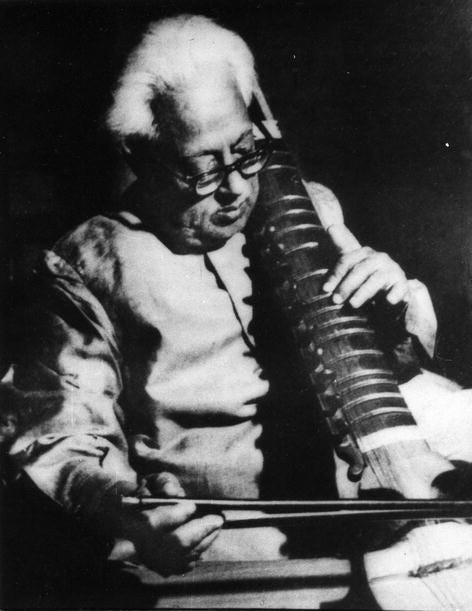
- Satyendra Nath Bose (1894–1974): Bose was an Indian physicist who worked on statistical problems in quantum physics and was noted for his collaboration with Albert Einstein. He derived the Planck’s law of blackbody radiation without using classical physics, and introduced the concept of Bose-Einstein statistics, which describes the behavior of particles that obey the Pauli exclusion principle. He also predicted the existence of a new state of matter, called the Bose-Einstein condensate, which was experimentally observed in 1995. Bose was nominated for the Nobel Prize several times, but never received it. He is the namesake of the boson, a type of elementary particle.
- Emmy Noether (1882–1935): She is best known for proving the Noether’s theorem, which states that every symmetry in a physical system corresponds to a conservation law. For example, the symmetry of time translation implies the conservation of energy, and the symmetry of space translation implies the conservation of momentum. Noether’s theorem is one of the most important and elegant results in physics, and has profound implications for quantum physics, relativity, and cosmology. She faced discrimination and persecution as a woman and a Jew, and had to flee Nazi Germany in 1933. She died two years later from complications of surgery. She was posthumously awarded the Ackermann-Teubner Memorial Prize for her work in mathematics.
I have written a separate piece on Emmy Noether and her monumental scientific legacy, you can check out the story here,
- John Stewart Bell (1928–1990): Bell was a Northern Irish physicist who is best known for his discovery of the Bell’s theorem, which shows that quantum physics is incompatible with local hidden variable theories. Bell’s theorem implies that quantum physics either violates the principle of locality, or the principle of realism, or both. Bell also proposed a way to test his theorem experimentally, by measuring the correlations between entangled quantum systems. The experimental tests, performed by Alain Aspect and others, confirmed the predictions of quantum physics and ruled out local hidden variable theories. Bell also made significant contributions to quantum field theory, particle physics, and cosmology. He was awarded the Hughes Medal and the Wolf Prize for his work in physics.
- Julian Schwinger (1918–1994): Schwinger was an American physicist who was one of the founders of quantum electrodynamics (QED), the quantum theory of electromagnetism. He developed the renormalization technique, which allows the calculation of finite and meaningful results from QED, despite the presence of infinities. He also introduced the concept of the anomalous magnetic moment, which measures the deviation of the magnetic moment of a particle from its classical value. He calculated the anomalous magnetic moment of the electron, which agreed with the experimental value to a remarkable precision. He also formulated the Schwinger action principle, which is a general method for deriving the equations of motion of a physical system. He shared the Nobel Prize in Physics in 1965 with Richard Feynman and Shin’ichiro Tomonaga for their work on QED.
Last year I wrote a piece mentioning ten unknown facts about Julian Schwinger, you can read it here:
These are only some of the hidden figures of quantum physics, and there are many others, such as Wolfgang Pauli, John von Neumann, Eugene Wigner, Lev Landau, and Freeman Dyson, but about them in the next part of the story.
These scientists have enriched the field with their insights and discoveries, and have inspired generations of physicists and philosophers. They deserve to be celebrated and remembered as the heroes of quantum physics.
Thank you so much for reading. If you liked this story don’t forget to press that clap icon as many times as you want. If you like my works and want to support me then you can Buy me a coffee ☕️. Keep following for more such stories!


