
PHILOSOPHY | GEEKY | ANCIENT GREECE | APOLLO | DIONYSUS
The Harmonious Ceremony of the Opposites
How the Apollonian and Dionysian element are seemingly in conflict but are in fact meant to coexist in harmony
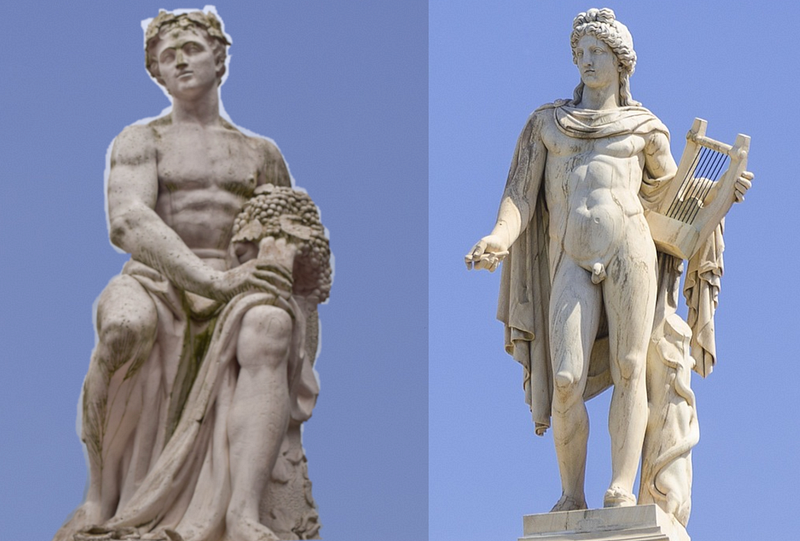
“But how suddenly the wilderness of our tired culture, which we have just painted in such gloomy colors, can be transformed, when it is touched by Dionysian magic!
A storm seizes everything that is worn out, rotten, broken, and withered, wraps it in a whirling cloud of red dust and carries it like an eagle into the sky.
Our eyes gaze in confusion after what has disappeared, for what they see is like something that has emerged from a pit into golden light, so full and green, so luxuriantly alive, so immeasurable and filled with longing.”
— Friedrich Nietzsche, The Birth of Tragedy
Nietzsche wrote The Birth of Tragedy at the young age of 27. In this first great work of his he took a deep dive into ancient Greek tragedy, which he considered the highest and most complete form of art, and made a good case about why mankind requires both the Apollonian and Dionysian element.
He also attacked Socrates for his laser focus on ‘dialectics’ (logic) and his shunning of art. Socrates, via his mouthpiece Plato, believed art was largely redundant and mankind can solve all its problems purely via rational reasoning, to which Nietzsche strongly objected.
However, rather than a mere review of his Birth of Tragedy in this piece I will make my own case about the Apollonian (logic, love, mind, Sun, stars etc) and the Dionysian (emotions, passion, lust, body, sex, Earth, Moon etc) elements; and why I think they are both vital.
Put another way, why I write both love/romantic poetry (Apollo) and erotica/smut (Dionysus) and why the two, despite being seemingly in conflict, are most definitely not. Or, at least, they shouldn’t be.
The ancient Greeks were keen to point out that mind and body needed to coexist in harmony. Although Apollo is ostensibly higher up the divine food chain, being a solar deity, a god of truth, prophecy, healing, the Sun etc the ancient Greek mythographers were quick to balance him out by spawning Dionysus.
He was the god of fertility, festivity, vegetation, insanity, religious ecstasy and theater. He had a following of demi-gods, humans and other creatures ranging from invariably horny or fun-loving Satyrs (male), Maenads (female) and lower deities like Pan, who could be considered a kind of lesser Dionysus — or, perhaps, the ringleader of Satyrs.
I wrote a poem about Pan last August called -unimaginatively- Pan. Its shameless header image was shot by yours truly at my balcony 😅 While it’s shameless it is pertinent to the poem. The little statue of Pan is a gift, but I cannot recall from whom.
The aforementioned Maenads devoured the legendary hero Orpheus -who once challenged Apollo himself to a lyre contest- after he declined their sexual advances, right after his wife Euridice passed a second time, after picking her from the Underworld. Hell hath no fury like a Maenad scorned.
Nietzsche developed his reasoning about why we need both the Apollonian and the Dionysian element in an entire book, but my own word limit and time is far narrower.
He posited that “Apollonian without the Dionysian is stale and restraining and Dionysian without the Apollonian is menacing and chaotic.”
The order and reason of Apollo and the chaos and passion of Dionysus need to keep each other in check, similarly to how our brains are wired. I would add, though, that when Dionysus is at the front wheel with Apollo at the backseat that spells a lot of trouble.
This means we have surrendered ourselves to our passions, our lust is blind and unchecked and hard substances, alcoholism or mental asylums are probably waiting for us down the road.
On the other hand if Apollo drives and Dionysus is in the kiddie seat the reverse happens: our life becomes numb and colorless, we seek refuge into depression, and by and large we survive rather than live.
The great mistake of Socrates and Plato, and that’s my own conclusion, not Nietzsche’s, is that reality is inherently too absurd to be neatly rationalized and explained. Albert Camus far more recently developed an entire philosophy around that concept, called rather appropriately ‘absurdism.’
Aristotle departed from his teacher Plato and his platonic idealism, which later built the philosophical foundations of Christianity. Nietzsche considered Christianity a nihilistic, life-denying religion and I do not disagree.
At its core Christian esotericism is something entirely different, identifying God with Love/Life, and flirting a bit with pantheism rather than a personal supposedly omniscient & omnipotent god that somehow exists beyond space, time and the universe itself.
I’ve read the entire New Testament in the original ancient Greek. Joshua Ben Josef never mentioned, anywhere, that he (alone) was the son of god. Instead he always said he was the Son of Man, accompanied by esoteric statements like “The kingdom of God is within you.” (Luke 17:20–21).
I’ve been to hundreds of Christian churches in both Greece and abroad, since I find it important to always visit all temples and churches of all religions wherever I travel (I love their serenity and art). In all the religious images of Christ I do not recall a single one without the words ‘The Son of Man.’
But that is not the high level interpretation of the Christian Church, particularly the most fundamentalist denominations like the Evaggelicals.
You need to sit down and talk with a priest who is preferably also a theologian and thus actually knows his craft — not an uneducated tele-Evaggelist or one of those guys who lead huge crowds into religious frenzy theatrics in the US while greedily pocketing all their “donations.”
I went a bit off/side-topic though. To conclude, and get back to the gods Apollo and Dionysus, we need both because -speaking from personal experience- whenever I leaned too much toward Apollo I focused too much on Love, my stellar or post-corporeal dreams, potentially dangerous astral trips and my body as a result suffered.
When I turned the tables and got full-blown Dionysian I became almost like a sexual predator, I focused only on sex, did not care about love and all my dreams about the future took the piss. No love, no feelings, pure empty pleasure.
Both Apollo and Dionysus need to be at the front seats, and both need to drive, at the same time. “A healthy mind in a healthy body”, as the ancient Greeks loved to say.
Now my one foot stands among the stars and the other is firmly on the ground. As I’ve written elsewhere here I know full well now that it is not possible to sit with both feet among the stars on your own. You only burn your wings out and collapse, like Icarus. Who might have made it if he could have flown with Daedalus.
But Daedalus was his father, not a mate. He was the past, not the present or an equal. It was not pride or the Sun that burned out Icarus’ wings.
It was his foolish assumption that he could reach the Sun on his own — which, I guess, is its own kind of pride. And if you read carefully the ancient Greek original text this is made clear.
sources: The Birth of Tragedy, by Friedrich Nietzsche | GoodReads Dionysian Classicism, or Nietzsche’s Appropriation of an Aesthetic Norm, by Adrian Del Caro | Univ. of Pennsylvania Press / JTOR Dionysians and Apollonians, by Michel Cabanac | PubMed

An article by Nikolaos Skordilis I recommend this poem by Divya Goswami, which also features some of her beautiful art:


