
8 Important Quotes of Albert Camus
“In the midst of winter, I finally learned that within me lay an invincible summer.”
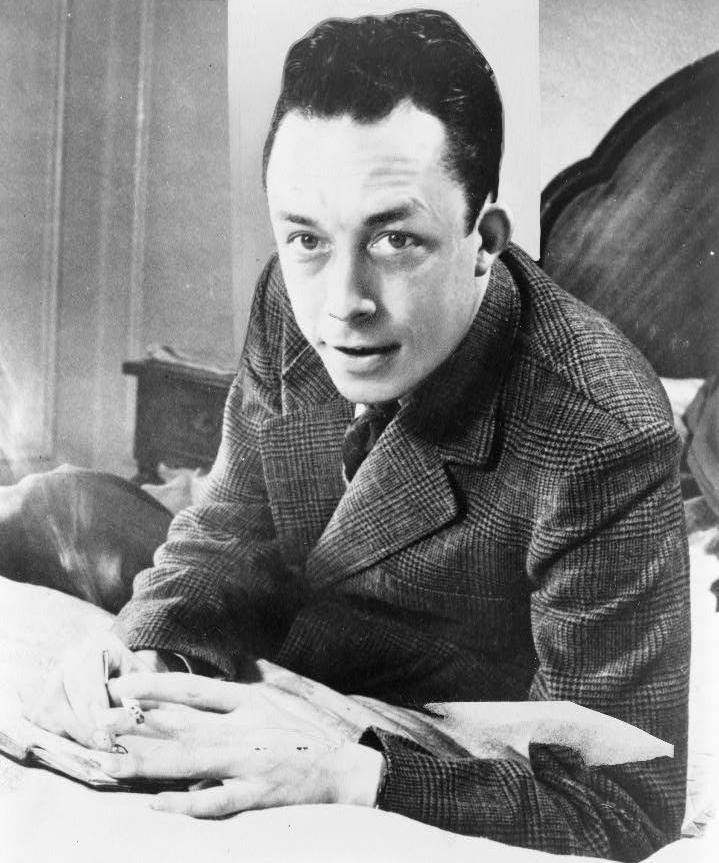
The French-Algerian philosopher, novelist and Nobel laureate Albert Camus is widely considered a dark thinker. I think the main reasons for that are his deep existentialism -which, I think, goes deeper than that of his mentor Jean-Paul Sartre- and his comments on the taboo topic of suicide.
While he never urged anyone to commit suicide the fact that he dared try to ‘untaboo’ it by drawing some dark humor out of it (“Should I kill myself or make coffee?”) probably did not help his case.
The real Albert Camus, though, is quite different. He was a vivid, luminous voice, with hope, friendship, love, freedom and life itself always being at the center of his philosophy and fiction:
“Don’t walk in front of me… I may not follow. Don’t walk behind me… I may not lead. Walk beside me… like a friend.”
“Live to the point of tears.”
While he did dress much of the above with his theory of ‘absurdism’ that was his very own way of ‘trying to make sense out of a senseless world.’ Some misinterpret Camus’ absurdism as ‘desperatism’. Nothing could be further from the truth. Camus was big on hope:
“In the midst of winter, I found there was, within me, an invincible summer. And that makes me happy. For it says that no matter how hard the world pushes against me, within me, there’s something stronger — something better, pushing right back.”
His theory of absurdism is best -or more directly- shown in his Myth of Sisyphus essay. Sisyphus was the founder and first king of the city of Ephyra -later renamed Corinth- in ancient Greece. Zeus, the mighty king of the gods, punished him for cheating death twice by forcing him to roll a huge boulder up a hill; only for the boulder to roll down every time it neared the top. He had to repeat that loop for all eternity.
Camus saw some kind of hope even in that:
“I leave Sisyphus at the foot of the mountain. The struggle itself toward the heights is enough to fill a man’s heart. One must imagine Sisyphus happy.”
Why would he be happy? Because Zeus gave him a purpose. Even an absurd, irrational, tedious, on-a-loop purpose is better than no purpose at all. That is when despair starts to rear its toxic head.
Let me add 8 more of Camus’ quotes that I think represent his voice and thought:
1. “You will never be happy if you continue to search for what happiness consists of. You will never live if you are looking for the meaning of life.”
Pretty self-explanatory. Camus thought that only living in the present was true living. Our past is the domain of our ‘demons’ and guilt, and if we only live for the future we get so worried, stressed and anxious we forget to live in the present.
2. “Nobody realizes that some people expend tremendous energy merely trying to be normal.”
The unhealthy obsession with the illusory ‘normality’ was as much in issue in Camus’ days as it is today.
3. “Blessed are the hearts that can bend; they shall never be broken.”
Camus was big on flexibility and adaptation. He was not fond of rigid hearts and minds.
4. “When I look at my life and its secret colors, I feel like bursting into tears.”
As Franz Kafka once wrote “Whoever retains the ability to see the beauty of the world never gets old.” Camus never got old either; he died in a car accident at the age of 46. In some sense he can be considered the ‘James Dean of philosophers.’ Kafka died young too, from an illness.
5. “What is called a reason for living is also an excellent reason for dying.”
An often misinterpreted quote. Camus does not urge anyone to die but to find such a strong purpose to live for that it would -or could- be worth dying for. Until someone finds such a high purpose their life has less meaning. Finding a purpose worth both living and dying for, though, is the ticket out of despair-land; you can, then, fully embrace life and start actually living.
6. “Peace is the only battle worth waging.”
Having been born in Algeria and seeing with his own eyes what his French compatriots did to Algerians made Camus a devout pacifist.
7. “The need to be always right — the sign of a vulgar mind.”
After Camus published The Rebel his old mentor Sartre started attacking him -usually indirectly, using… intermediaries (really)- for ‘betraying the communist ideal.’ The Rebel was a thinly veiled attack on the Stalinist regime and its atrocities, while Sartre kept on pretending it was all sunshine and rainbows in Siberia-land.
Eventually Camus had to respond, but he often let Sartre have the last word; either out of respect or simply so their debate could end, at least for the day. Once again, some misinterpreted that as Camus having a lesser intellect than Sartre. Camus would not ever bother to attempt a comparison. I think Camus’ above quote is a jab on Sartre himself.
In my own experience I have found it’s toxic to always want to be right and/or have the last word in every discussion. This feeds insecurities and our narcissistic tendencies. It’s OK to have someone have the last word from time to time.
It’s OK to just add a 👍️ to end your toxic debate on Twitter or FB. Above all not for them but for you. You’ll have more time to spend on something actually creative. Like, you know, writing.
8. “Where there is no hope, it is incumbent on us to invent it.”
Hope, after all, is all we have.