avatarRandy Runtsch

Summary

The content discusses the Okinawan people's longevity, happiness, and cultural practices, including their dietary habits and spiritual beliefs, as well as the significance of guardian lion statues in their tradition.

Abstract

Okinawans are renowned for their exceptional longevity, with a high proportion of centenarians, and their overall happiness and friendliness. The article attributes these qualities to a combination of factors such as the practice of "hara hachi bu," an eating philosophy encouraging consumption until 80% full, and a diet rich in fruits, vegetables, and soy-based foods. Spirituality also plays a key role, with ancestor worship being a central aspect of their religion. The presence of shisa, guardian lion statues, on Okinawan properties is both decorative and protective, symbolizing the warding off of evil and the retention of good spirits. The author, married to an Okinawan, reflects on the benefits of adopting some of their ways after 25 years of marriage.

Opinions

  • The author feels fortunate to be married to an Okinawan and suggests adopting some of their practices.
  • Okinawans are described as spiritual people, with a religion that includes the worship of their ancestors.
  • The Okinawan diet, which includes purple sweet potatoes and a preference for pork, is seen as contributing to their longevity.
  • The shisa statues are valued for their dual role in protecting Okinawan homes from evil spirits and keeping good spirits within.
  • The author appreciates the "statue" challenge by Vidya Sury, Collecting Smiles, indicating it has been a favorite writing prompt so far.
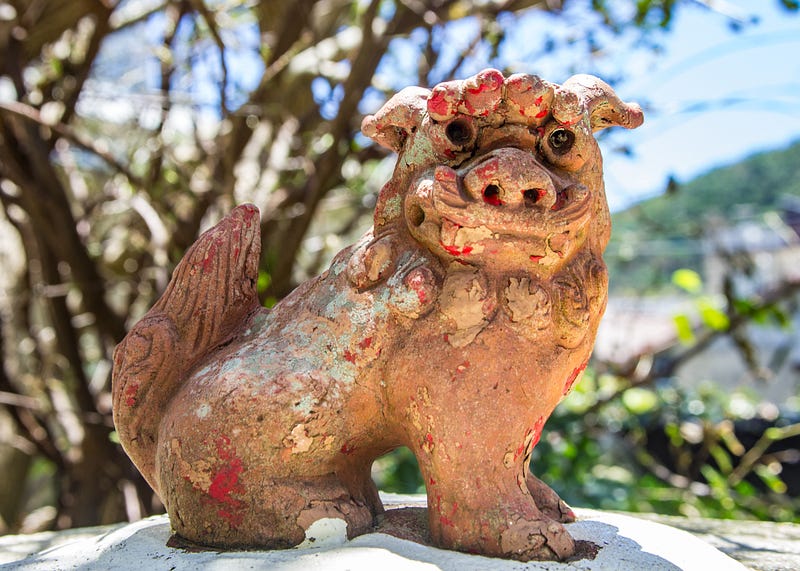
A closed-mouth shisha guardian lion decorates the wall around a house on Zamami Island in Okinawa. Photo by the author.

The Happy and Healthy People of Okinawa

February Six Word Photo Story Challenge: “Statues”

Eat until you are 80% full.

Okinawans are known for their happiness, friendliness, and longevity. These citizens of the Okinawa Prefecture of Japan occupy half of the islands of the Ryukyu Islands chain, which includes its largest island, also called Okinawa.

According to the World Economic Forum, 81 out of 100,000 Okinawans live to the age of 100 or longer. Contrast this centenarian prevalence with that of Japan as a whole (48), France (37), Italy (32), and the United States (20).

Many factors go into making Okinawans the longest-living people on Earth. One is that many of them practice “hara hachi bu,” which means eating until you are 80% full.

While Okinawans favor pork over other meats, they also consume a diet rich in fruits, vegetables, grains, soy-based foods, and Okinawan sweet potatoes. My wife Kazumi grew up in Okinawa and relishes the island’s purple potatoes steamed whenever she can find them in the U.S.

Okinawans are also spiritual people. A key part of their religion is the worship of their ancestors.

Some Okinawans mount decorative guardian lion statues on the roof of their house or atop a wall surrounding their property. These shisa are almost always seen in pairs. One of the shisa opens its mouth to ward off evil spirits. The other keeps its mouth closed to keep good spirits in.

As a whole, Okinawans are happy, healthy, and friendly people. I feel fortunate to be married to one of them.

After nearly 25 years of marriage to an Okinawan, I think I should adopt some of their ways.

Following are other writers whose statue stories you might enjoy.

Dennett

Julia A. Keirns

Erika Burkhalter

Thank you, Vidya Sury, Collecting Smiles, for this month’s “statue” challenge. It has been my favorite writing so far.

Monthly Challenge
Okinawa
Spirituality
Longevity
Japan
Recommended from ReadMedium