
The Graying of Our Oceans
Will the rising temperatures of the seas forever erase the technicolor corals from our collective memories?
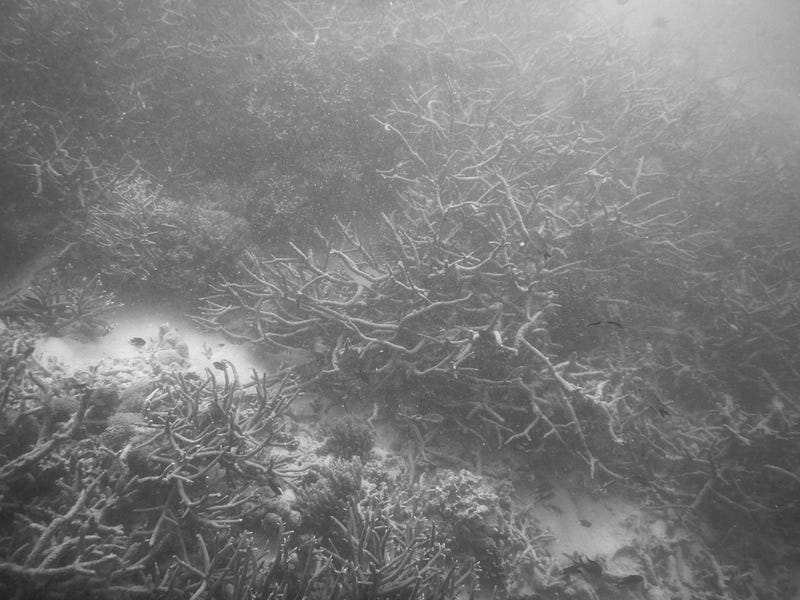
For anyone who knows me, my passion after work and family, are two-fold: international travel and scuba diving. When I can take a trip where I can enjoy both, I am in complete heaven. I’ll never forget my first scuba diving experience of Discover Scuba in the Grand Bahama Island in 2002. The first dive was remarkable but the second dive with sharks was a mind-blower and I was hooked forever. Now after four hundred plus dives, I still dream of heading under the water.
For me, scuba diving is the closest one can get to zero gravity without going into space or a zero-gravity machine. It’s also such a wonderful time of solace and meditation. It’s only you with the quiet of the blue sea, fish, ocean reptiles, ocean birds, sea mammals and technicolor corals to entertain you!
You can imagine how I must feel about one of the major consequences of climate change — the warming of our oceans and the bleaching of those multi-color corals. I first learned about it when I joined a scuba diving club in NYC in 2012. Someone had recently come back from diving in Thailand’s Andaman Sea with a very similar itinerary to my own. He told me how bleached and ruined the corals were there. I was extremely surprised by that statement since I had dived those same reefs back in 2006, and they looked very healthy and in good shape to me.
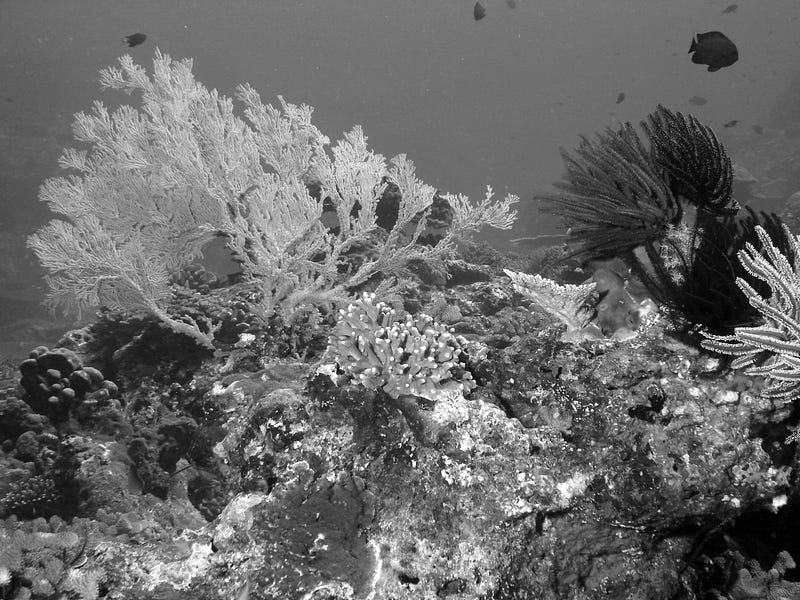
I have been lucky to dive in many locations in the world with thriving corals like Cuba, Indonesia, the Philippines, the Red Sea, Margarita Island, Palau, Easter Island, and South Africa to name a few. How much longer will that last?
When I was at the Great Barrier Reef in 2004, I remember all of my dives full of technicolor corals and fish. What was the most fascinating to me, though, was the huge Queensland groupers who learned to adjust their hunting techniques to take advantage of the scuba divers. On night dives, they acted like shadows waiting for you to shine your flashlight on a nice treat and then from behind you they swam out to pounce on their evening snack!
The Great Barrier Reef I visited in 2022, was a different experience entirely. The reef looked gray and worn to me like an old grandma’s knitted gray shawl with moth holes born into them. The colors of the corals had been bleached out of them. The fish left were extremely scarce and so tiny. I wondered what had happened to the happy groupers in 2004 following divers around in a symbiotic relationship for a snack? I couldn’t find a single one almost twenty years later on that part of the reef at least.
What causes coral bleaching?
What can we do to stop it and repair it?
According to N.O.O.A What is coral bleaching? (noaa.gov), increased ocean temperature caused by climate change is the leading cause of coral bleaching. Runoff and rain from heavy storms can also pollute the ocean water. Exposure to the sun and air during extreme low tides can bleach the corals in shallow water.
When corals are exposed to pollutants or ocean water that is too warm, the algae which have a symbiotic relationship with the coral abandon them. Without the algae, the coral’s major source of food, the coral bleaches and turns a grayish white. It then can easily become sick and die.
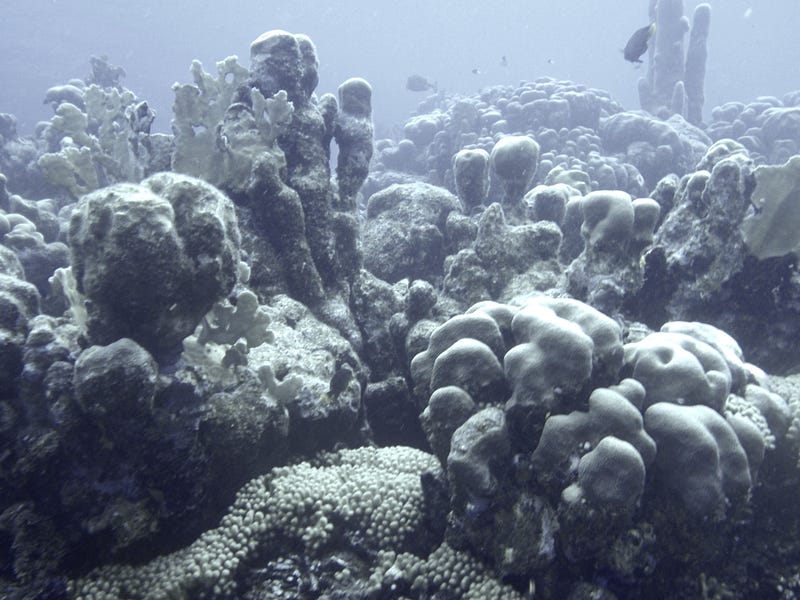
Only by using greener sources of energy and reducing pollution can we effectively combat the longer-term and more sustainable impacts of climate change on our coral reefs.
In terms of what we can do in the near term? We can become involved in supporting not-for-profit organizations and NGOs that are working closely with government organizations like N.O.O.A to farm coral and replace them in places where the corals have been bleached and destroyed. I saw this process in 2012 in Bonaire and it gave me so much hope.
In 2012, I took a trip to Bonaire with a New York dive group. Bonaire is a Carribean island just north of Venezuela and is famous for its shore dives all around the island. It’s also famous for its macro-diving, seeing small creatures. Much of the island’s reefs were thriving at the time and every dive was full of thrilling encounters with octopuses, squid, shrimp, seahorses and nudibranch amongst the larger fish.
My most memorable dives were not further than fifty feet from my bed as the hotel’s local reef was teaming with creatures. It was interesting to see how different the reef environment changed when diving the same place but at different times of the day — dawn, mid-day, dusk and dark. It was as if the location transformed into an entirely new environment with the movement of the sun.
During this trip, we also did some conservation of our own by helping Bonaire to count fish on our dives and planting coral pieces in the teaming coral farms to replenish the next generation and to better protect our reefs and oceans.
Recently, I read an article in the Wall Street Journal Florida’s Coral Reef Supports Fishing, Tourism and Beaches. Can Science Save It? (msn.com), that in the Florida Keys, the third largest natural barrier reef, from Miami to the Dry Tortugas Reef, 60% of the 558 coral reef sites monitored have been bleached. To revitalize the reefs, they are not only using this process to replace the damaged corals but also developing more weather-resistant strains of corals that can be planted. They do this by purposely stressing the corals, growing by exposing them to warm water and chemical pollutants. They are also looking at ways to engineer heartier varieties, use IVF to grow them faster, and transplant varieties that are more warm water resistant.
I hope we continue to come together as an international community to rebuild the corals and find a sustainable solution to climate change for ourselves, and most importantly, for the next generation of ocean lovers.
It would be a very sad day indeed if technicolor corals could only be found in our dreams.
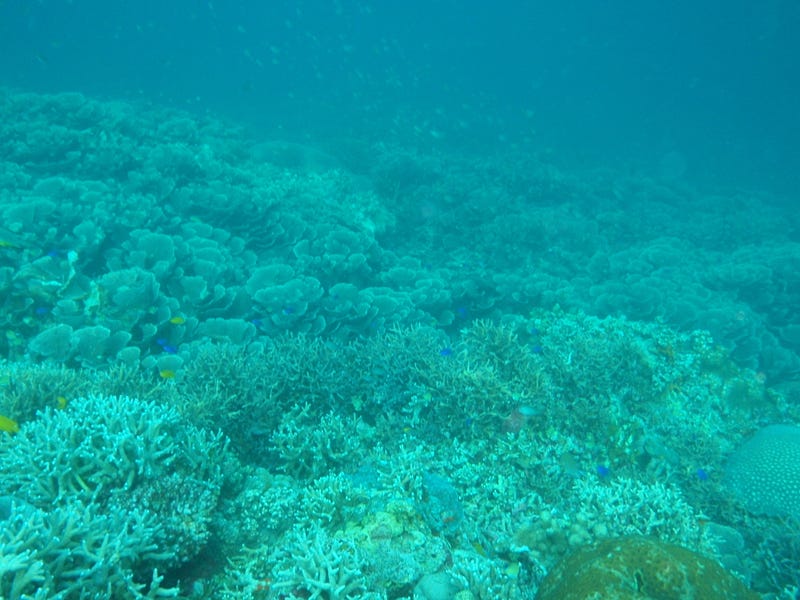
For other great articles about travel in the gray, see my recommendations below.
Warren Thurlow’s recounting his visit to Robbin Island in Cape town, South Africa really gave me food for thought.
I really enjoyed the gorgeous black and white photography of Christina Daniels in Seeing India in Gray.


