
The Golden Temple in Amritsar, India: A Profoundly Spiritual Experience
Visiting one of Sikhism’s most prominent places of worship
Religion has always piqued a profound curiosity within me. This, in large part, is due to my multifaith upbringing — my paternal grandparents were Jain, the rest of my family is Hindu, and I attended a Christian preschool.
I’ve long strayed from following any religion, although I still identify as Hindu, albeit solely in a cultural/secular sense.
My family is originally from the western Indian state of Gujarat and moved to California in the 1980s. Our quickly growing hometown didn’t have very many other Gujaratis, but the Punjabi population was quite robust, so we made several friends and acquaintances who’d emigrated from Punjab, a state in northern India.
Though the Gujarati and Punjabi cultures share several similarities, they’re also quite different — we eat different foods, speak different languages, and in many cases, follow different religions. Given that a significant amount of Punjabis identify as Sikh, we came to learn about their unique holidays, religious practices, and places of worship.
It felt quite surreal, then, to visit the Golden Temple, a place I’d seen numerous photos of and heard much about, but had never imagined setting foot in myself.
Arrival
I traveled solo throughout India from July 2016 to February 2017. In the initial weeks of my journey, I stayed in Amritsar, Punjab’s second-largest city, for a couple of nights.
After a brief bus journey and a cycle rickshaw ride from my Couchsurfing host’s home, I came upon a section of the city in which the foot traffic noticeably increased. Middle-aged men with long gray beards pedaled along on their cycle rickshaws, scanning the surroundings for potential customers. Others walked along the streets in white kurtas and bright orange turbans that matched the marigold garlands that hung from vegetable stalls. Local mom-and-pop shops gradually gave way to souvenir stores and tour agencies. Excitement and anticipation welled up inside of me, and I held my breath knowing that I’d soon lay eyes upon one of the most revered religious sites in the world.
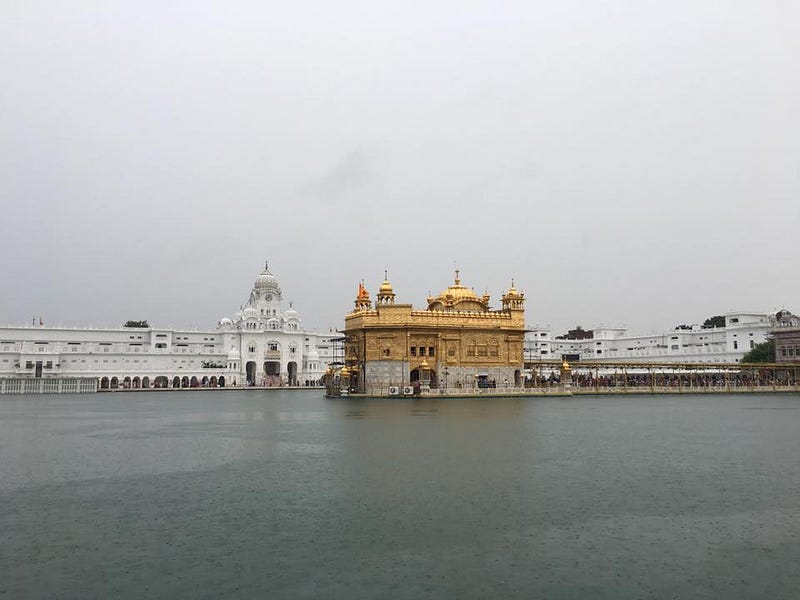
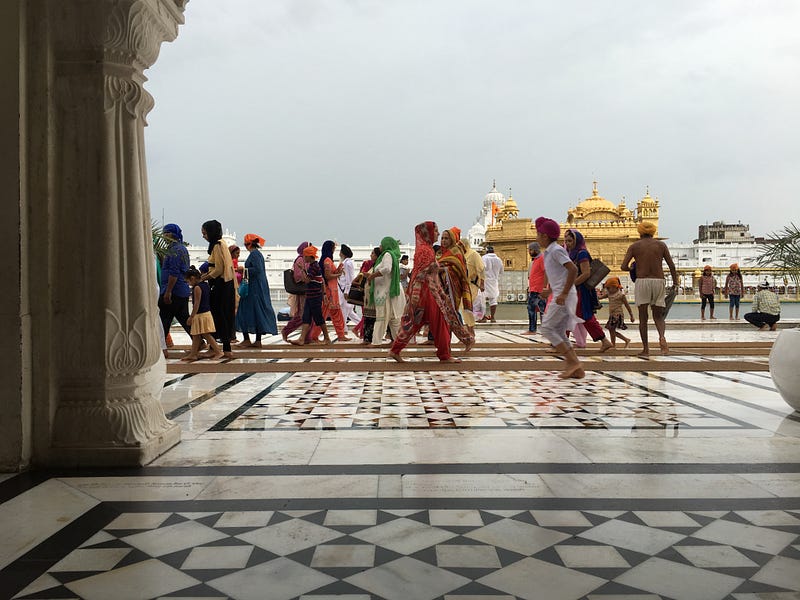
And there it was, just like I’d seen in so many portraits. Except there was a liveliness and energy to it that I hadn’t expected. Whereas many photos had made it look empty, that was certainly not the case. At least a few thousand people walked around the perimeter, with countless others within the buildings along the edges.
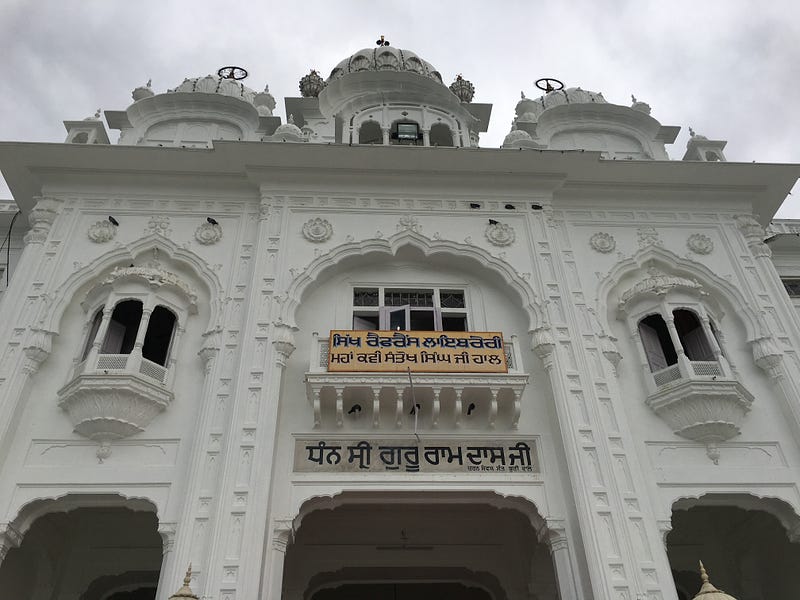
Sri Harimandir Sahib, the official name of the Golden Temple, is the most prominent place of worship in the Sikh religion. Its name literally translates to “Abode of God.” Pilgrims from all over the world flock to the holy site, known in Punjabi as a gurdwara, to pay their respects and connect to their faith on a deeper level.
The complex was enormous. The main temple, a white and — hence the name — golden structure stood in the center, sparkling despite the overcast sky. A walkway led to the main building, on which a long line had formed to enter the inner sanctum. In the sanctum, skilled musicians and respected priests recited religious scriptures (and this went on 24/7/365!). A crystal clear pool surrounded the main temple, where devotees, mostly men, bathed. Finally, a walled courtyard enclosed the pool and temple, which was comprised of white buildings and a marble walkway. Each of the white buildings held additional prayer rooms, while the walkway provided a space for visitors to sit and take it all in.
Before entering, all visitors must remove their shoes and cover their heads. I handed my Teva sandals to a volunteer who placed them in a storage area and grabbed an orange bandana from another volunteer. As the final step, I dipped my bare feet into a small basin and made contact with the cool marble floor, where the temple grounds began.
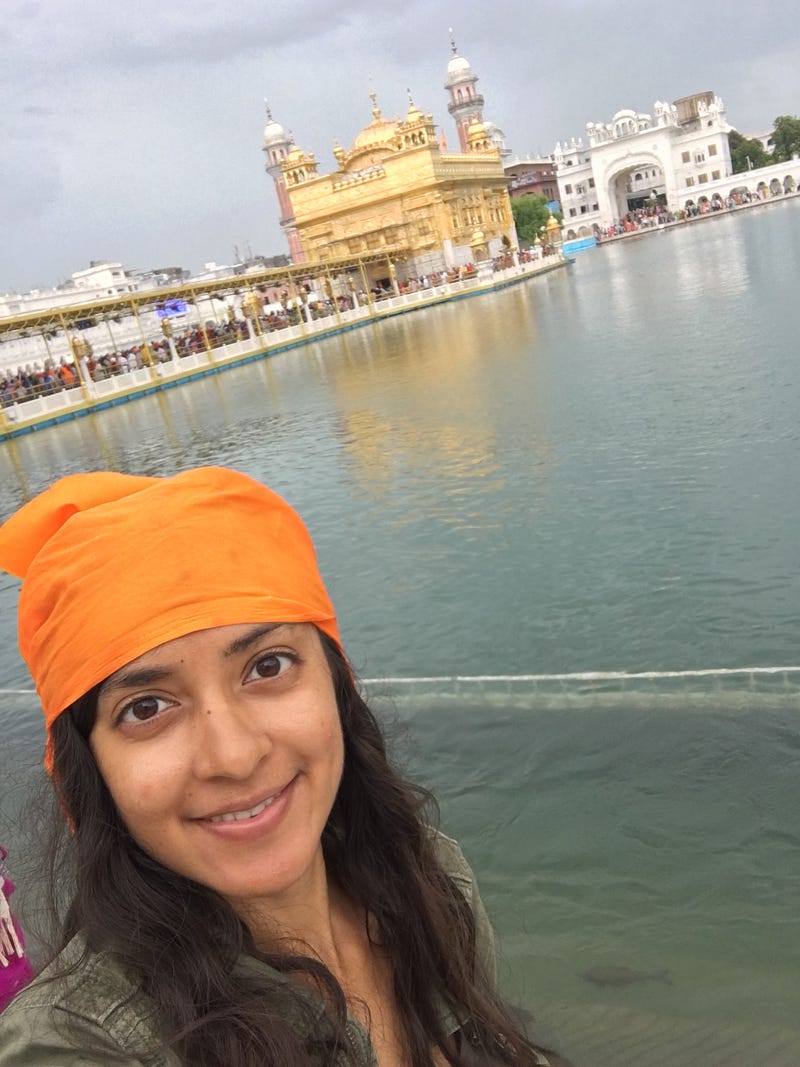
The Golden Temple was built in the late 1500s on land acquired by Guru Ram Das, the fourth in a succession of ten leaders of the Sikh religion. Throughout the subsequent centuries, the Golden Temple was the site of religious and politically motivated acts of violence against the Sikhs. In the 1700s, the Mughals and Afghans desecrated it. In 1984, under Operation Blue Star, the Indian Army raided its doors to remove a militant Sikh leader and killed dozens in the process. Despite being destroyed many times, the temple has always been promptly reconstructed. From its conception, the Golden Temple has also opened its doors to all people, regardless of faith, social class, or gender.
The Sikh religion is based upon the teachings of the first leader of the faith, Guru Nanak. Seva, or selfless service, is a core component of Sikhism. This is most prominently illustrated by the fact that the Golden Temple serves free vegetarian meals to anywhere between 50,000 to 100,000 people a day. And its operations run as smoothly as they do thanks to just as many volunteers. Free accommodation, for foreigners and Indians alike, is available every day of the year.
For the longest time after arriving, I sat against a pillar on one of the walkways and stared out, spellbound as I savored the grandeur. All kinds of visitors passed through the place: Sikh families, non-Sikh Indian families, baggy-eyed backpackers, fellow solo females, a tour bus full of well-to-do Europeans, and foreign families with small children. Some people sat and talked, while others remained in their own inner worlds, deep in meditation. Groups of older men and women even chanted prayers, which provided a soothing soundtrack. A tranquil feeling soon enveloped me — one of inexplicable love and connection to everyone in this communal space — and I didn’t want it to go away.
The Langar
A lanky preteen boy approached me, snapping me out of my mesmerized state. An orange bandana covered his head and he wore dark jeans, stylistically similar to the ones Bollywood actors wore on screen in the early aughts. As if I were a long-lost friend, he smiled and waved.
Oh great, I guess I can’t even avoid the salespeople here, I thought to myself as I instinctively put my hand over my purse. After having encountered several pushy rickshaw drivers, shop owners, and other salesmen throughout my India travels, I’d developed a protective instinct.
“Helloooo madam, what is your good name?” he asked in a high-pitched voice. (Throughout India, this is a common way of asking someone their name.)
“Brina,” I replied, trying to formulate an escape plan.
“Where are you from?” he carried on.
“California,” I replied, in as flat a tone I could possibly muster, my suspicion growing.
“Ahh, California in America, yes?”
“Yes.”
“I hope to go to America one day.”
“I hope you do, too.”
“You have seen the langar?”
“The what?” I asked.
He then motioned to his mouth, miming eating, and said, “Come!”
Lured by the promise of food and crossing my fingers that this kid wasn’t chasing cash, I followed him. We moved quickly through the walkway, weaving through cheerful children and sprawled-out septuagenarians. I struggled to keep up, my feet hitting the cool marble floor with each rapid step. After weaving our way through the crowds, we arrived at a set of stairs that led to a massive rectangular building.
The boy handed me a steel plate and cup from dish racks almost two stories high. Dozens of people scurried up the steps, and we followed them into a waiting area. At least a couple hundred of us gathered in this enclosure, with hearty laughs and hurried chatter ricocheting off the walls. The kid yelled something indecipherable, waved and turned back the way we came.
Before I had the chance to thank him, a large set of doors opened, releasing us like a herd of bulls into the dining hall. Rows and rows of thin mats lined the floor, and my fellow diners abruptly occupied the nearest spots. Though everyone moved swiftly, I soon realized that there would be no shortage of space. The building could easily have fit a thousand people.
I sat down with my utensils, next to a pale-skinned woman whose bronze eyeshadow accentuated her large brown eyes. The doors closed once we reached maximum capacity and the main event began. Twenty to thirty men in tightly wrapped turbans and cotton kurtas passed by, hurriedly plopping dal (lentils), roti (flatbread), and kheer (rice pudding) onto our plates with impeccable precision. We dug in ravenously, and the sound of chewing and slurping filled the stuffy air. I still found it hard to believe that enough of this food was made daily to feed a modestly-sized city.
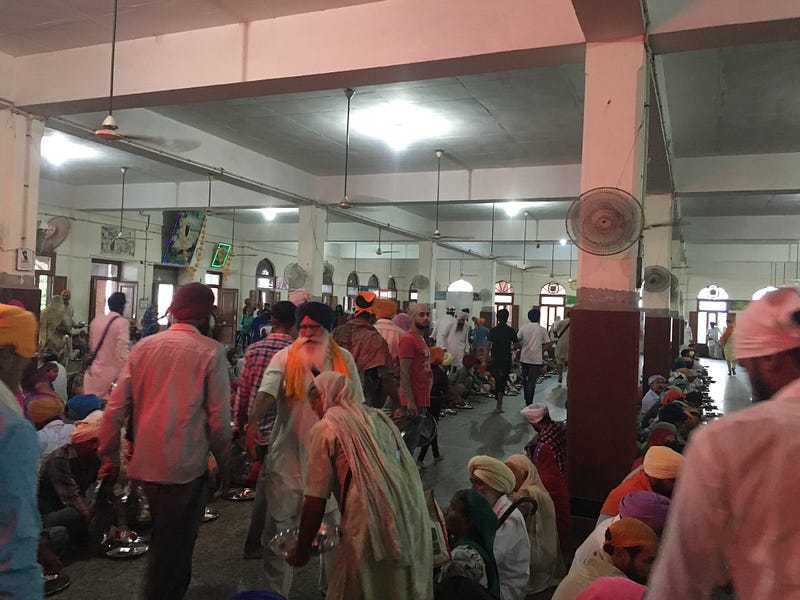
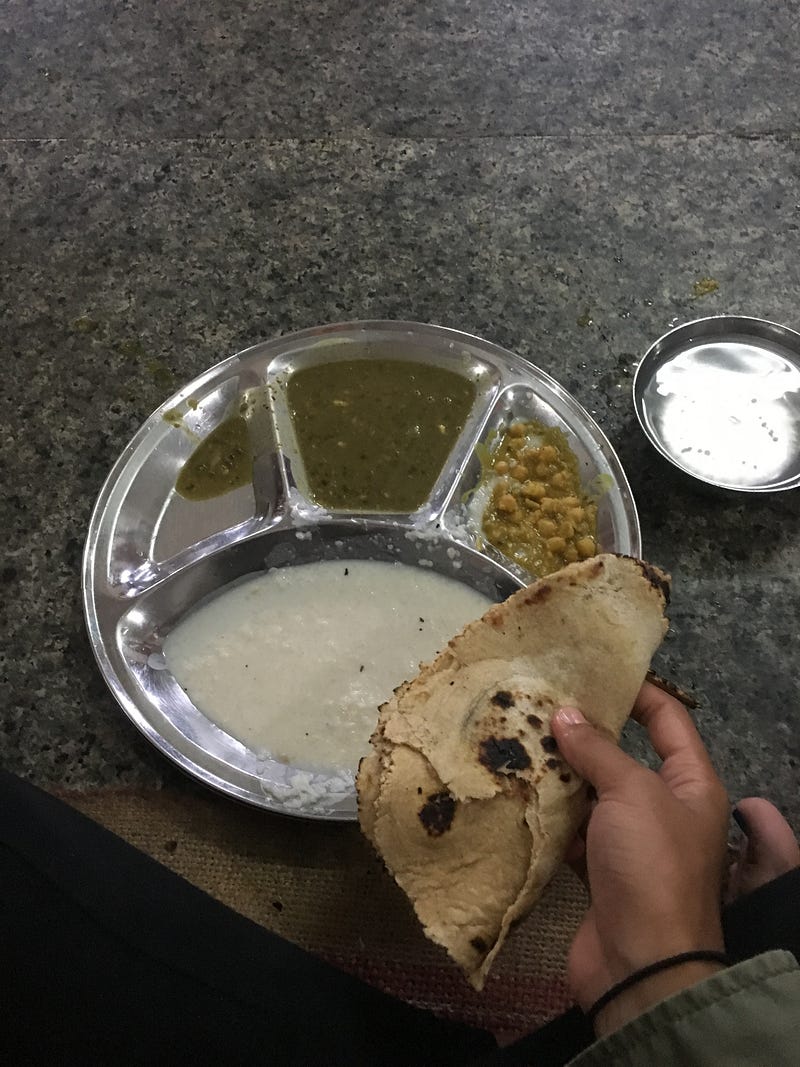
As much as I would have loved to savor each delicious bite (and take a few plates to go), we had to be mindful of time and rations for other diners. Within twenty-five minutes of entering, I stood up and followed everyone out, wishing I could have stayed inside to observe for longer, but satisfied nonetheless.
Reflection and Transcendence
As I returned to engage in more people-watching along the walkway, I looked on intently as an elderly couple bickered nearby. They reminded me of my late paternal grandparents — Ba and Dada, I’d called them. Ba and Dada would’ve loved the Golden Temple, as its values embodied everything that they stood for: selflessness, connection to the divine, and resilience. I wished I’d gotten to travel to India with them when they were still alive.
Ba and Dada had been devout Jains, abstaining from all meat and alcohol, and setting aside several hours a day for prayer. Each morning, they’d sing, ring bells, and light oil lamps, chanting centuries-old incantations as they connected to the divine.
In my childhood, attending events at our local temple was full of excitement; a time during which I caught up with friends and scored some prasad, or food used as a religious offering. The older I got, the more detached and disillusioned I became with religion. In college, I turned my back on it altogether. The sexism woven into several of the doctrines became more apparent, and I started to question the meaning behind many of the practices I’d blindly followed.
Now, I realized I didn’t have to cling to any extremes; that I could still practice the aspects of Hinduism that I found meaningful from a cultural standpoint (with modifications where necessary), while forgoing whatever didn’t resonate. Ultimately, I felt lucky to have been raised with rich traditions and values.
I had planned to wrap up my Golden Temple visit in the inner sanctum. However, I wanted to attend a ceremony at the border between India and Pakistan in the evening. So the inner sanctum was out of the question, given the ever-expanding line.
I’d seen groups of people entering rooms along the walkway, which emanated echoes of chants, so I decided to take a look for myself. I made my way inside one of these rooms, and suddenly any fear of missing out on the inner sanctum evaporated.
The room was big enough to fit two hundred people and possessed an elegance akin to a royal palace. Half the visitors sat on the right side, while the others sat on the left, leaving a walkway in the middle. Red velvety carpets covered with paisley rugs lined the floor. Above us, three chandeliers sparkled with golden fixings, casting an almost ethereal light into the collective space. The aroma of fresh jasmine, which hung on garlands on both the stage and ceilings, lingered in the hair.
Up front and center, on a mini stage, sat four men with thick salt-and-pepper beards. One played the tabla (drum), another the harmonium, and they all sang. The deep sounds of their voices, combined with the rhythmic beats of the instruments, slowly lulled me into a state of serenity.
I sat down, crossed my legs, and felt an ease and lightness I hadn’t realized I’d needed; it was as if I’d belonged in that space all along. My eyes instinctively closed as I took in the collective divine energy that radiated throughout the room. The sounds of the scriptures flowed around me, wrapping me up in a loving embrace. My mind went still. Nothing else mattered more in that moment than just being… there. In that space, hate, fear, and grief seemed to evaporate. This concept of “me” temporarily ceased as, well. It was this powerful little blip in time that just was, and I felt immensely grateful to have encountered such an enchanting transcendence.
Huge thanks to Globetrotter editors, JoAnn Ryan, Anne Bonfert, Michele Maize, Jillian Amatt, and Adrienne Beaumont for making this publication possible for all of us.
For more intriguing stories about spiritual sites and experiences around the world, I think you’ll really like the following.
I enjoyed the rich descriptions and captivating photos in Brad Yonaka’s story, which takes place in an entirely different part of India:
Also, as a lifelong Californian, I really appreciated Carol Labuzzetta, MS Natural Resources, MS Nursing’s reflections on the spiritual nature of redwood trees:
And finally, thank you all for reading! For more reflective stories and mini essays about life, check out my Substack newsletter, The Tuesday Tapestry.


