
A Puja in Sikkim
Globetrotters Monthly Challenge — Spiritual Sites
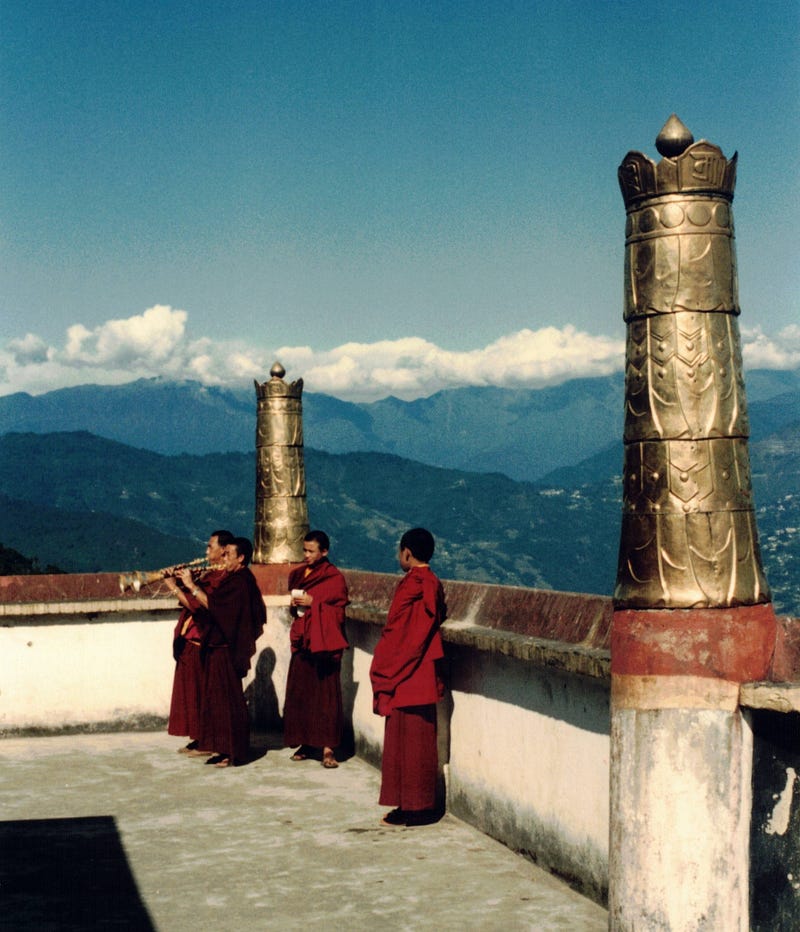
It is an irony that, as someone who has never felt any inclination toward religion, I’ve spent so much time in places dedicated to the spiritual.
Much of this concerns how easily those places work into a travel itinerary. Temples of worship are usually free to enter, and nearly every city, town, or village has one. Sometimes, they are a quiet reflection of the world around them; in other cases, they seem entirely disharmonic.
There may even be a little ritual involved, like taking off shoes, covering the head or legs, or lighting a candle. I take all of this as part of the experience of how a space dedicated to the unseen divides itself from the mundane world.
Sometimes, I enjoy going in just to escape whatever chaos is happening in the street. To be somewhere quiet where I can look at some lovely artwork and relax.
Occasionally, I get a lot more than that.
The road north from Darjeeling passed through much more rainforest than I thought existed this high up in the Himalayas. Dense vegetation washed up the sides of the steep Rani Khola watershed, where the provincial capital, Gangtok, sat perched high on the eastern slope.
My main objective was just to get here. Sikkim is a world unto itself, nothing like the rest of India. It forms a minute wedge, sandwiched between Nepal on the west, Bhutan on the east, and China to the north. It operated independently until 1975 when its leaders yielded to pressure from India to become a semi-autonomous state of the latter. This undoubtedly brought them a better future than annexation by China would have. I endured the ritual of British-inspired bureaucracy in Darjeeling to obtain the pertinent travel permit. There was even a ceremonial passport stamping at the border. The permit only allowed me to visit Gangtok and environs, though I fully intended to violate this restriction.
After a night in Gangtok, I headed down to the Rani Khola River and up the western side, a combination of walking and riding in share taxis. I appeared at the front door of the Rumtek Monastery and wandered in to have a look.
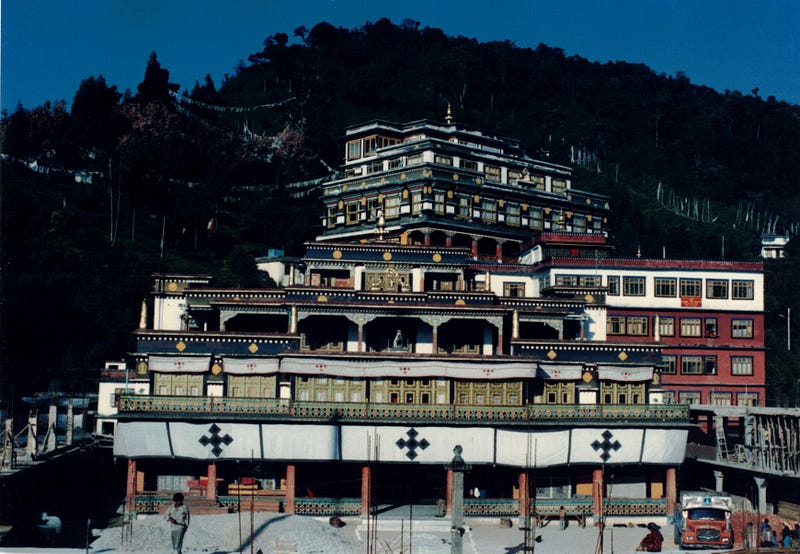
Rumtek, the largest Buddhist monastery in Sikkim, was heavily remodeled in the 1960s as a replica of Tsurphu Monastery in Gurum, Tibet. My previous experience of Buddhist temples was restricted to those I had seen in Dharamsala. But I knew the basics: walk clockwise around the temple interior, spin the prayer wheels (also clockwise), step over the doorjamb rather than on it, and not make a touristy nuisance of myself while the monks were chanting.
It was a sad yet opportune time to visit. One of the four high lamas (under the Dalai Lama) had recently died, and Rumtek was where they were holding a puja (devotional homage) to send him off. I gleaned this information from one of the western Buddhists there, a French man clothed in the typical red robes of the ‘Red Hat’ Tibetan sect.
The puja had already begun on the second floor of the main building. Seated monks filled most of the room, but there was still some space in the back. The casket of the deceased lama was in the room center, completely covered with offerings of fruit, incense, cake, khadas (scarves), money, and other random stuff.
After some time, a person of obviously great importance entered and caused a minor stir. I was told by someone present that this was the senior of the remaining three high lamas. The room got so crowded that I decided to leave and explore a few of the other monastery buildings before finding a ride back to Gangtok.
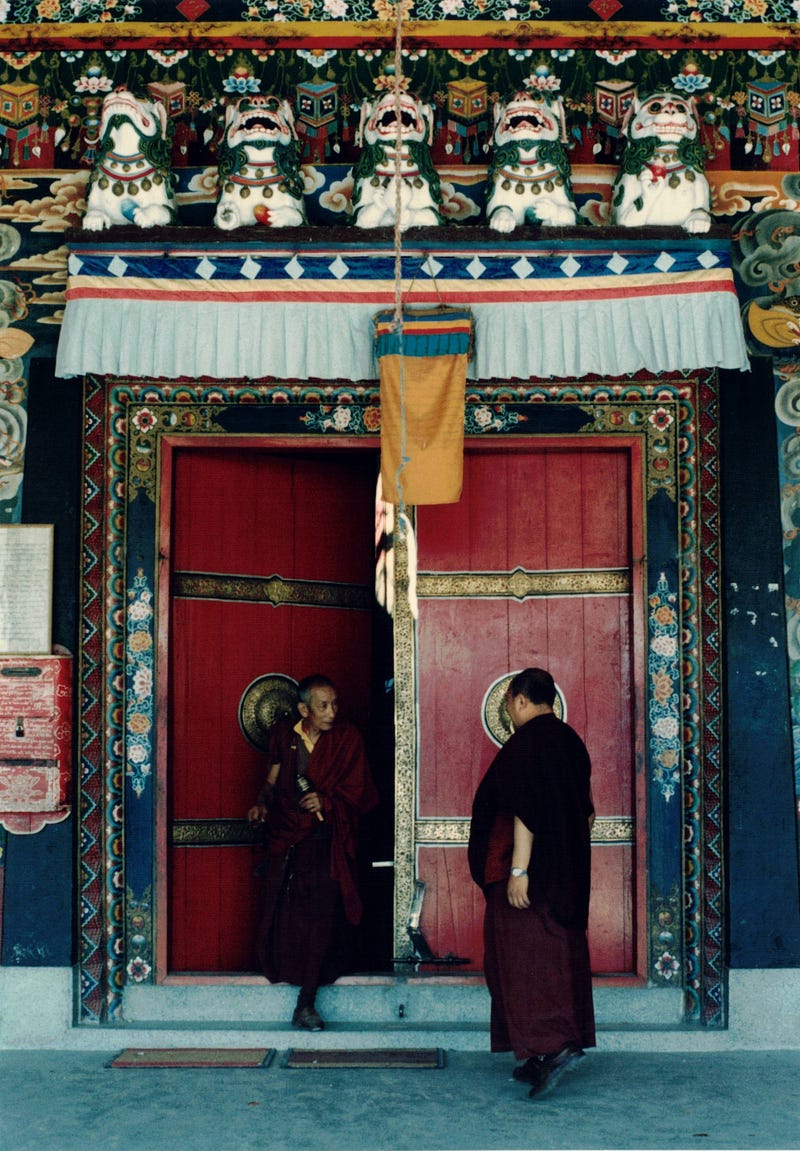
Rather than immediately carry on to other parts of Sikkim as I had planned, I decided to return to Rumtek and the puja. It would last two more days.
At dawn the following day, I made my way back up the dizzy, winding road from Gangtok, sharing taxi expenses with two German backpackers. Fortunately, there was a hotel of sorts adjacent to the monastery, so I could stay locally until the puja was over.
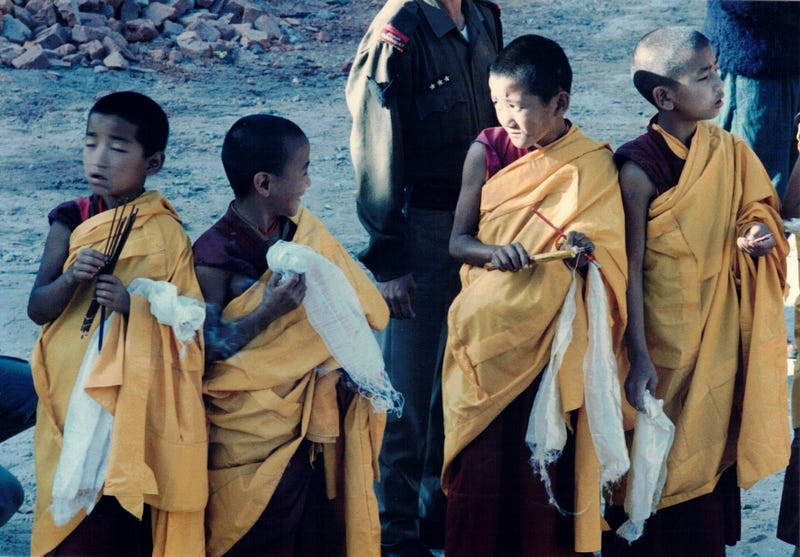
The session on the ground floor included many young monks, some no older than eight. Many had probably been sent involuntarily by their families. It was a way for those families to earn ‘faith credit.’ The boys struggled with the endless chanting, visibly bored, surreptitiously picking their noses and stealing glances at each other.
Looking for a more serious ritual, we went upstairs to where the casket rested, still draped with flowers and offerings. I had a pack of biscuits and water and intended to stay as long as I could tolerate sitting on the hard floor.
There were several styles of chanting, using rising and falling tones, loud then soft, occasionally broken by the cacophony of crashing cymbals and dongchen (horns). It is difficult to describe if you haven’t heard it before. I stayed very still and absorbed the ambiance. The rhythm slowly enveloped my senses, and I lost track of time.
At some point in the afternoon, I felt an odd connection between myself and everyone else in the room. The chanting created a sort of audial standing wave. I could make it stronger by humming along, especially when the chant flattened into the characteristic ‘om.’ It wasn’t a joyous or ecstatic feeling, just very unifying. People around me became lights in my head, floating across the harsh, barren Himalayan landscape. There was no strong emotion to it; we were all just together.
It was the first time in my life that I felt wholly immersed in a religious ritual. Not that I understood a single bit of it in a literal sense.
Some of the young monks in attendance began filling baskets with the offerings left on the high lama casket or from the many alters along the back wall. They brought the baskets around, distributing the contents to everyone, monk or otherwise. Their movement past the sunlit windows caused curls and eddies in the incense smoke.
Someone left an orange, a handful of candies, two khadas, and a 50 rupee note on the floor before me.
There was a break during which Tibetan tea was served. It tasted awful. But I drank it all and have never turned it down in any Buddhist temple I’ve visited since.
In a repeat of the day prior, the high lama entered the room, and the focus went to him. He spoke, led some chanting, then spoke again. Many of the monks began forming a line. The French monk got up, and I asked him what was happening.
“The high lama is giving blessings. You can receive if you want. You need a khada.”
I had just been given two of those, so I took one and got in line. By the time I was at the high lama, I knew enough to mimic the others, bowing down and draping the khada over my outstretched hands for him to take. He said a few words, placed it around my neck, and touched my forehead.
I placed the 50 rupee note back on the offering tables and draped the other khada around the neck of one of the Buddha statues, as others had already done. I was hungry so I ate the orange.
When I met up later with the German women who had come with me by taxi, they said I looked different. I think the word they used was ‘radiant.’ It was an odd observation. I’d never been accused of looking radiant in my life. Eight hours of immersion in a puja must have wrought some subtle change in me. And being blessed by a high lama made me feel accepted into the puja without question or reservation.
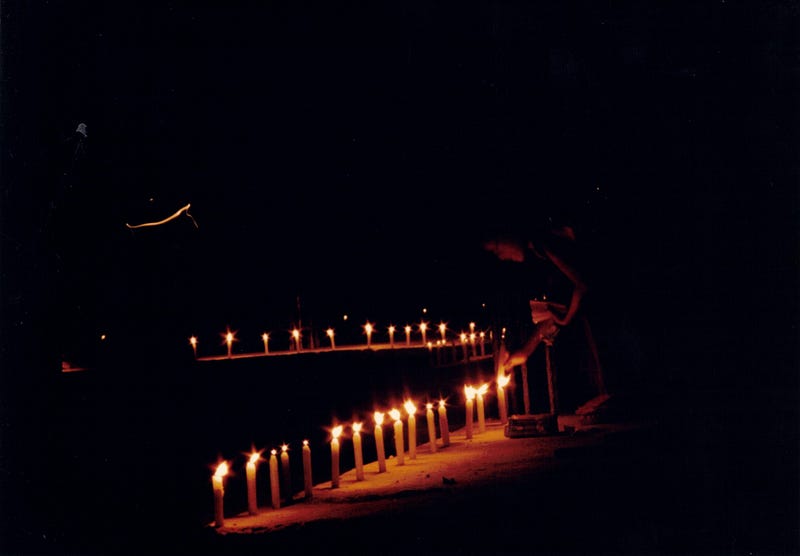
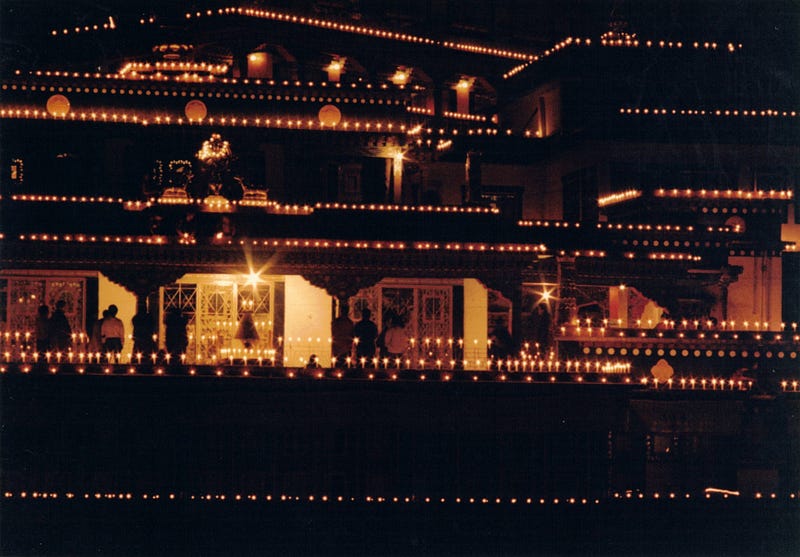
That night, the monks brought out thousands of candles and placed them singly along the edges of the roofs. By about 8 pm, the entire complex was bathed in candlelight.
The next day started early. Singing woke me up at 4 am, so I went across the street to look. Monks drew a chalk path with the eight auspicious symbols from the monastery door into the courtyard. After dawn, an SUV appeared, and many people gathered around it, including the highest government official of Sikkim, Chief Minister Nar Bahadur Bhandari. The high lama’s casket was brought out and put in the back of the car. I was told that the body would now be taken to Kathmandu (several full days driving from here) where it would be cremated in a large ceremony.
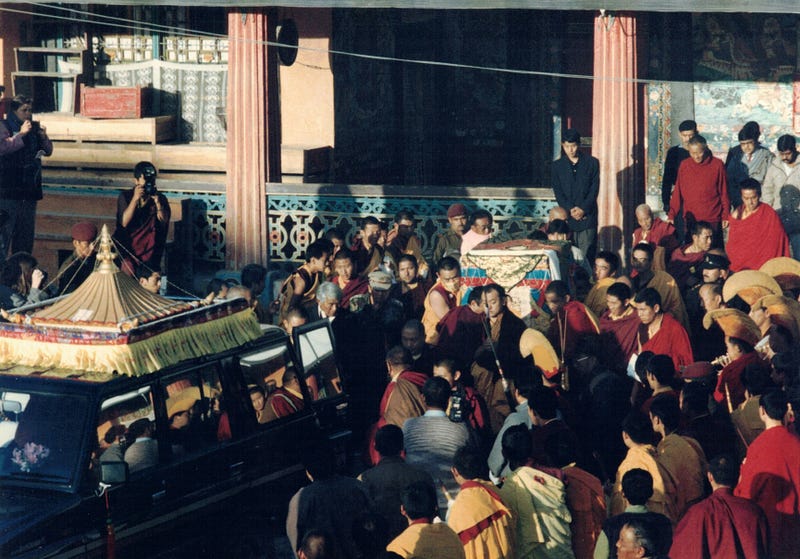
I went to the monastery’s roof and watched the car slowly descend the switchback road. People gathered at the sides, throwing khadas on the roof. Old women cried and spun hand-held prayer wheels. All along the route ahead, piles of cedar branches had been lit aflame, their columns of smoke marking the path to Nepal.
I did not take my experience at Rumtek as a sign I should become Buddhist. I’m far too critical of belief without analysis and of the social enterprise surrounding religious concepts in general. Nor was my experience any attempt at meditation.
But that feeling of synchronicity and acceptance by others is a powerful thing. Religion is good at generating that, whether through Buddhist chanting, singing church hymns with dramatic organ music, circumambulating the Ka’aba in Mecca during hajj, or dancing around a fire along with fellow villagers while wearing a scary mask.
This article is a response to the Globetrotters Monthly Challenge prompt “Spiritual Sites” from Anne Bonfert:
Personally, I am much more familiar with the genre of spiritual site described in this article from Warren Thurlow:
This article, by Matthew David, is a wonderfully described meditation course he partook in, something I would like to try someday:
Thank you for reading! And thank you, Globetrotter editors JoAnn Ryan, Anne Bonfert, Michele Maize, and Adrienne Beaumont. Please check my profile for other travel-related articles at Brad Yonaka.