
SPIRITUALITY
Ten Days of Silence
My Experience at a 10-Day Meditation Course | Pokhara, Nepal
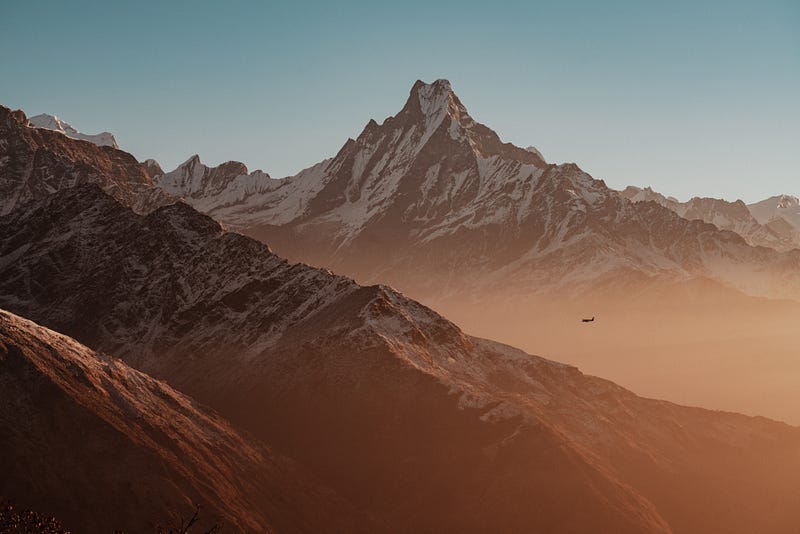
We ascended silently in the pre-dawn light, up steep jungle paths to the men’s dining hall. There at a clearing at the top of the ridge, I turned back to watch the sun’s rays anoint the icy and distant spires of Himalayan giants: Machapuchare, Manaslu, Annapurna: seen from miles away, the forlorn, gargantuan peaks seemed more remote than the surface of the moon. Closer at hand, the morning mists had started dissipating off the surface of Begnas lake below, and the screams of roosters carried across the waters. The aluminum trays and dishes started to clang in the dining hall, so I left the fragile dawn to find my plate and get in line for breakfast.
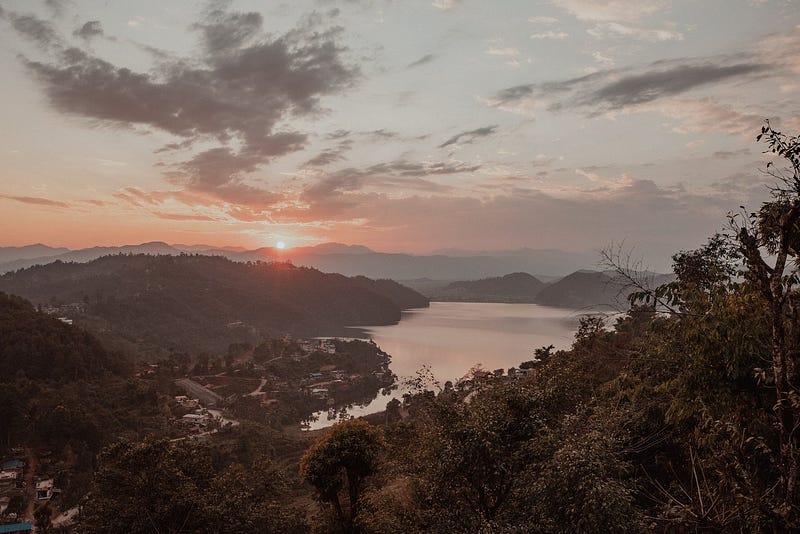
Vipassana means “to see things how they truly are,” and was the meditation technique developed by the man who came to be known as the ‘Buddha’ some 2,500 years ago. On January 1, 2022, I joined a ten-day course of intensive study and practice of this technique, directed by a nightly video discourse recorded in 1991 by Burmese Vipassana instructor S.N. Goenka, along with assistance from on-premise instructors and volunteers. We had to surrender all of our valuables for 11 days, take a vow of silence, and refrain from any act of communication or physical contact. No external influence would distract us from this sacred, disciplined inner journey. The meditation center was located above Begnas Tal in the Himalayas, near Pokhara, Nepal.
Vipassana is chiefly concerned with purifying the mind, which can’t be attempted until one’s mind is sharp and balanced enough to examine its deepest levels, and to observe the most subtle of bodily sensations. The technique requires strictly disciplined practice, and is why we spent our first three and a half days focused only on the small area below the nostrils.
Much to one’s chagrin, sitting still for ten hours a day requires the utmost mental and physical endurance. Within seconds after the starting bell (4:30 am) rings, the mind instantly desires stimulation and becomes bored when it doesn’t find a suitable distraction.
It then starts to wander, and visits one’s past: recalling figures one hasn’t thought about in decades, replaying in-depth conversations that one didn’t know they remembered; or it starts to plan one’s future — hopes and fears become calculated, analyzed, brought before the mind’s eye. Soon I’ll realize, “I’ve done it again.” I promptly return my attention to my breathing and continue to focus for another thirty seconds before becoming bored again.
When it isn’t my agitated mind that’s plaguing me, it’s my restless body. My legs, knees, and hips start to protest after sitting cross-legged for even a few minutes. I feel burning, itching, and throbbing sensations popping up all over, especially in my right knee, which I abused the hell out of during two months of almost constant trekking in the Himalayas.
I keep wanting to itch this or stretch that, lean this way, or crack that joint, and I soon realize that my entire foot has fallen asleep, as countless, formless icy needles start to assault it. I start to think about how many of these dreadfully silent days remain, and how I will possibly maintain my sanity through all of them. The two hours here before dawn seem like an eternity, but by some miracle, the clock eventually strikes 6:30 and the bell rings for breakfast. We break posture one by one, and I struggle to rise to my feet with muffled groans, as my throbbing and strained muscles protest at the act of rising again.
We eat, and live really, as monks do — aside from the robes and the shaven heads. We have no menu to order from, and we are paying for neither food nor housing. We take what is given, provided solely by the donations of students who have come before, and watch without words as our plates are filled with vegetarian dishes by the servers at the table, then go back to the benches to eat in contemplative silence — save for the loud, abrasive smacking of lips of the Nepali boy eating beside me.
We then wash and dry our aluminum dishes and set them back at our assigned places, then cover them with a turquoise linen napkin. After admiring the horizon of snow-capped mountains after sunrise for a few moments, I headed down to brush my teeth, then collapsed into bed in our cold and damp room, and slept until the 7:50 am bell rang. There are ten hours of meditation each day; ten hours of focusing all my awareness on a patch of skin no smaller than a few square inches.
The mind is like the ocean. As one delves below the surface level of the mind, one observes currents and secrets there, and a stillness that is not accessible at the surface. Journeying deeper reveals even more mysteries, realities, and even another world. After spending four excruciating days trying to balance my mind, I began on day five to really dial into my meditation, as we began expanding our awareness beyond the upper lip to rove slowly over the entire surface of the body.
After hours of toil, I came to feel brief, isolated sensations ignite everywhere my focus resided. As these continued to ring out as my focus deepened, I felt that I was no longer at that shallow, surface level of my consciousness. Whatever it is that I refer to as “I,” dwelt no longer on the sensory edge of my body, aware only of my external surroundings — it was starting to withdraw deeper within me, retreating into some inner sanctum.
I was no longer concerned with stimuli originating from elsewhere in the room, I was aware only of matters on the inside; as if the external surface of my body was the periphery of all that mattered, where all experience ended, not where it began. I then felt what the teacher refers to as “uniform subtle sensations,” in the form of constant, warm vibrations all over my body. I realize how odd this may sound — I had always been a skeptic around meditation and spirituality, but I can’t emphasize enough how shocking it was to experience these tangible, palpable sensations.
As my focus deepened, I felt distinct waves of energy coursing over me, like strong tides advancing across the ocean that was my body’s surface. And as I realized what was happening, I lost awareness of time, and soon these warm waves began to move not just over me, but through me, as if a current of energy was contacting me at my front and completely passing through every molecule of my body until exiting out my back — pulsating several times a second.
Eventually, the flood of feeling within me subsided, and my mental balance inevitably toppled as I returned suddenly to the surface of that inner ocean. I immediately stood up from my place in the hall to step outside and process what had just happened. Looking out across the Himalayan lake below me, I came to the realization that I had stumbled upon an elusive boundary that lies on the razor-sharp border between body and mind where I could experience them independently of each other. What I experienced was personal and profound, yet fleeting. For a series of moments, I had begun to only scratch the surface of what Vipassana meditation can show me.
By day six, at least two of the twenty male students had abandoned the course. Their seats in the hall were soon filled by others who had been sitting further back. A Frenchman had left halfway through day one, and the Turk seated next to me had broke down in sobs on the fifth night, and was gone by lunch on the sixth.
By this halfway point in the course, I was feeling as if I had regressed in my practice. Ever since the moment of my breakthrough on day five, I had struggled to replicate that sensation, and my entire body felt blind to what had been so real just the day before. Because I now felt a very noticeable absence of those sensations, I became impatient and frustrated with myself, making it even harder to focus my mind and regain that precise mental balance I had reached earlier. At my current state, finding that level of equanimity and stillness seemed more difficult than stacking an egg on top of the eye of a freestanding needle. To make things worse, some virus was working its way through the men, and I was adding to the chorus of sniffles, throat clearing, and general discomfort that abounded in the hall.
Days seven and eight were a struggle as well. I still couldn’t get back to that state of equanimity I had reached on day five.
It’s amazing how much ground you can cover when you spend an entire day thinking, the depths that you can go to within your own mind, the names and the faces from the past that come to you that you had thought were all but forgotten. Childhood friends, moments with family members long dead, and trying to make sense of why these images came to you here at this moment. Those uncomfortable hours spent inside helped me dredge up weights from my past that still had a pull on me, and helped me to change the way I saw things past and present. In our few breaks of the day, I trod the jungle paths wondering what I was doing there, and how it was affecting me. I was in constant dread of the inevitable chiming of the bell calling us back to the meditation hall.
Yet, the abundant mental clarity over the preceding week had given me so many personal breakthroughs — new ideas of people to reconnect with, topics to write about (I had been writing in my head every day for lack of the permission to read or write, hoping I could remember enough of it for when I got back to Pokhara), new projects, and even epiphanies regarding my own thought patterns, habits and flaws. I realized it all comes back to the meaning of Vipassana: to see things as they truly are.
The final two days were no less full of struggle and grappling with my own mind. I was conscious of the fact that time was quickly running out, and that I had completely stalled in my meditation practice. Before I knew it, our final sitting under noble silence had come to an end. The instructor stood up and left the hall by his private exit without saying a word, and soon other students started to trickle out the student doors one by one. I felt as if I had failed, convinced myself that I hadn’t tried hard enough, that I had wasted ten days of my life and still didn’t know what the hell I was doing.
I then left the hall, to find the Dhamma servers standing outside the entrance, awaiting me with big smiles on their faces. “How was it?” they asked, referring to the preceding ten days. Seeing their expressions and feeling their energy wiped away all of the regret and doubt I had been feeling, and I was awash in joy as I realized I had come out on the other side of one of the most difficult ordeals I had ever undergone. It was over!
And I knew I was changed in some subtle way, though I couldn’t yet describe how. I felt an overwhelming sense of accomplishment and peace. I reclaimed my wallet from the steel chest that was being reopened and made my dana (donation) so that others may benefit from the training I had received at the generosity of others. We then had a jovial lunch after the bell called. Everyone was radiating joy and contentment — we couldn’t stop smiling.
The next morning, I was alone on a local bus back to Pokhara, with my phone steadily vibrating with the accumulated notifications of eleven days. It felt refreshing to reenter society, and to hear from and send messages out to my loved ones, and it was more than a little overwhelming to know that at the end of this bus ride, I’d have a city full of cafes and eateries at my disposal.
During that bumpy ride back into the dusty roads of civilization, I reflected on the abundance of joy that the retreat had filled me with, the weights of baggage that lifted off of my shoulders, and also a complete lack of anxiety or worry. The one doubt that lingered, however, was of my ability to continue to strengthen my meditation practice all alone; outside of the tranquil setting of the Dhamma facility.
On my first night back in Pokhara, I sat on the floor of my room at Green Peace Lodge, as a thunderstorm raged over the lake outside my window, and I began to just observe my breath, as I had been taught. I let go of all expectation or desire to experience anything other than stillness. Within minutes, my body’s surface lit up all at once in waves of vibration and sensation. I sat and fought with myself to hold balance and sink deeper into my consciousness. I directed a free flow of my awareness and sensation along the surface of, and through my body until the lightning and thunder outside seemed no longer to even register with me, over an hour that felt like ten minutes.
The sensations were more potent and intense than anything I had felt at the meditation center. Even after I stopped and stood up to stand on the balcony and watch the storm outside, my hands still tingled as if smoke or spirit were issuing forth from a million flames in unison across my hands. I was somehow more at peace, more alive, more aware than I have ever been. I looked out at a storm-battered lake but was simultaneously looking out across some other realm within myself that was now accessible to me, seeing it now clearly for the first time.
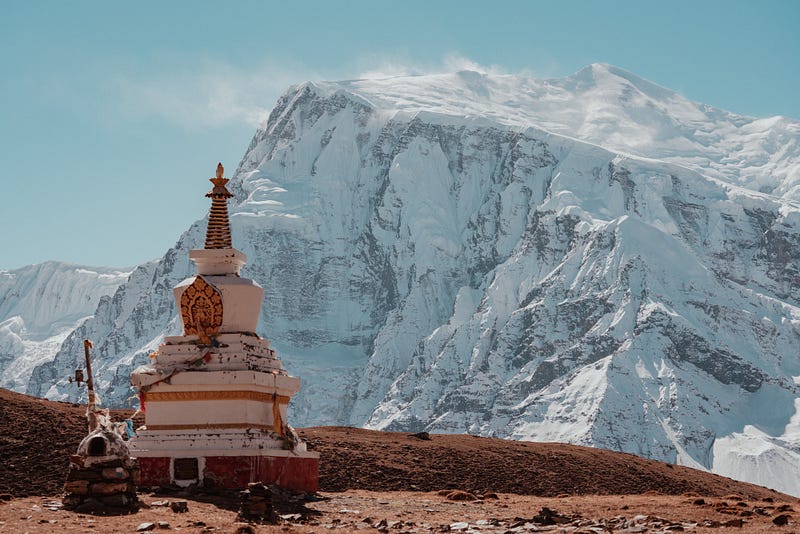
This was submitted as part of the Globetrotters’ December Monthly Challenge.
I enjoyed Mario López-Goicoechea’s photographs and sentiments from his cycle-tour of London in
(Can I join you for a ride the next time I’m in London, Mario?)
And I loved Oksana Kukurudza's story about hikes to sacred sites, particularly her film photographs from Macchu Pichu:


