
‘The Gift’: Part One (ii)
Comparative Mythology
It might help to read the first part of this if you haven’t already.
In Akkadian versions of the story of Inanna — see Part One (i) Introduction - we see a couple of minor alterations, mainly concentrating upon the added detail that after Inanna’s descent into Kur (or a psychological state of anger, grief, depression), all sexual activity — and therefore reproduction — ceases on Earth. This is why the other gods, most often in these traditions called Enki or perhaps Ea, send a rescue party to retrieve her (complete with her new knowledge from the tree which grows there).
This is where we again loop round and tie into the programme which started all this, ‘Atiye/The Gift’.
In ‘The Gift’, Atiye travels down through the archaeological dig at Gobekli Tepe (guided by the spirit of her maternal ancestor) into a chamber which contains purple crystals. This in turn leads her through to an alternate version of the world, where everything appears barren and human fertility has become deadly to the very scant few who even manage to conceive and carry to term. Women in childbirth die every time — along with their babies. In this alternate reality is the programme’s version of Kur.
Dina Katz, an Assyriology expert, has a particular interest in ancient Sumerian afterlife and funerary customs. She ties the husband of Inanna/Ishtar, Dumuzid/Tammuz (shepherds) and his sister, Geshtinanna (connected with agriculture), and their sacrificial role in this myth to a common theme of symbolic healing rituals.
These rituals include those of the Celtic/Druidic spiritual traditions who celebrate the rule of the Oak King in summer, the Holly King in winter in a continuous cycle as the Wheel of the Year turns and the two take over from each other again and again and again. In the page linked to above it is suggested that these are not actually two separate entities, but two aspects of the same being, The Horned God, Cernunnos — also known as:
“the Green Man, Herne the Hunter, and Lord of the Wild Hunt, he is a god of fertility, growth, death, and rebirth”.
Diane Wolkenstein, who you see in the video above, is a folklorist and she considers the Inanna myth to be about the union between Inanna and her own ‘dark’ and shadow side.
“Symbolic of acceptance of death in continuance of life.” - Diane Wolkenstein
Here is another connection to a cycle or wheel and we can also see obvious similarities with the Demeter/Persephone/Hades myth.
Considering this repetition of parallel stories in various ancient religions always makes me question whether this was also the original or true purpose behind Adam’s two wives in Christian lore. Lilith, the baby-killing monster (winter), then Eve, who is fertile and bears him sons (summer) — after consuming the knowledge of life and death from the tree in the Garden of Eden.
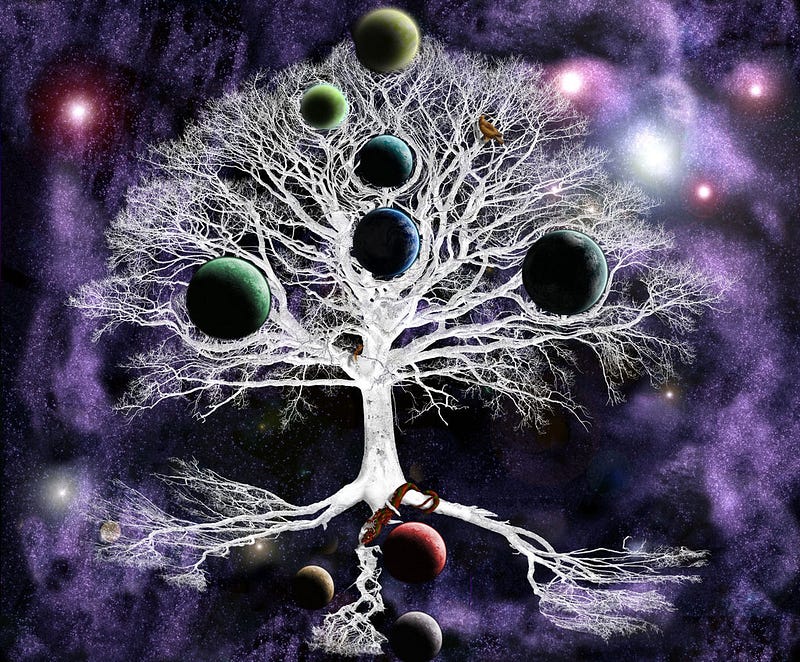
Considering trees: there’s always a holy tree — in Eden; in Kur; in Druidic lore (here trees plural); Yggdrasil for the Norse; and more. Even in the aforementioned book series/show ‘Game of Thrones’, which may be fictional but the author (George R. R. Martin) pulls together a lot of these religions and cultures within his world building. In that world ancient ‘weirwood’ trees, with faces carved onto them, are symbols of the religion of the Old Gods. These trees are scarce, but appear to have extraordinary powers. Upon joining the Night’s Watch at the North Wall (constructed from ice and held together by Old Magic), Jon Snow and Samwell Tarly take their vows in front of a weirwood just to the North of the Wall. They are also an important part of the development of Bran Stark’s character.
In the Epic of Gilgamesh — a literary history which involves five Sumerian poems about the king of Uruk around 2100BCE, later added to others to form an epic story in Akkadian — we discover something entitled ‘Inanna and the Hulippu Tree’. In this, Inanna is young and as yet without her full power. She has a willow tree, removed from the bank of the Euphrates, growing in her garden. She had intended to have it made into a throne when it was fully grown, but as the tree matures a ‘charming serpent’, the Anzu bird and Lilitu make their homes in it. Inanna cries, so Gilgamesh (who is her brother in this story) slays the serpent, frightening the bird and the Lilitu away — then makes a throne and a bed out of the tree for Inanna.

The Lilitu is a spirit which, in tablet XII of the Gilgamesh epic — which is an Assyrian translation of the Sumerian — is named as ‘Lilith’. This isn’t the same Lilith as we find in Judaism, yet it is associated with a serpent. The Dead Sea Scrolls are said to refer to ‘liyyot(h)’, plural, and in the sixth century Jewish exiles in Babylon talked of ‘demons of the night’ giving them a similar name.
The Kabbalistic version of Lilith refers to her as part of the creation myth. “the 1st light” — the Light of Mercy — appears on the first day (“Let there be light”), but is surrounded by a ‘husk of evil’ which grows and produces a second ‘husk’ which is Lilith.
Taking into consideration that Lucifer was called “Morning Star” (also Venus) and the husk of darkness ‘births’ a second husk which is Lilith, it follows that the husk is is female and is/has a womb. Origin myths around creation really need to involve elements like this (whatever the religion) because they are all coded versions of conception, gestation and birth in living creatures.
(Adam’s first wife was Lucifer’s daughter and a demoness who refused to be compliant and dutiful, so a second wife was created from an actual part of Adam’s body so that she had no choice but to be obedient because she knew nothing different until she encountered the serpent, ate the fruit and gained the knowledge of life.)
So, in other words, Lucifer/Morning Star/First Light surrounded by darkness/a dark womb/the shadow self brings about the Creation of new life/independent thought/freedom of action.
Without darkness there can be no light.
Those of us brought up with Christian teachings are told that God created Everything, so it stands to reason to me that he also created evil, to make us appreciate the good more. Therefore, ‘God’s Plan’, the reason we’ve been told bad things happen, is purely selfish — because ‘He’ wants to be loved more he makes awful things happen to us, so we’ll appreciate when they don’t?
‘God the Father’ of Christian faith sounds like the OG Narcissistic Parent to me!
Comparative mythologist Joseph Campbell (author of seminal works ‘The Hero With A Thousand Faces’ and ‘The Power of Myth’) also interprets these stories as having psychological symbology. He talks in terms of the power of descent into the unconscious; the realisation of one’s own strength through a period of powerlessness; and acceptance of one’s negative qualities.
“Mythology is very fluid. Most of the myths are self-contradictory. You may even find four or five myths in a given culture, all giving different versions of the same mystery. Then theology comes along and says it has got to be just this way. Mythology is poetry, and the poetic language is very flexible.
Religion turns poetry into prose. God is literally up there, and this is literally what he thinks, and this is the way you’ve got to behave to get into proper relationship with that god up there.”
— Joseph Campbell
From Joseph Campbell and the Power of Myth with Bill Moyers (book) (p. 141)
Thank you for reading. Stay safe. Stay well. Keep reading at Counter Arts and Rainbow Salad.