
Memoirist Idol
The Garden Gate
My grandparents’ small garden was a part of something bigger than itself
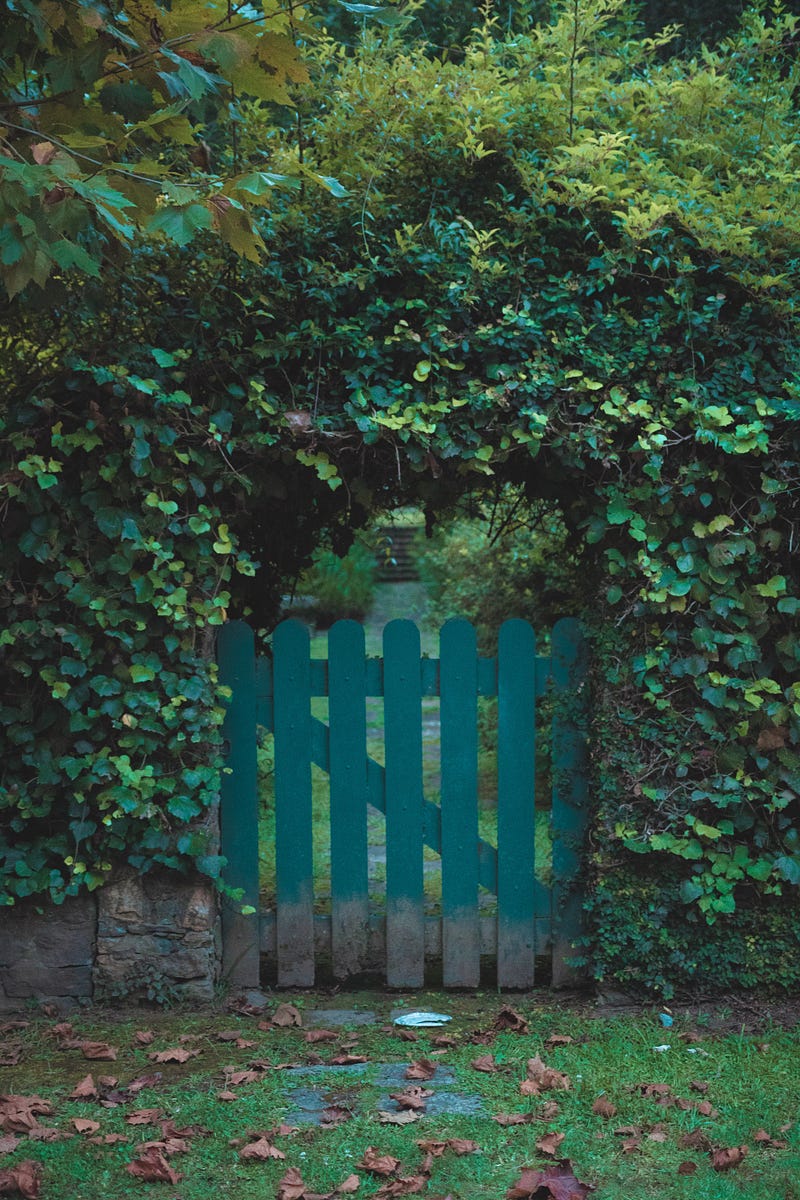
It was glossy green with tightly spaced pickets. On countless summer evenings, having walked up the narrow alley that served merely as an unadorned passageway between the very public front of the house exposed to the busy-ness of the city streets and the intimacy of my grandparents’ yard, I would watch my mother reach over the gate to flip its simple latch, or, finally tall enough, I would do it myself. Quickly I would scamper past the Rose of Sharon tree, its scent a delight to bumble bees of which I was terrified. But in a few short steps my fear was quickly forgotten
Fragrant rose bushes, with their burgundy and ivory blossoms, bordered one side of the enclosure. Along the back was the grape arbor, where in late summer enticing clusters of pale green grapes dangled from woody vines. The third side was lined with tomato and pepper plants and the fig tree, all carefully tended to by my grandfather with aged hoes and rakes.
The utility of these simple tools was evident in their worn finishes and pitted metal surfaces, metaphors for my grandfather, whose gardening expertise was evident despite the slowness and rigidity of his movements. The square bed in the center of the yard was reserved for the herbs — oregano, basil, mint, and parsley — curiously embellished by an ornate pedestalled planter of prickly Hens and Chicks.
As an inner-city child of Italian immigrants, this was my playground. It was not a traditional American playground of slides and swings and sandboxes, but a playground of the imagination where I tested my balance on the uneven bricked edging that segregated soil from sidewalk and envisioned myself a bride processing down the aisle with a diminutive bouquet of pilfered white candytuft.
Little did I know that as I pressed crimson rose petals to my cheeks to affect the mature look of a rouged woman or knelt solemnly in the soil beneath the grape arbor with my sister to bury a pet parakeet or dime store turtle that the garden gate had led me not to a mere playground but that through it I had crossed a threshold and entered a place and time that tethered my grandparents, and me, to a heritage and tradition that only as an adult I would come to treasure.
While the yard itself was small, its width standard for a city lot, twenty-five feet, and its depth perhaps forty, it was a part of something bigger than itself. It was a piece of home for my immigrant grandparents. In a new country, with a new language, where to the foreigner all things were foreign, solace was sought through the communion of customs and traditions shared with paesani, and where there was soil and sun and seed, even in modest proportions, the displaced soul could remain tethered to its past and gather sustenance to face the unfamiliar.
Often I watched my grandfather, tall and lean, in his baggy dark grey trousers into which his short sleeve button front shirt was tucked and secured by a leather belt, hunch over to prune the tomato plants which stood in tidy rows or carefully water the roots of each, extending his reach by the use of a can nailed to the end of a long stick. Little did I know that what I was seeing was a vignette of a small village in Italy where life was understood through its connections to the earth and its seasons and where physical and spiritual nourishment was attained through patient and tender labor.
Today the paint of the garden gate is dulled and peeling and the yard unkempt. My own garden has diminished to a few herbs and a fig tree. But in Philadelphia, in a small yard on Dickinson Street, a great grandson, tall and lean, in jeans and a T-shirt, hunches over to prune and water tomato plants and with tenderness and patience connects to the earth and its seasons and to a legacy begun in a small Italian village life times ago.
Shoutout to May Y. Yang for her poignant story We Were Outsiders, But We Had One Another — He Had No One. It is beautifully written, well-paced, and impossible to begin without wanting to read to the end.