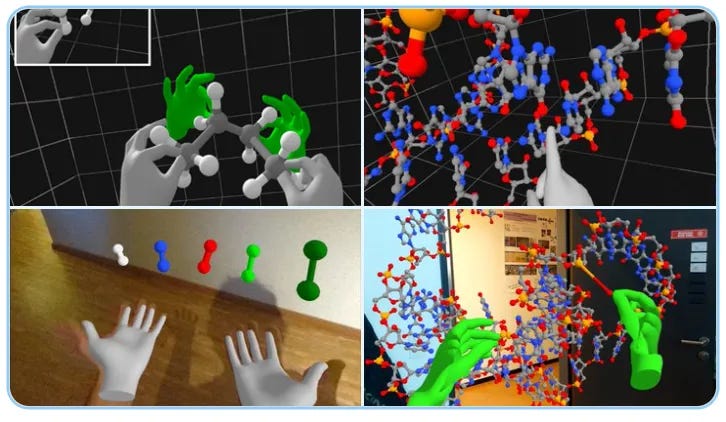
The Future of Chemistry Education is just around the corner with HandMol
A free tool for immersive molecular graphics and modeling that runs in all devices from computers and smartphones to VR headsets
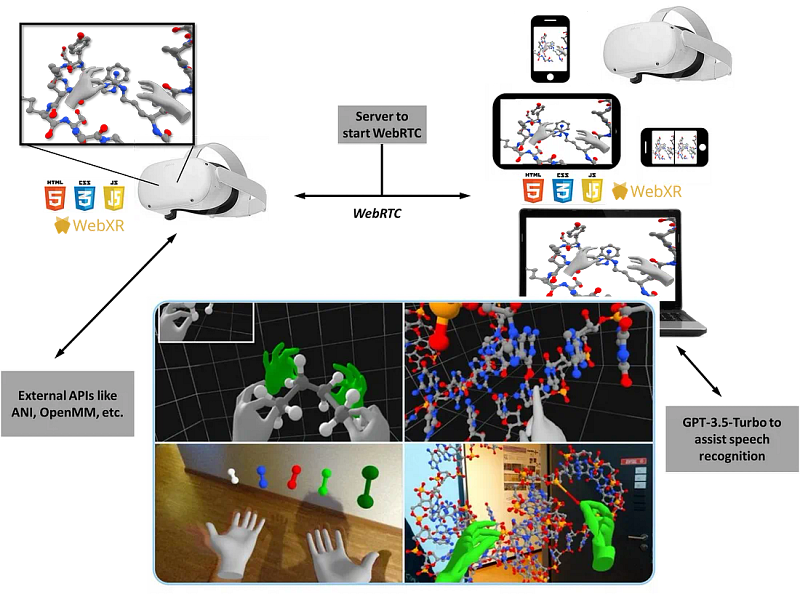
Today I bring you, dear reader of Age of Awareness, a tool that blends several new technologies into a science-fiction-esque resource for education (and also possible for work) in chemistry. It is called HandMol, and it is a fully web-based app designed to revolutionize the way we visualize, manipulate and discuss molecular structures. Moreover, the tool and associated preprint offer a glimpse into the future of science education and scientific research in general -possibly inspiring others to create similar tools applicable to other fields of STEM education.
What HandMol exactly is
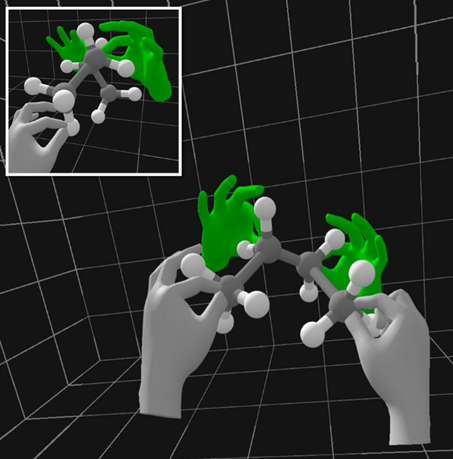
HandMol provides immersive visualization for molecular graphics and modeling, extended with capabilities to interact with atoms and molecules naturally by using simply one’s hands, realistic physics and chemical simulations acting in real time, and the option to have two users acting together immersively on a molecular system.
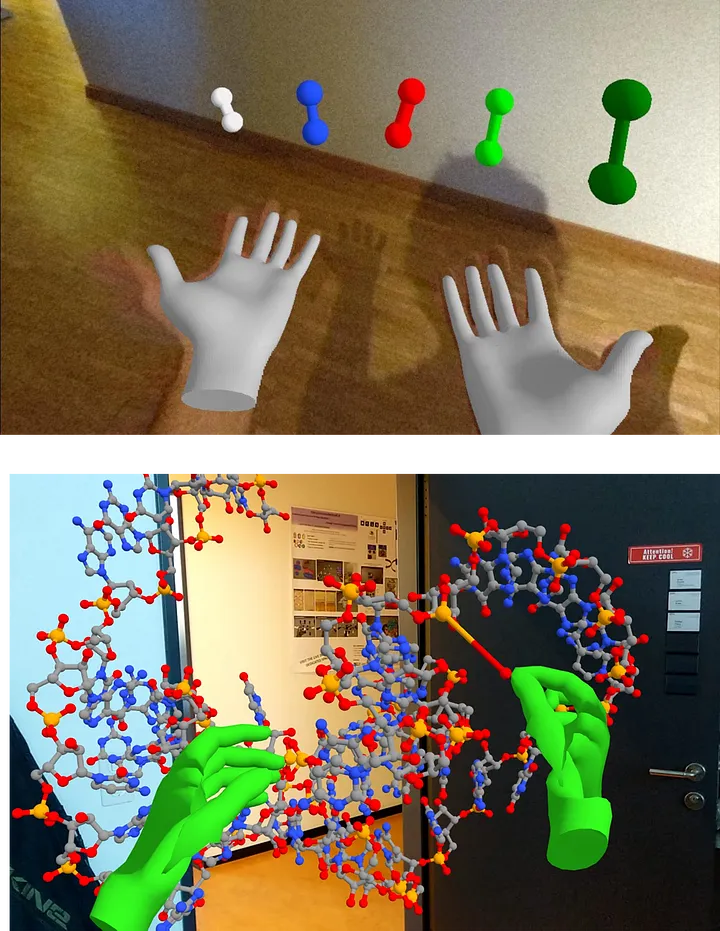
Something like what you can see in the following picture, where the two grey hands belong to the person whose view is displayed and the green hands belong to another person connected to the same VR session:
If you want to see more before we go into HandMol’s details, check out these videos:
Best in VR headsets, but Democratized to Support Other Devices
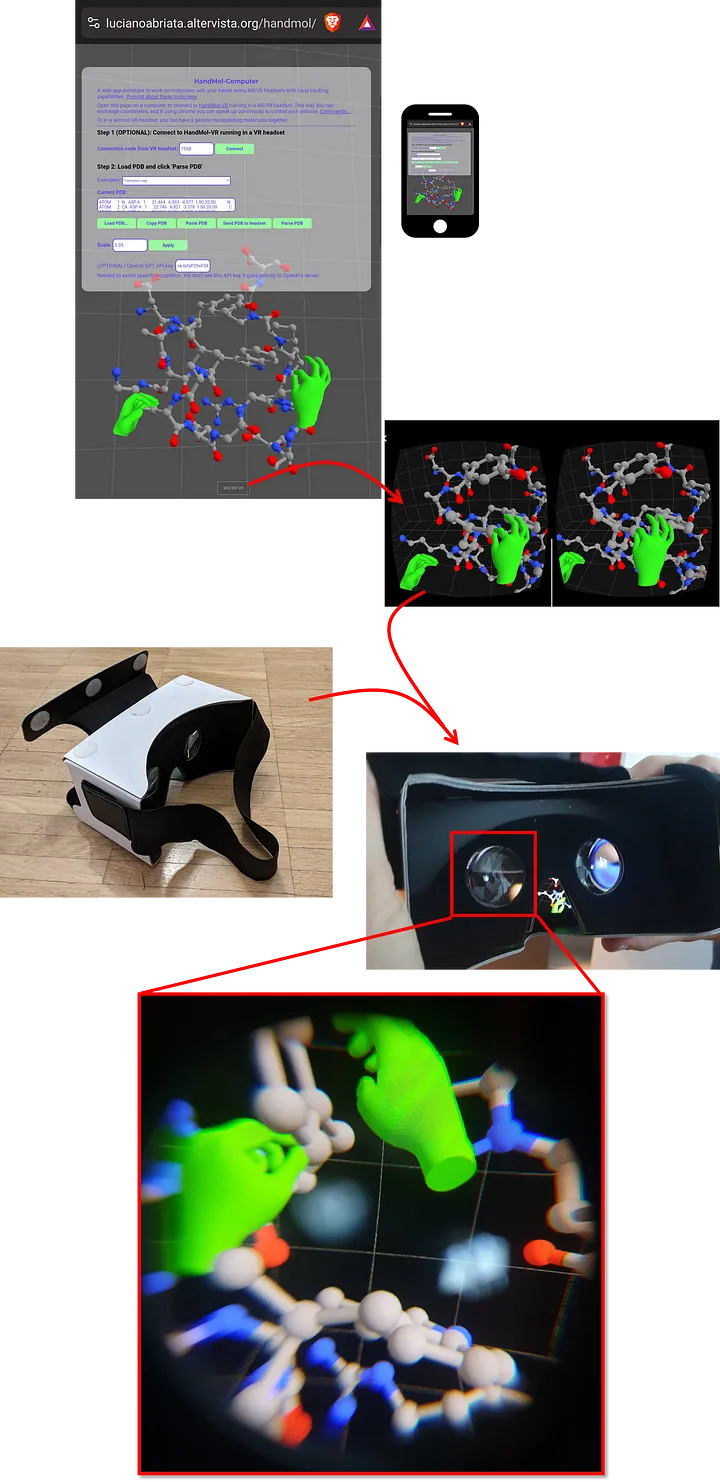
As you might be advancing from HandMol’s description, it is meant to be used in VR headsets (we recommend those from the Meta Quest families, which start today at USD 350). But thanks to its core web nature, HandMol actually runs on all devices, even immersively in smartphones. So I recommend that you read on even if you don’t have a VR headset at your disposal.
Just to prove it, here you have the app running on a smartphone and then in a smartphone in VR mode whereby it is inserted into some $2 goggles to produce an immersive view that has nothing to envy the VR headsets -although of course hands aren’t tracked by the phone so you can’t grab molecules with it (in the picture, the hands belong to another user who entered the session in a VR headset):
How HandMol Could be A Game-Changer in Chemistry, Especially in the Classroom
I am of the idea that gone should be the days of static two-dimensional representations that fail to capture the true essence of molecular structures, which are inherently three-dimensional objects. HandMol intends to address exactly this, and could then pose the paradigm shift in molecular visualization. But it isn’t just about seeing molecules on a screen, it’s about experiencing them in a way that transcends traditional boundaries and allows more natural interaction between human users and computers, and also between humans -such as teachers and students.
I believe that even this prototype of HandMol is ready to take students’ understanding of molecular structures to the next level.
Imagine a classroom where students and teachers can engage in real-time discussions and manipulations of molecular models, breaking free from the limitations of 2D pictures and also providing features that classical plastic-made molecular modeling kits can’t offer, such as realistic mechanics and the possibility to build huge systems.
Some Concrete Examples Right out of HandMol
HandMol includes several examples that can help illustrate various concepts of basic chemistry (bonding, molecular geometries, isomerism, conformation and dynamics, reactivity, etc.) and introductory chemical and structural biology (proteins, nucleic acids, protein-drug complexes, etc.):
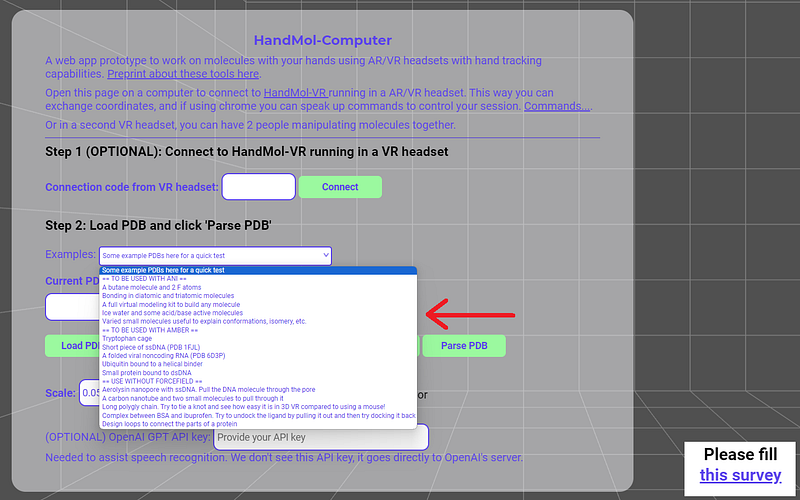
While I’m sure you can come up with more ideas by trying HandMol out, let me share with you some concrete example applications based on the example molecular systems that HandMol brings out of the box:
HandMol as a “Virtual Modeling Kit” The hands-on experience of assembling molecules probably enhances the understanding of molecular geometry and structure. Plus, realistic mechanics automatically inform the user about possible geometries, bond lengths and angles, etc.
Choosing A full virtual modeling kit to build any molecule with Minimize on release active with the ANI forcefield, you get to see a series of atoms distributed in space that you can move together to build molecules atom by atom. Once the molecules are built, you can make them interact, deform them, and do any other similar thing you’d do with molecules loaded already formed.
Exploring Molecular Conformations and Isomery Visualizing molecular conformations in 3D can be challenging with traditional methods. HandMol simplifies this process, allowing students to explore and grasp molecular conformations with ease.
You can for example load Varied small molecules useful to explain conformations and isomery (possibly but not necessarily with Minimize on release on with ANI); and in this session compare how butane twists around the C2-C3 angle but not butene, or compare the flexibility of aromatic and non-aromatic rings, drive conformational transitions by hand, compare S vs. R isomers, etc.
Simulating Chemical Reactions Chemistry is not just about static structures; it involves dynamic processes. With ANI activated, HandMol enables the simulation of simple chemical reactions such as forming small molecules by approaching atoms, or making H atoms jump between water, acid and base molecules, etc.
HandMol thus provides students with a virtual laboratory where they can observe and understand the transformations of molecules. Be careful, though, with the exact reactions you show, because ANI’s capabilities are at the time very limited for this.
Understanding Biological Structures: Protein Complexes, DNA structures, and More A dedicated set of examples presents a small protein, the Tryptophan cage, as well as a protein complex for ubiquitin, an RNA molecule with a 3D fold, a protein-DNA complex, and even a protein-drug complex. In 3D, these complex structures are far easier to understand than in 2D; besides, with Minimize on release active with the AMBER forcefield you can try perturbing the sytems to see how they respond, for example twisting the DNA or approaching its bases in a non-canonical way, or removing or forming salt bridges in complexes, etc.
Beyond Education: HandMol in Self-Learning and Research
It is important to stress that being so easy to deploy and use (it’s just an URL away, without registration and free to use!), HandMol isn’t limited to formal educational settings. Especially as VR headsets become more available and students can afford them, I see it possible that students begin to analyze molecules in immersive 3D at their homes, perhaps even use HandMol’s two-user capabilities to consult with each other through the internet.
For researchers, HandMol opens up new avenues for collaborative exploration. I envisage the use of this tool to assist a researcher’s work in setting up systems for molecular simulations, testing conformational changes, and engaging in real-time discussions like never possible before.
Not only VR, but also AR
One potentially important limitation of utilizing VR headsets in the classroom is that students might “alienate” quickly after loosing visual contact with their teachers and mates. Using augmented reality, where one sees the real world with virtual objects superimposed on it, might then prove better than VR. Moreover, AR is thought to allow better limb coordination and also to lower the risk of VR sickness.
HandMol includes experimental modes where the visualization happens through AR rather than VR, both in VR headsets (where we recommend a device with color cameras, such as Meta’s Quest 3 or QUest Pro) and in smartphones. See here, for example:
How to Use HandMol for Free
As a draft prototype, HandMol is freely accessible at https://go.epfl.ch/handmol welcoming user feedback on usability and features. The preprint provides detailed instructions for single-user VR sessions, VR sessions linked to a computer, and collaborative VR sessions with multiple users.
To know more about how to use HandMol, check out the dedicated section of this preprint:
Future Prospects and Extensions
As we embrace the future of education and research, HandMol stands at the forefront, offering a glimpse into a world where interactive, immersive simulations could dramatically improve education and self-learning. Not only in chemistry, as HandMol proposes in its niche, but also in other areas of the sciences and engineering.
You could imagine for example VR playgrounds where to test physics, observe biology in detail, explore 3D geometry, and more. All based on ideas similar to those put forward by HandMol.
Further reads
If you are interested in how HandMol works, check this out:
And also the preprint describing it:
Don’t miss this other web-based immersive tool for chemistry and biology, also free to use:
And here are two articles about moleculARweb, which uses AR without any headsets at all and supplementing hand tracking with feed from the phone’s or computer’s webcam:
www.lucianoabriata.com I write about everything that lies in my broad sphere of interests: nature, science, technology, programming, etc. Subscribe to get my new stories by email. To consult about small jobs check my services page here. You can contact me here. You can tip me here.