
The Flamenca: Form Poetry with Flair
Fortnightly Prompts from the Sky
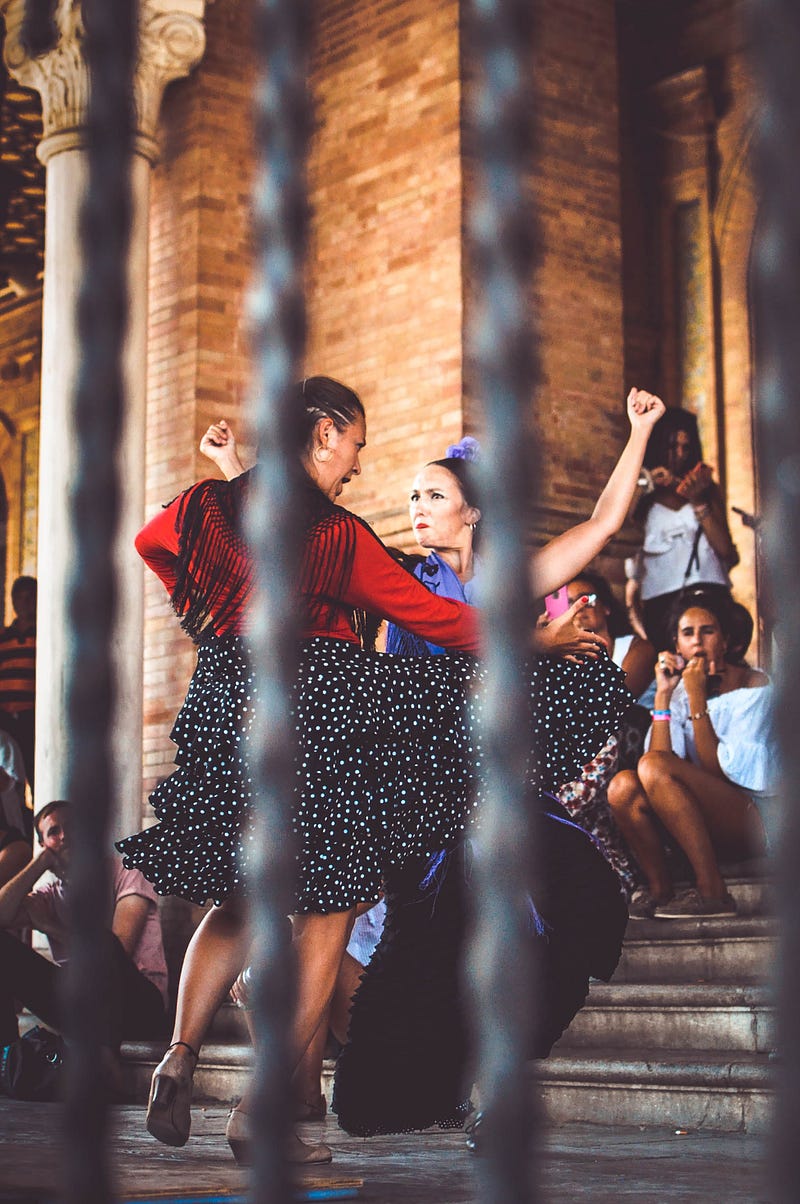
Honing our craft as poets is both a constant and diverse journey. Writing form poetry can allow our poetic voice and range to develop in unexpected directions. The framework of form, whether loose or tight, gives focus and clarity to our ideas — if not in better ways than free-verse, then certainly in different ways.
In producing these poetry prompts for Sky Collection, I’m thoroughly enjoying researching, discovering and reflecting on different poetic forms. I love how many are imbued with cultural and historical backgrounds — giving the poems a certain flavour or essence.
So without further ado, let’s discover a form brimming with energy and cultural history.
The Flamboyant Flamenca — Spanish Form Poetry
As its name suggests, this form of Spanish poetry is connected to the dramatic folkloric dance and musical form — the flamenco. Its syllabic structure is intended to evoke the rapid percussive sounds of the heels of a flamenco dancer hitting the floor. Known by several other names such as playera and sequiriya, this possibly obscured my attempts to pin down the flamenca’s precise historical origins — at least in English references.
Robert Lee Brewer of Writer’s Digest claims the flamenca is also known as the seguidilla gitana, or Gypsy seguidilla. A brief definition and example of a traditional seguidilla on Wikipedia shows considerable differences beween the two forms. The additional term “Gypsy” suggests to me that’s it’s a looser, freer variation — and certainly the flamenca has less structural rules than the seguidilla. I found reference to “The Poem of the Gypsy Seguidilla” by twentieth century Spanish poet and playwright Frederico Garcia Lorca (1898–1936), but was unable to locate an English translation.
However, there are several innovative performance examples of the flamenca on You Tube, suggesting to me that it’s a contemporary poetic form, perhaps evolving out of the more formal seguidilla.
The Flamenca — Structure and Attributes
The flamenca is both a stanzaic and syllabic poetry form. A flamenca is written in quintains (5-line verses). The whole poem may consist of a variable number of quintains — allowing a certain freedom of subject detail and poem length.
In terms of syllabic structure, a flamenca is constructed with a 6–6–5–6–6 formation.
Additionally, Lines 2 and 5 employ assonance. I prefer the Oxford definition to Wikipedia, which defines assonance as “arising particularly from the rhyming of two or more stressed vowels, but not consonants (e.g. sonnet, porridge ), but also from the use of identical consonants with different vowels (e.g. killed, cold, culled )”. However, Wikipedia has more detailed information.
So, to summarize, each quintain (verses of 5 lines) will be constructed thus:
Line 1: 6 syllables Line 2: 6 syllables (employ assonance) Line 3: 5 syllables Line 4: 6 syllables Line 5: 6 syllables (employ assonance)
The tightness of specified verse and syllabic structure with a direction as to some of the “sound-sense” of the poem via assonance, combined with a freedom of subject and imagery seems enticingly reminiscent of the elements in a flamenco performance.
A Flamenca Example
Here’s an example — a single verse flamenca — which I may develop into a longer version:
Nocturnal Incantations (update: new version - Night Burnings)
Bound by red compulsions in gritty alleyways, half-lit cantinas; her pain and ecstasy, proud feet find fevered beats
Brief analysis
I’ve taken the theme of the dancer and her emotional connection to her dancing as a central image, which is a thematic direction you might take. A dance can be a metaphor for a life narrative, which I also explore through her “red” emotions of “pain and ecstasy” (denoting blood and desire /love).
Assonance features
I’ve used the short “i” sound (in / gritty) and the sound of the “y” (long “e”) as assonance features (gritty / alleyways) in Line 2. In line 5, I’ve used the long “e” vowel sounds of “feet” and “fevered beats” and the consonant repetition of “f” throughout. There is also the more subtle repeated “d” sounds, ending “proud” “find” and “fevered” — like heel-stamps on a floor.
Subject and Themes
There are no limitations as to subject or theme. But I would suggest the form’s Spanish cultural history, originating out of a passionate and highly dramatic dance form lends itself well to themes of passion: apart from dance or dancing itself, consider desire, love, heartbreak, or other tumultuous events such as storms, fires or even political chaotic scenarios. You might imagine taking the idea of a person or a relationship and describing it through the lens of these themes.
The slightly assymetric syllable counts of the flamenca and the potential for percussive sounds through the use of assonance nudge towards certain energies more than others: emotive intensity and ardour rather than calm and reflection, a sense of movement, rather than stillness.
Sometimes for me, the focus on a form is the actual catalyst to a particular idea for a poem rising up into my mind. Almost as if, in understanding a form’s history or tradition, the holding of it in your mind’s eye creates transference of creative d.n.a from its past into the present of one’s imagination.
Inspiration from Flamenco’s Complex History
As a dance and theatrical aesthetic, flamenco is a populist form with diverse cultural origins. It is performed rawly and spontaneously on the streets as well as in cantinas and theatres, embracing darker themes than may be apparent to the conventional Western stereotype — the image of a beautiful (young) woman dancing in a red dress. Its complex cultural history embodies political and class struggles, as well as individual pain and triumph. According to Brittanica.com, certain flamenco forms such as the martinetes, an early song variation created in the environment of the forge, echo:
“the beat of the hammer against anvil, reflecting the pain and sense of persecution felt by the perpetual outsider.”
Here are some written examples, and also a link below to an incredibly inspiring flamenca called “Tightrope”, accompanied by a flamenco dancer and musician. I found this electrifying to listen to — the only disadvantage was being unable to see how the words were laid out on the page. However, what is apparent is the flamenca’s potential to come alive in performance.
Variations on the Flamenca
Just like the steps in a flamenco dance, the flamenca poem form comes with a few variations.
Alternative flamenca rhythms: An 11-syllable line
Robert Lee Brewer includes an “official” variation on his website — stating that Lines 3 and 4 may be combined to make an 11-syllable line — thus turning the verse into a quatrain (4 lines).
You could also experiment with this variation within a multiple verse flamenca — by making them all quatrains, or introducing this variation between and through several quintains. For example, in a five-verse flamenca, you could experiment with making verses 1 and 5 quatrains, or 2 and 4.
Dance a little on the page — find your own poetic rhythm with this variation.
Introduce a rhyme sheme
Brewer writes a Flamenca (“Two Loons”) where he also rhymes the assonated lines (2 & 5). You too, could experiment with this, or any other rhyme scheme.
Let yourself by inspired by the form and its thematic resonances.
Your Turn — Write a Flamenca
Get those pens flaming or set those words on fire on your screens, writers! I’ll be excited to see what this form stirs up in our collective poet’s consciousness.
Experiment with contradictory imagery, or a thread of the unpredictable, just like the chaotic rhythms of a flamenco’s heels, or those sometimes jarring emotive breaks in a flamenco vocal accompaniment. Drum up those percussive syllabic sounds to get your imagery leaping off the page!
When you write your poems, please tag me because I don’t want to miss them. Include a link to this post in your own. Please use the tag Writing Prompts on your submission, so it appears in the right place in Sky Collection.
Submit your drafts to Sky Collection. If you are not a writer here yet, please see these submission guidelines. Tagging some writers, but all are welcome to participate!
Agnes Louis Shringi Kumari Stacey Christiansen Lynne Nardizzi Nathalie E. Amazan Dennett Anna Rozwadowska Thomas Plummer Thomas Gaudex Alice F. Amanda Spiller Steven Clifford Ellie Jacobson Dr. Amy Pierovich
Follow Melissa Coffey for thoughtful essays and provocative poetry & fiction. Not a Medium member? Join with my referral link to access all my stories & so much more. Find your voice & others you’ll want to hear.
More Articles on Poetry: