The FED Doesn’t Have Skin In The Game
Ray Dalio was once again very critical of liquidity injections and monetary easing programs, which he describes as the ‘Garbage Effect’

It is not news that when Ray Dalio, one of the richest men in the world and chief manager of the Bridgewater Associates fund, speaks, he moves the market. It happened with the statements he made in which he said that he preferred Bitcoins to have bonds, which caused the price of Bitcoin to rise substantially.
This week he again made harsh criticisms of the monetary policy that the Fed continues to carry out with its massive purchase of bonds, thus injecting a lot of liquidity into the markets. He made his statements coincide with those of the FED in which they tightened their policy for the next few years and the market has already reacted exorbitantly.
The main problem that he anticipates is the supply/demand that would trigger inflation because there would not be enough demand to buy these bonds.
Dalio has not been the only one who has anticipated this inflation, Taleb already warns that we are going to enter a hyperinflationary environment, and therefore recommends selling all long-term bonds. On the other hand, Soros strategist Stan Druckenmiller has also made statements in which he affirms that the risk-benefit ratio is the worst he has seen in his life.
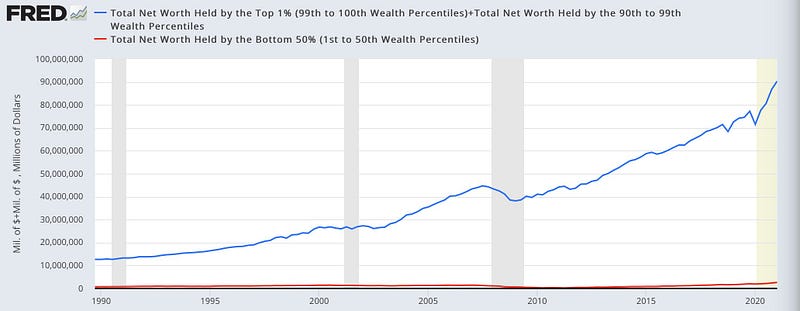
In addition, the social inequality that is being generated is even greater, as you can see in the below example since March 2020 lows the net worth of the top 10% has increased by nearly $20T while the net worth of the bottom 50% has increased by a mere $0.7T
How can we protect ourselves from these monetary policies?
This inflation will affect the markets. In addition, the impact will be greater the more they try to delay the decline, although it is most likely that the leaders of the Fed have already finished their mandate, hence the title of the article. One of the lessons that we seem to have not learned from the 2008 recession is that debt is not fixed with more debt.
When it seems clear that the USD is going to lose its hegemony as a reference currency, it seems necessary to have other currencies that can generate that stability, one of the ones that I like the most is the Swiss franc. On the other hand, we have gold that for more than 2000 years has not lost its status as a currency, and therefore, it could be a good refuge.
Finally, I propose to have a small portion of the portfolio invested in highly risky assets that benefit from market volatility. This type of strategy, if not managed correctly, can lead to the loss of capital, however, the risk/reward ratio is extremely low.
Most Recent Stories
- My Biggest Writing Mistake (So Far)
- The Ten Most Useful Finance Apps
- Building Your Financial Future as a Teen
- The Market’s Big Lie
- The Coming Eviction Crisis Will Be Merciless (Yet Mostly Ignored)
This article is for informational purposes only, it should not be considered Financial or Legal Advice. Not all information will be accurate. Consult a financial professional before making any major financial decisions.