
Data Driven Art
The End of Analog Art
An Interactive Story of 12,000 Tennis Balls
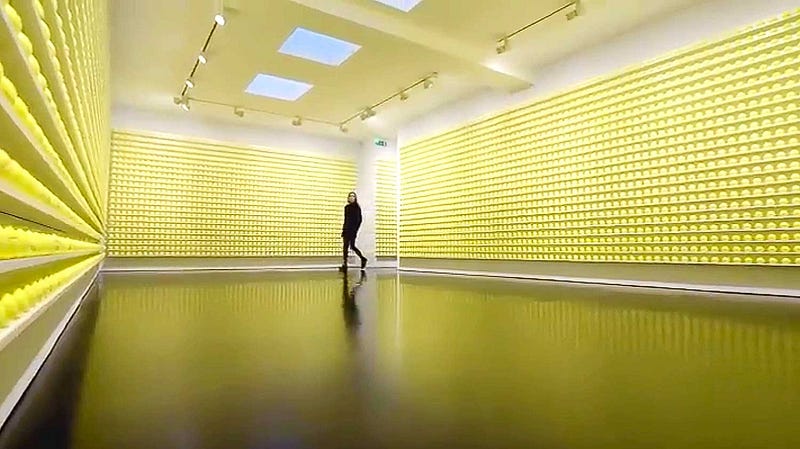
In a world where everything is documented, there are still moments that have not been established. But thanks to the latest installation by David Shrigley at the Stephen Friedman Gallery in London, those moments will be remembered. The end of the analog art world. In the two-story gallery space, Shrigley presents his structure of 12,000 tennis balls.
An interactive art project encourages visitors to bring old tennis balls to exchange for new ones. The Shrigley installation celebrates what it means to be human. The part of something bigger, but ultimately just one of many. This process shows how we can give up items when they become obsolete and puts the viewer in an artist who changes the image. Placing a worn, dirty object on a pristine yellow wall destroys the whole thing. It’s like the movie “Don’t Look Up” because you can see the truth about your role in this game. In the new world of NFT art, this exhibition is a nostalgic memory of collective participation in the celebration of art. Interaction at bringing “garbage” and advertising new products is aimed at tennis players. Instead, Metaverse game players should come to experience the wonder of giving up something to get something in exchange.
In 1972, the International Tennis Federation introduced yellow balls into the game’s official rules. The change was because the yellow color of the balls made it more visible to viewers watching the game on TV.
Literal meaning: yellow balls. The color of money for buying things, used for values in lotteries, medals, postcards, paintings… even in modern society, it is often associated with money or profit. The empty ball, the dirty ball, the dark red ball … in this installation of 12,000 balls, you can see all of them. The viewer can touch the balls and feel their weight. In some colors, you can find a hole. And your own problems are to be solved by these balls — they are not just used as decoration! I became interested in this installation after reading the description of this artwork — a white paper with instructions: “Bring something old, take something new.” This is a fascinating concept because it can provoke countless discussions and make viewers think about their roles.
The transformation from one object to another changes value and memory. The transformation of time and space. The shift from one form to another, from vague to more realistic plans. Ideas become more strategic, from individual goals to collective processes requiring participants. Instructions are like algorithms, 0 and 1, the input and output connecting every installation object, starting from the package and ending with an individual entity. The viewer as a participant/bot– a collector of objects and memories, a participant in new processes.
Just as the world of analog art ends, the world of AI art begins. Old balls can be replaced by new ones.
2021 is the last year of the dominance of physical spaces in art. The future of AI art will be where newly created Machine Learning algorithms act as artists, curators, and critics, welcoming contributors by guiding their projects with refined insights. A critic who analyses the works of art to provide a constructive critique and an AI curator offers valuable information while conducting the community regarding new and exciting artworks that they can enjoy. Welcome to the AI art world. As an AI art curator, I am proud to say that this “analog” installation is extraordinary. I hope you enjoyed reading about this tennis ball installation as much as I wanted to write about it.
Data-Driven Art is the future. It’s about time that you jumped into it.
Join us, with my referral link, to support all talented writers on medium
I am an Art Curator, founder at EvArtology, and ML consultant at MLearning.ai. I advise companies and institutions in the creative industries on using AI tools in their daily work. Human collaboration with ML models can be very creative and bring huge benefits. The new era begins now.


