
7236 Grays Avenue
The Eden Address of Memory
Free Verse
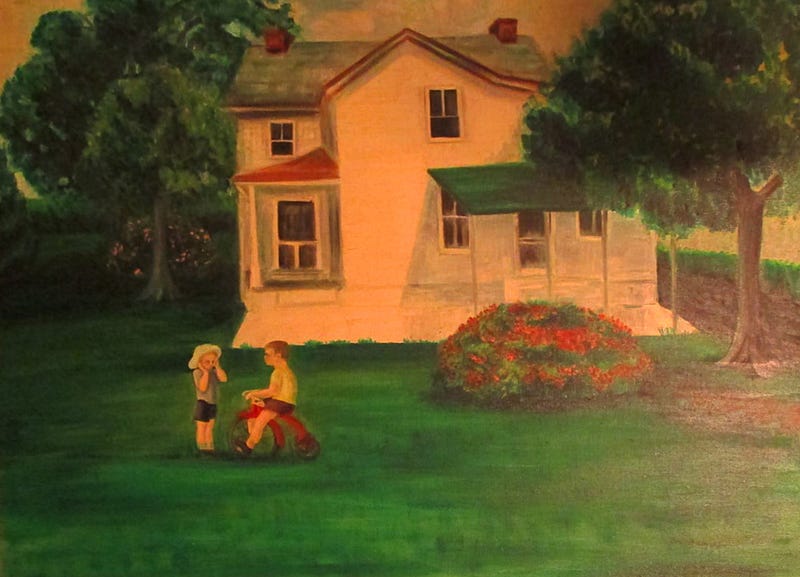
The house appears blurred — an instance of sepia pallor. It is a surprise, really, like sighting in March a monarch — Floating skyward along with a derelict crane, some broken sundial.
The instant remains as a shot — captured on a high-speed shutter — As the train shoots onward on polished tracks in a valley sunken.
Between the rough row homes along the SEPTA tracks — This rusted-autumn leaf of Philadelphia so changed from my youth — Elmwood Avenue and Island Avenue — Threatens to rise up along the R2 tracks from its decomposition.
This instant: This glimmer between tightening vices — Then and Now — Heaven and Whatever — Childhood and Adulthood. Fantasy and Reality. Creation and Re-creation.
But if my craft was better — My timing accurate, and this moving machine — Does not the train sound the same as it once did then? By the burning shopping cart in the backyard for trash? Rocking this cradle in place to my clock-appointed calendar — I would surpass the shutter speed — And utter and shudder in my seat in slow motion — Forever Frozen in Time — Fiddling to open the aperture to maximize the light of insight — To slow down every memory of that instant like stop-action animation — To see my childhood unfold there in Eden.
In the smeared window through which — Can one even look through such a window? I could share tales of my Reign on Innocence. Eden dwells at that garden address of memory — Between broken brick and concrete in a widening whorl of poverty — I spent the richness of youth there where no harm seemed close.
You would say, my friend — My fellow familiar stranger on the R2 to Philadelphia — If I told you the story of that house — If I had the courage to wake you — the power to move — To feel — to do justice to that Willow — Weeping now that my arms are gone — To consecrate that Island acre of green — Amidst faded Meadows of City cement — an Oasis So sweet, the play inside the Gates of Time, Forever ageless, circling the azaleas — azaleas so red — Yes, you would say, love, resides here.
But other residences reside, full of such love — I expect both real or imagined — Even in that strange gray and concrete house now — Where others must love and continue — Moving through the ghosts of our dust and atoms and memories — Strangers now in that once leased land of paradise — Where we all return — And hide wide-eyed — Are we really ready to say “yes”?
Yes — why should I be afraid to dance in front of others? To capture moments of glory, of insight, forgotten — In the dark corners of our adult lives, Some vaulted taboo — Yes — wanting to breathe again, once again — With the lungs of childhood and promise.
Dream your house, my friend, my fellow traveler — Allow me mine. For I expect to see the house soon — Not in a dream, but real, not in sepia photos or Super 8 films — As I pray it will — As it always will, standing, waiting, breathing — As a constant — my reassurance that time is a friend— Why do we treat time with such animosity? Where no morning glare dare reveal the lines Of decay on a grandson’s princely Dominion of Youth.
Ball games — Kentucky coffee trees — and rain watching on the porch — Comforting without fear.
The old house appears for an instant. And in that instant, I relive those days again — With such clarity, where I was love’s champion And cherub — baptized in backyard puddles — Holding such firm command over life with the family blessing — Conscious of the self-importance where the house existed for me.
My grandma, my grandpa, the momentary tenants, Caretakers of the house for me, for us all, for what times we had.
Isn’t it foolish to think we own anything?
I close my eyes and return — Rolling, moving further away as I move closer. And again I walk toward the house as I had for years — To clutch the chain link fence, Never thinking the house so small — So weathered — the gray silence so strange.
I want to think they’re still home. Grandpa in his music room and museum — An old curiosity shop — My grandma making a roast.
And they will welcome me, kiss me, and start with — Remember when? And I will smile and listen to the stories I have already memorized — As I watched and worried before I even knew about worry — Since time has slipped unseen through the gate.
The stranger on the train beside me stirs. He checks his watch. The train is one minute late arriving at Suburban Station. What is one minute? One hour? One lifetime? With every stop, we have aged. As everything — everywhere — has aged.
Are your lines deeper? Are my eyes darker? In the yellow grime of the train's window — I say goodbye to the stranger as he collects his briefcase. He follows the fault-line in progression to the outside maze.
I remain seated — Not wanting to close the scene on this play. I pick pears for grandpa at a penny apiece, Turning bricks over for surprises — worms! Burning grass with my magnifying glass —
The scenes keep me as a man — so curious — So grounded in the now — Nurturing the boy in the man — So the man may leave the boy. As I now leave the train — Time, indeed, has played with me enough For today.
Thank you for reading. You can listen to the poem here. Follow me on Medium at Walter Bowne.


