
The Dutch invented the stock market and here’s why that’s important during the coronavirus outbreak
In moments of crisis, humanity goes back to their routes and for some reason, the story of where one humanity ends is where a new humanity begins. This is a real story of the beginnings of western civilization and the end of their bad upbringing.
The first stock market in the world started in the country of tulips, the Netherlands.
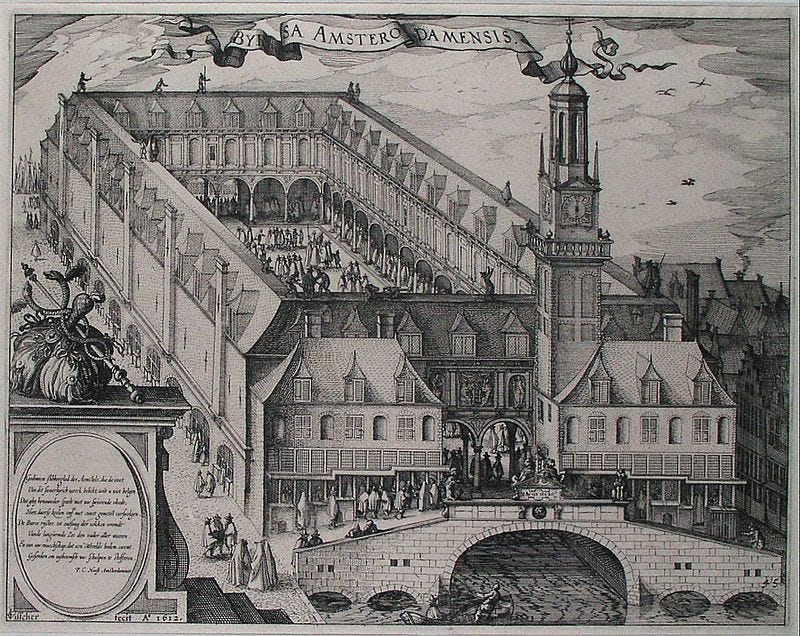
The first stock exchange was, inadvertently, a laboratory in which new human reactions were revealed. By the same token, the New York Stock Exchange is also a sociological test tube, forever contributing to the human species’ self-understanding. The behaviour of the pioneering Dutch stock traders is ably documented in a book entitled “Confusion of Confusions,” written by a plunger on the Amsterdam market named Joseph de la Vega; originally published in 1688.
It all started in the 17th century when the Dutch, as traders and navigators were building empires of money from the ships with spices they were bringing from India through the Amsterdam harbor, the greatest in Europe at the time. Their experience as navigators allowed the Dutch to bring more than 50% of the ships from India into Europe without failing. But despite that, a lot of the wealthy people could afford to lose a ship every once in a while as for others a shipwreck would destroy their entire lives. It was then that the stock market was invented to help these businessmen and traders not lose their confidence in their investments. The stock market allowed everybody to buy a small share into the cargos so it would be a split loss instead of an individual loss. That’s why they talk about “ emotional laboratories” because they learned how to deal with loss as a society instead of individually.
The emotional connection between this story and what’s going on in the world today may not seem obvious, but I think it is. I do not believe in coincidences but in synergies and I believe history is teaching us all a lesson today.
System of systems
If the planet has a “flu” it gets “cold” and our Mother earth just got a bit colder while the pandemic affected our production of polluting CO2 emissions. When you look at it from that perspective, the pandemic doesn’t seem as bad as it is.
Also, if the economy is affected by the pandemic more than people who die from the pandemic, then the reference system is wrong for taking the quarantine measures to help stop the spread because the future deaths from the economy crashing will be much harder to take. It won’t affect only old people with previous illnesses but mostly children and mothers as well as vulnerable workers and devastated bankers taking suicide note as their last contribution to this life.
You see, everything can be flipped and seen from a more macro perspective when we think of how it affects our microcosmos. But the reality is that being human means that we can’t only see the macro as much as we can’t only see the micro. It’s somewhere in the middle. The objective macro allows us to make rational decisions and has proven by many economists to be the way to go forward when calculating financial impacts and projecting models of economical behavior. But the reality we’ve tried to neglect is the one that unfolds today. It’s much more subjective than we like to think. We could care about the fact that the stock market is crashing but the stock market, as we learned from the Dutch when it was invented, it was invented in order to spread the loss to more people than just one. It was a financial abstract tool created in order to help people who were suffering big losses on their own.
The paradox of collective individualism
What happened in China was for sure a terrible misfortune. The Chinese use the word “fortune” as a symbol of a power outside their own that can influence their system. They also believe that individualism is ridiculous in a country of a few billion people. They are however proud of being an ancient wise civilization and connected to their routes and energy systems. Still, when the virus started to spread, the first thing they did was to put an entire city of a few million people on lockdown to help stop the spread and contain the newly discovered Coronavirus. Their reaction was what most westerners would say as being submissive to the communist system.
The collective totalitarian system in China allowed the virus to be contained despite being so violent in its velocity of spreading. It got to a few other countries though due to the Chinese New Year and that’s when we started seeing how democratic countries react to it.
The Italians felt their joyful way of life should not be strained by such an event so they carried on until it became clear there is no escape from it and life as usual needs to stop. The democratic countries where individualism is part of the pop-culture turned something that could be contained into an untamed disaster.
But coming back to the stock market, I would like us to focus the attention once again at the element of ownership. Ownership in this context is for both good and bad events that a society needs to deal with. The stock markets taught us to cope with it better together than on our own while individual ownership of goods could grow.
One time I asked Professor von Mises, the great expert on the economics of socialism, at what point on this spectrum of statism would he designate a country as “socialist” or not. At that time, I wasn’t sure that any definite criterion existed to make that sort of clear-cut judgment. And so I was pleasantly surprised at the clarity and decisiveness of Mises’s answer. “A stock market,” he answered promptly. “A stock market is crucial to the existence of capitalism and private property. For it means that there is a functioning market in the exchange of private titles to the means of production. There can be no genuine private ownership of capital without a stock market: there can be no true socialism if such a market is allowed to exist.”- Murray Rothbard, in “Making Economic Sense” (2006)
So in the economical sense, private property is for those in capitalistic countries, not for those in communist countries where socialism prevails. Yet, if we look at the rate of ownership of houses in the Netherlands compared to Romania for example, a former communist country from the Eastern European block, there’s a big discrepancy: Netherlands 69% and Romania, which has 96% ownership rate, ranking the first in the world at this. Now I know that correlation is not causation, but there is some truth to it that is undeniable here.
As data shows, socialism doesn’t stand for less privacy nor for less ownership. Moreover, if we look at architecture which I like to use as the most edificatory example of how we perceive our inner lives, the houses in China and in communist countries have far more walls and concrete to prevent the light from coming in but also the unwanted eyes than any capitalistic country. The Dutch are especially known for their big windows and lots of light coming in their houses along with the curious looks of street bypassers who can see from street level directly into the living rooms. There’s a clear correlation now between more privacy in the sense of personal intimacy in socialist countries than in capitalistic ones.
But this is actually history more than the present. The progressive Dutch culture has changed a lot in the last decades. The pillars of this front runner in innovation in all areas are changing while the burden of the world is still being carried out by them with one of the most powerful economies in the world.
I wrote another article on collective trauma and shaping the emotional intelligence of society as a group through “black swans” the 9/11 event, the floods the dutch faced when they started building their dikes and communism. The history of the dutch with water goes a long way back. Not only they started having in the 8th century the first innovations with dikes in history but they became better at it through their 11 centuries of fighting the waters. As such, in the 19th century when the last families were involved in helping each other to survive the floods, the great grandparents of the generations living today still had embodied knowledge of what collectivity feels like. Individualism did not prevail and moral values, despite being functional, low context and progress-oriented included family and preservation of human connections and bonds.
The Chinese, on the other hand, have a radically different approach and requires much more context. Chinese people value money today because they didn’t value that as a society for centuries. They were focused on being happy more than making money. That changed since China became the factory of the world though. As such, the Chinese have changed their high context culture for the sake of economical progress but may have lost some of their happiness on the way.
The Dutch society also changed once again in the ’70s when the dutch laid back style became a new norm. The bikes bring about that wellbeing conversation the world is avoiding to have. Their economy has achieved the highest standards and so they could afford to explore back the depths of the human soul. The emotional intelligence allowed them to continue growing while developing more emotional depth without losing their grip on the steering wheel. It was not until the rise of new technologies and internationalization and globalization took new proportions that this stable paradise was shaken once again.
Despite being a great nation on a small land and having built the first multinational corporation in the world ( The Dutch East India Company) and later the most innovative system developed by the Philips corporate model which allowed every country to have its own market approach and with that become one of the most powerful companies in the world, they failed at one hierarchy: the one about family. The more they learned how to create the abstract organizational structures, the further they were from the elements that glued things together. In medieval times, the king was not a scary figure like Hitler or Stalin but instead, it was one with many servants ready to die for him. The same structures applied to the western world building their modern leaders. We know more about the American “t-shirt” founders of the new tech companies than we know about all the CEO’s of European companies that make the majority of publicly listed companies on the stock market. That’s all because somehow, the west had to prove there is “nothing to hide” by trading our privacy for it. It was a forced way of invading the privacy that started with an existing need to prove their fairness during their trading history. The weighting of goods shiped by sea would prove is the entire cargo is grains or not because volume and weight would be correlated in the main markets in Amsterdam. But later on, witchcraft became the religious context in which people had to prove they don’t do any magic in their homes by leaving big windows inside their private homes to disclose that goes on inside to the world.
That’s where the correlation between forced lack of privacy and controlled building up hierarchies comes into place.
The big “hairy monster” had to be demystified and the organizational structure had to dissolve for more flat ones in order to allow values such as transparency to prevail.
I am sure it makes no sense why “nothing to hide” is brought in the context along with transparency. Well, in a family, being vulnerable means being held accountable by the ones that know you best. That’s one of the most important values of a family that allows the growth of their members. However, in a society where family values become diluted, where marriages fall apart and kids leave their nest as soon as they are able to provide for themselves and never benefit from the direct support of their family unless it’s really necessary, the value of being held accountable and thus vulnerable falls through the cracks.
Being able to be truly transparent without the fear of being humiliated for your shortcomings is a resilient trait of personality you don’t get to develop unless you get both the accountability and the support of the family from very early on. Now going back to the independent and individualistic nature of the westerners, they tend to grow in families where accountability exists and held at a high moral standard for growth, however, the safety net that there is support and failure is “allowed” doesn’t seem to exist as much as in Chinese families where up to 3 generations live in the same house together. The westerners have thus developed more the model of individualistic that needs to be transparent because society requires that but would much rather become part of a group without standing out of the herd because that provides the safety.
The irony is then that despite fighting for transparency ( thus accountability for our actions in public settings) as a way to move forward, that was not developed together with a sense of safety provided for individuals but more for collective society. As such, the pitfalls of such societies are that they look for a sense of belonging in the hierarchies that they forgot: family and loved ones. It’s now a full circle that the society that invented the private ownership through collective investments ( the symbol of capitalism being the stock market) is looking further into the values of the collective ownership ( with all its intricacies we see in sharing economy trends) through the lenses of accepted socialism.
The paradox of socialism being the “black swan” of the Dutch
For many years I was telling my friends back in Romania that I live in a very socialistic country here in the Netherlands but nobody really understood the paradox. How could it be?
Well, people in this country have made a new step now with Mark Rutte going on national TV for the first time in a speech since probably the 9/11 incidents. The very quite politicians in the country reveal a way of being that allows people to focus on themselves while the country is being taken care of. There is very little panic, more ration, and more discipline than in places where everyone is vocal all the time, yet everyone’s voice is still heard here.
The Prime Minister addressed the nation with a very interesting message very different from the rest of the world about the coronavirus.
Those who have had the virus are usually immune afterwards. Just like in the old days with measles. The larger the group that is immune, the less chance that the virus will jump to vulnerable elderly people and people with poor health. With group immunity you build, as it were, a protective wall around them.- Mark Rutte
His values clearly show the socialist views more than the capitalistic ones. We “own” together a sickness but also an immunity to it that allows the strongest to survive and carry on life as usual. However, the economical burdens we undertake while taking this fall of the stock markets and workforce realities are still something supported by the entire society. China did not help people who are part of the gig economy and have lost their jobs due to the coronavirus lockdowns and quarantines. But the Netherlands does.
There’s an underlying message here about a “black swan” as Taleb talks about in his books that we haven’t seen coming from the founders of capitalism: the Dutch are going back to human values! The values of helping each other as people allowed them to form that first stock market, and now in the face of a virus crashing the stock market, they don’t protect the companies but the people who are behind the companies so that new ideas can emerge after the emergency is over and life can go back to its normal rhythm. Proving antifragility means building resilience not as a collective but as individuals. And despite many thinking that collective immunity is not about individuals, it seems to be more about that than about collective benefits. Of course, we do share collective benefits at the end of this, but the individual is the most protected in the entire ecosystem.
The reference system is the human again
We talk so much about circularity today and about human-centric businesses, but we don’t address them in the philosophical way in which they were intended: to serve as a reference for how we view the world. The world does not revolve around individuals, yet every individual is part of the whole. Being in a circular format means that we always come back to the same point we started from.
In this case, the Dutch invented the stock market to take a fall as a group, not as individuals and today when the stock market takes a fall, we stay together to form immunity as a group despite that making our stock fall, even more, showing that the instruments we created don’t control us; we control them! That is full circle humans being humans.