
How Societies Develop Emotional Intelligence Through Collective Trauma
I’ve been living in the Netherlands for over 5 years now and there’s one story I keep on hearing that makes the explanation for why they are emotionally intelligent compared to my home-country fellows in Romania. They tell me about the story of their dikes. The waters came and flooded the Netherlands and that had forced people to work together to stop the water … but they didn’t share their private lives with others. They learned to work together for this purpose but individual survival was still an individual battle. The 19th century Van Gogh painter who killed himself after receiving letter from his brother that he is having a child and will no longer be able to support financially the great artist revealed how these family businesses where not something encouraged. Living off the wealth of your family was not really an option for Van Gogh despite having a priest father and an art dealer as a brother.
My home-country on the other hand, was a country suffering from collectivism during communism times. So the country forced putting together resources but didn’t care about individual survival. Most of Romanian families support their children until a very late age and individual survival is a matter of the collective family putting resources together. This is the result of the fear that the government will not care about its individuals and so the family needs to be the safe space.
Now the analysis between the two types of individuals formed growing up in these societies is an impressive combination. The first, the dutch develop a native emotional intelligence because they grew up in a community where the government cared for them and is still taking care of people ( the impressive social system in the Netherlands is the result of that), but their knowledge of individual surviving is very limited. They only( or mostly)do well in groups. The second, the Romanian will be a resilient person with a deeply ingrained survival mechanism because it benefits a collective family that can support anytime if things get hard but can’t rely on the government structure. However, the emotional intelligence required to connect the dots with new social groups outside the family will be a different ball game. As a result, the millenial generation created the “light revolution” in 2017. Our group intelligence was born after this point and Romanians are becoming awake and trusting their peers and learning emotional intelligence as a society from scratch.
As a consequence, both groups will have pitfalls when it comes to individual knowledge of either their survival or their ability to connect dots but they will share a common pattern on the collective memory. It is known that the effects of a collective trauma can span up to 2 generations. People who experienced first hand the trauma will be the ones most impacted and would not be able to completely handle the lessons coming from the trauma. However, the second generation will already be able to make sense of the key learning and will rewrite the impact from a less emotional perspective.
Let’s see what that means for emotional intelligence.
There are 2 levels of capturing and somatizing collective trauma:
- The direct way would automatically lead to a high intense emotional impact which forms a coping mechanism that closes off people. They become extremely rational and try to solve cognitively situations and that leads to a surviving mode ( listen to Esther Perel’s story of her Jewish family living emotionless after the holocaust and surviving the concentration camps).
- The indirect way when you are second generation and you will live with the people directly affected by that trauma but you won’t be able to intellectualize it so you will experience it on an emotional level. This trauma is harder than the first because you don’t even know what it is exactly.
Intellectualizing vs Emotional Intelligence
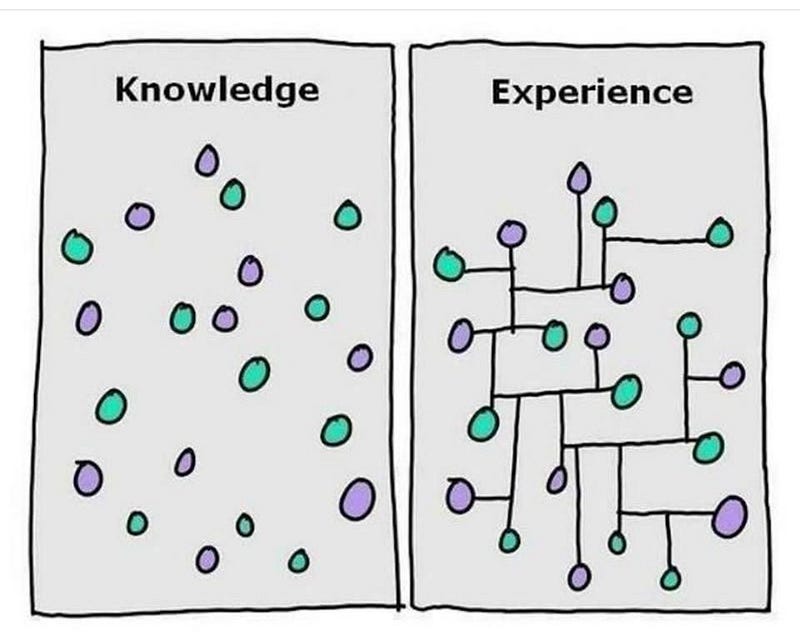
We see the trend of 3rd culture kids rising and together with it the cultural complexities and complex traumas. I wrote an article about this with an emphasis on the development of the inner critic in a complex cultural complex. Kids in such complex cultural situations develop an extra sensitivity to capturing more knowledge from the outside world. It can easily become a very burdening legacy to carry is not connected and made sense of. And this is where I wanted to get to in order to justify the title of this chapter.
We’re thinking knowledge is everything. Then we see that experience means connecting the dots between the knowledge stored in our heads and creating comprehensive maps of if becomes a more powerful tool. But what does that mean on a somatic level?
- We first go through a stage of acquiring information from the environment. That is usually our cognitive brain that ( in the stage of development as a child) will make sense of the world and if the information is important, it will be stored in the emotional brain with a “note” about how that impacted us. There’s a funny movie(Inside out from Pixar) I mentioned in a previous article which describes how we form these memories and how we decide what to keep and what not. That ultimately becomes our personality.
- The next stage is about processing in an emotional way what happened and allowing the neural networks to store a “feedback” or “recall” function of those actions through different trigger ( God how I love our technology emulates perfectly how we work as humans!).
In this second stage, individuals and communities base their actions on feelings they’ve previously lived ( not even first hand sometimes) and if the revival of the initial event is not send back into the rational brain, it may remain like a lingering limb stuck in our collective memory and never fully healed as wound. This is where we can develop collective emotional intelligence.
Let’s look again at the 2 countries and 2 traumas.
Romanians like to complain a lot.
It’s part of our collective trauma coping mechanism. We’ve experienced ( not me, not first hand but my grandparents) the collectivism and the lose of our goods thanks to a communist government that wanted to provide equal rights to everyone. The force applied to the wealthy destroyed families. My family was one of those wealthy ones in the monarchy times. With many priests ( the highest in the hierarchy in rural communities in the early 20th century Romania), my grandparents lost everything to communism. They faced radical humiliation due to the system. As such, my grandma complained a lot and taught me that communists are bad, socialism is a bad system and she was horribly discriminated for being rich and educated. She invested all her remaining fortune on me to build a legacy from an educational perspective because that could not be robbed away. I grew up investing in my brain but feeling nothing. The emotional intelligence I developed was mostly outside of the family environment. I grew up with an addiction to reading and getting more cognitive awareness, but I failed to connect to my emotions. As a result, my body developed a lot of chronic illnesses and somatized trauma. But later on as I moved to the Netherlands at the age of 24, I saw a big difference in the 2 systems. That’s where I could tap into the collective emotional intelligence of the Dutch to heal my own background. The reliability in government structures and that the impeccable infrastructure will not fail to hinder my potential in life made the difference.
We’re a country built on water so we need to work together and we are intensely commercial so we need to know how to communicate.
The Dutch grew up with a lot of emotional intelligence due to the collective work they had to do in order to fight the waters. Their long history with building dikes makes it today compulsory for children to take a swimming exam before joining school. The system forms individuals who are ready to face difficult conditions, uncertainty and diversity but protects them on a mental level from having to face that alone. They also have an important colonial history and a more recent one in the 60’s when they needed cheaper labor and powered their factories with people from their colonies or African continent. We are seeing today 3rd generation dutch-Africans and most of them have not yet integrated fully. There are many stories on the topic of cycling for example with women in these expat communities not being able to bike despite the cycling infrastructure the Netherlands benefits. On the opposite spectrum, the Dutch have acquired a deep sense of self awareness based on these cultural differences they had to adapt to in workplaces and daily life. Mixed families are more common here than in many countries in the world. It makes sense that we are able to decode our cultural differences into basic human essence and experiences. We all share the same needs despite differences in race, religion, sexual orientation, vision on politics etc.
The intellectualized trauma of the waters, the changes and need to adapt to multiculturalism allowed the Dutch to develop further their emotional intelligence by becoming the best salesman in the world, traders by legacy. Their interpersonal abilities come from a shared trauma where they needed to discuss their emotions with each other to overcome challenges. They are direct and straight forward and cut to the chase, and as Erin Meyer also shows in his 4 quadrant model for cultural, they are a low-context type of leadership and communication style. This important aspect allows me to build on the next hypothesis.
Let’s say we want to understand what is the most important aspect that determines decision making processes in a country where there’s a low context style of communication vs a high context/implicit one.
- In a Low context country, the most important factors are : clarity, results, shared general values
- In a High context country, the most important factors are: bond, connection, and feelings.
For a country like Romania, with a high context style of communication, we need to feel we share more common ground in order to connect, while sharing our food ( see indian cultures as well) is something we don’t consider much of a bond but we do it habitually. Developing emotional intelligence in a high context country relies heavily on being able to overcome these habits of sharing too much, too quick and being able to monetize facts and solid results and build a collective trust system somewhere else than in the governmental structures if those failed us in the past. Being result driven kills our coping mechanism of creating the bond to face the pain of our past, but helps us become more independent from codependent relationships with our families and build more with the community.
While the opposite happens in a low context country where they need the bond and connection as a coping mechanism for the results of long lasting effects of capitalism. Capitalism on top of their historical background of being traders, travelers and an empire made them live more in the performance paradigm ( I wrote an article about the inner critic and the results of being performance based personality). They need connection, feelings and stepping back from the head to the heart. But I managed to fit in this culture because I was also the same way due to my personal family history. I lived as well based on performance. Capitalism alienated people, created a more individualized society that only meets to work together without sharing personal emotions, just adjusts the emotions of the work environment through direct feedback.
Coming back to collective trauma examples, once the internet penetrated all environments and economies, the 9/11 event was the first big traumatic collective event we lived “on the internet” era. The way communication was done around the world in the media was low context, focusing on finding the bad guys, blaming, creating a culture of fear and creating a global enemy in the Arab world which ultimately led to making a direct transition to financial recession and the economical crises 7 years later. For the global agenda, 2001 and 2008 remain the biggest events in the era of the internet. But we learned only a few years later to speak about the impact it had on individuals, to share the individual stories and emotions. Brene Brown speaks about the fear in our culture. We’ve internalized the fear. We lived a collective traumatic event at a global scale and internalized the fear individually. Oprah makes a huge AHA discovery for herself in the interview with Brene in 2013 in her show and it seems that the rest of the world has not yet caught up on that yet.
Since then, the world is shifting again with more and more self help books and shifting again from individual to collective responsibility of changing this internal fear and feeling of not being good enough. Working cultures are trying to be that new place for creating the safe environment where people bond, connect and share not just work together for a common goal. This is basically the shift from a centralized system that provides stability ( see the Netherlands) to a descentralized one that can work in a country where there’s less organizational clarity and more high context structures of communication in place ( like Romania).
We can look at minor collective traumas again and we can see how the event in Paris with the Notre Dame seemed to be a collective trauma of the french but became global interest in a matter of hours. People seem to shift from low context to high context and create bonds across culture where there’s non across individuals in the same community. The people stepping in to help where themselves philanthropists who lacked an emotional bond and needed to devote their fortune to such a collective trauma to mark their contribution and feel worthy. They could not invest in something that would have brought more for their individual egos than this. Anything less than an entire nation being grateful would have not done the trick.
This is part of the new type of leadership we see in the world. Is this the key to a better world though?
This article of part of the research on my first book on social innovation and new leadership. In the book I write about the things that we don’t talk about in leadership and C level positions and how we should create a new order of responsibility for our collective and individual mental health. Feedback is welcomed.