
The Double Life of Dr. Richard Alpert
How a psychologist found a way to be here now

What do a Stanford-educated psychologist, a spiritual teacher, and a character from Lost have in common? They’re all Richard Alpert. Two of them are the same person, by different names.
If you’re a lover of counterculture, you might know Dr. Alpert better by his other name—Baba Ram Dass, the author of the seminal and delightfully weird book, Be Here Now.
Richard Alpert’s life would begin in 1931, but his rebirth would come years later. An avowed atheist for most of his life, he’d talk about his transformation in 2006 with Tufts Magazine, saying “I didn’t have one whiff of God until I took psychedelics.”
Educated at Tufts (undergraduate psychology class of 1952), he attended Connecticut’s Wesleyan University for his master's degree (1954). His mentor at Wesleyan was another luminary of psychology—one David McClelland. McClelland is the 15th most cited psychologist of the 20th century according to the Review of General Psychology.
He’s the man behind motivation Need Theory, and behind the education of Alpert—he recommended him to Stanford, where he earned his PhD in psychology in 1957. He then taught at Harvard for a time, where he met another big name in counterculture: Dr. Timothy Leary.
Leary was the founder of the Harvard Psilocybin Project, and he and Alpert worked together on the project from 1960–1962, before the project was famously shut down a year later. Leary and Alpert had (much like Dr. Albert Hoffman, creator of LSD) used themselves as test subjects for their research.
In 1962, Albert would conduct his own famous study—The Good Friday Experiment. Alongside physician, psychologist, and then-Harvard Divinity graduate student Walter Pahnke, the experiment was testing the use of psilocybin (magic mushrooms) on theology students. The test was to determine whether it would act as an entheogen (a substance that triggers a mystical/religious experience) in religiously-predisposed populations.
One test subject in the experiment would go on to a career in comparative religion—textbook author and professor Huston Smith, who said of the experiment, “[it was] the most powerful cosmic homecoming I have ever experienced.”
It would lead to the firing of Leary (who supervised the experiment), and Alpert, due to concerns over ethics—and as it turned out, public perception of the use of psychedelics. It would be many, many years before the testing of psychedelics for clinical use would be mainstream again.
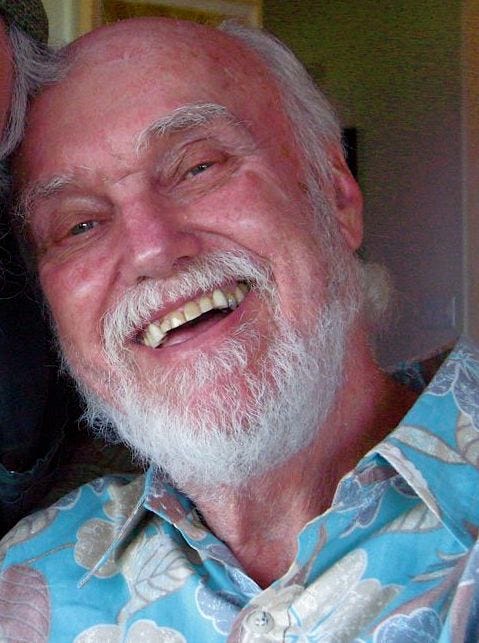
In Be Here Now, Alpert talks about his dismissal. He went through a crisis of faith, which would eventually take him on a trip to India. There, he met yoga guru Bhagavan Das (formerly Kermit Riggs), and later the man who would alter the trajectory of his life: Hindi guru Neem Karoli Baba.
Alpert would study under Neem Karoli Baba, whom he called “Maharaj-ji,”and would receive his new name from him—Baba Ram Dass, meaning “Servant of God.” God, in this context, means the Hindi deity Rama. Rama, in Hinduism, is the seventh and most powerful avatar of Vishnu and is equated with the supreme being in Rama-venerating traditions.
Ram Dass would return to America, and stay at the still-standing Lama Foundation, north of Taos, New Mexico. During that time, he’d write and present a manuscript to the burgeoning spiritual community called From Bindu to Ojas.
From Bindu is the core of what would become Be Here Now. Members of the Foundation would edit, illustrate, and set the text for publishing over the next few years. The book would go on to become a bestseller in 1971—introducing many in the U.S. to Hinduism, mindfulness, and yoga for the very first time.
Be Here Now is one of the first books, and certainly one of the most accessible, for those not born Hindu seeking to become a yogi.
The book would inspire a number of people, Steve Jobs cited the book as one of his favorites, and the introduction would inspire George Harrison’s “Be Here Now,” for the Beatles’ 1973 record, Living in the Material World.
Dass spent the rest of his life living both lives. He taught others about mindfulness, yoga, and numerous workshops on conscious aging and dying (and remains an influential figure in the growing field of death doulas).
After a spat with Leary that began in 1974, they reconciled in 1983, and met up again in 1996, shortly before Leary’s death.
Ram Dass was an interesting guy. A psychologist, writer, spiritual teacher, and noted bisexual—he’d say of his sexuality, “isn’t gay, and it’s not not-gay, and it’s not anything — it’s just awareness.”
And that’s how he approached his life, balanced between science and spirituality.
His work wasn’t science and wasn’t not-science. Just awareness.
The controversial work he did with Leary and others in the Harvard Projects would lay the groundwork for today’s renewed interest in psychedelics for treating mental illnesses.
But his most important lesson for the world was the title of his most famous work. A reminder to approach life with awareness and mindfulness:
Be Here Now.
If you enjoyed this, you’ll enjoy all my work — I’m delightful. Mostly. You can obviously check me out here on Medium — you can sign up here, if you need to, and find out more about me and my work below:


