
The division of the Roman Empire marked the beginning of its end. Why did the rulers decide on this?
In the 4th century AD, one of the most significant, perhaps the most important event of antiquity occurred. It was then that the Roman Empire split into two parts — the Eastern and Western. How did this happen? What were the consequences of the division of the Roman Empire? We’ll answer these and other questions below.
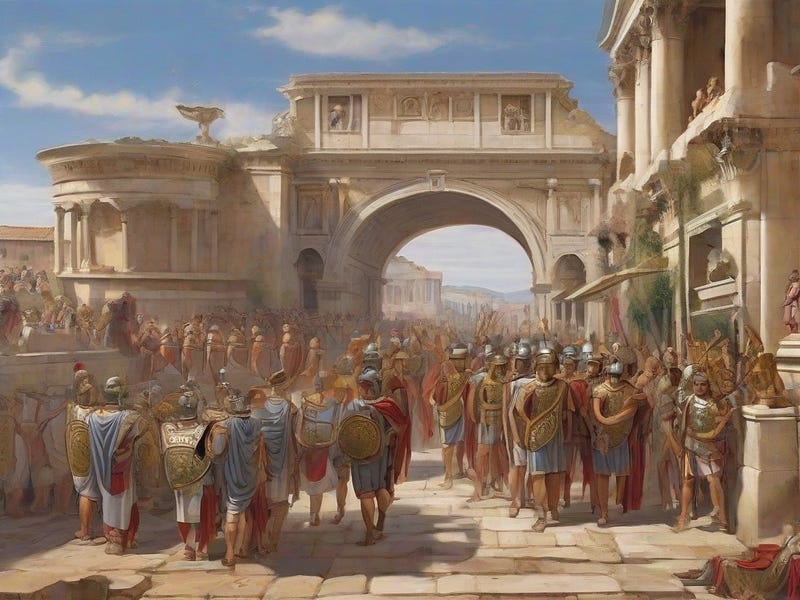
For a long time, the Roman Empire stood as the greatest power in the ancient world. Successive rulers subjugated increasingly vast territories, forming a gigantic empire. Paradoxically, these territorial gains led to a rift within the empire. Efficient management of such an extensive area simply wasn’t feasible (though it’s important to emphasize that this wasn’t the sole reason for such a state).
As a result, the Roman Empire had to split into two parts: Eastern and Western. This event was supposed to heal Rome. It didn’t do that; instead, it indirectly initiated the downfall of the colossus and heralded the twilight of antiquity.
Tetrarchy in the Roman Empire
With the expansion of the Roman Empire’s borders, the republican form of governance gave way to imperial rule. During Diocletian’s time, the emperor became an absolute ruler. Eventually, it became apparent that one person couldn’t efficiently manage such an extensive area. To maintain power, the emperor had to share it.
In 286 AD, Diocletian sanctioned the office of Augustus, essentially creating a second ruler. However, this organization of the empire didn’t yield the desired results. To streamline the functioning of the empire, he appointed deputies, known as Caesars. Maksymian became the first Augustus, while Galerius and Constantius were appointed Caesars. This birthed the form of shared governance — the tetrarchy, meaning the “rule of four” — which envisaged a division of power between two Augusti and two Caesars.
In theory, after 20 years of rule, the rulers were to step down for the Caesars, who would then choose their deputies upon assuming the office of Augusti. Diocletian wished for the position of Caesar not to pass from father to son. Instead, the deputy was to be the person best suited at that time.
At that point, one couldn’t yet speak of an actual division of the empire. However, the tetrarchy unquestionably initiated this process. It solidified spheres of influence that later led to the disintegration of the once cohesive empire.
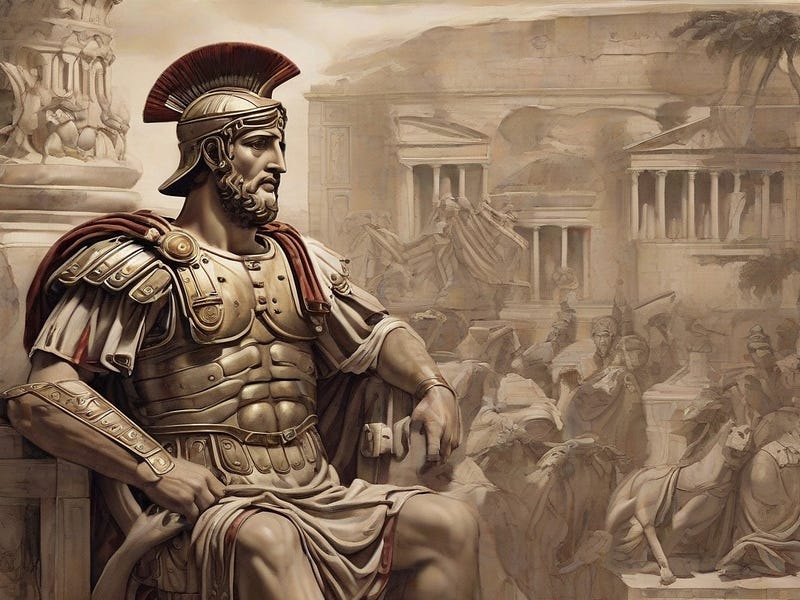
How long did the “rule of four” last?
Following the accepted rule, after 20 years, Diocletian and Maksymian stepped down. Flavius Severus and Maximianus Daia became deputies to Constantius and Galerius.
When introducing the division of power, Diocletian had Rome’s best interests in mind. However, it turned out that his idea couldn’t last long. The exclusion of hereditary rule became the seed of rebellion, which erupted into civil war. The internal conflict was instigated by Maxentius (son of Maximian) and Constantine, the son of Constantius. The latter emerged victorious. In 324 AD, Constantine, thereafter called “the Great,” began to rule independently.
Who divided the Roman Empire into two parts?
In 330 AD, Constantine the Great founded Constantinople (on the former Byzantium territory). The city’s advantageous location made it a strategic defensive point and an important trade hub. Five years later, the emperor died. Before his death, he divided the empire among his sons: Constantine II, Constans, and Constantius II. Besides them, other relatives were to share power, but after the ruler’s death, his closest heirs got rid of their further co-rulers.
In 337 AD, the division of the Roman Empire took place. Constantine II ruled in Gaul, Britain, and Spain. Constans governed Italy, Africa, and Illyria. Constantius II received the East, Thrace, and Asia Minor. However, the division of power couldn’t last long. Constantine II marched against Constans but fell in battle. Constans seized his lands, but in 350 AD, he was assassinated by Magnentius, one of his generals. Then Magnentius took over 2/3 of the empire. However, the third brother didn’t intend to leave the usurper in control of his father’s lands. In 351 AD, he defeated Magnentius. Two years later, Constantius II became the sole ruler.
After his death, Julian the Apostate became emperor. Then, the power fell to Valentinian, who allowed Valens, his brother, to rule (in the eastern part of the empire), and soon after, also Gratian, his son. When Valentinian passed away, the next co-ruler became Valentinian II. Soon after, Valens fell in battle against the Goths. At that time, Theodosius took over power in the East.
After the deaths of Gratian and Valentinian II, the third co-ruler became the sole ruler. Before his death, he divided power among his sons. He passed away in 395 AD, marking the final division of the empire into the Western Roman Empire and the Eastern Roman Empire.
Causes of the Roman Empire’s division
Why did the mighty empire split? Several factors contributed to this. Firstly, invasions by barbarian tribes, primarily concentrated in the western lands (but not exclusively), led to a significant weakening of Rome. External enemies weren’t the only threat to the state’s integrity. The territorial vastness facilitated internal conflicts that the emperor couldn’t efficiently quell. To contain the “fire” engulfing the vast empire, a division of power was necessary.
Eastern Roman Empire
Arcadius stood at the helm of the Eastern Roman Empire. His empire comprised the following lands:
- Asia Minor,
- Balkan Peninsula,
- Syria and Palestine,
- part of Armenia,
- Crete and Cyprus,
- Egypt and Cyrenaica.
The capital of the empire was established in Constantinople. The empire lasted until 1453 when the invasions of the Ottoman Turks ended its existence.
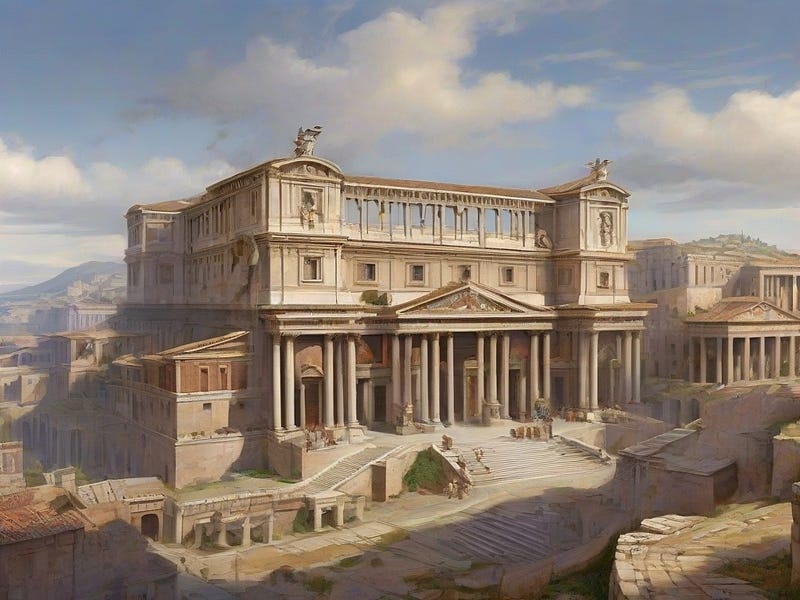
Western Roman Empire
The Western Roman Empire fell to Honorius. The lands within the Western Empire included:
- Italy,
- Gaul,
- Britain,
- Spain,
- Dalmatia,
- areas of North Africa west of Cyrenaica.
Ravenna became the state’s capital due to its better defensive prospects. However, this geopolitical entity didn’t endure for long. The Western Roman Empire fell in 476 AD when Odoacer dethroned Romulus Augustulus.
Development of cultural and religious differences between the Western and Eastern Empires
Even during the tetrarchy, a cultural division between the East and West began to emerge. The East was influenced by Greek culture, while the West was rooted in Latin culture.
These cultural differences translated into social and economic disparities in both parts of the empire. Urban centers flourished in the East, while the economy in the West largely relied on land ownership. Constantinople soon became the most efficiently managed capital. The East had greater financial resources and was less plagued by barbarian invasions.
Under the reign of Theodosius, Rome became a Christian state. Christianity prevailed in both parts of the empire. In the East, religious changes occurred later during the schism.
Consequences of the division into Western and Eastern Empires
Despite the division, the empire was supposed to remain a unified state. However, that didn’t happen. Deepening social, cultural, and political differences led to a situation where both parts began to function as completely independent states. Instead of supporting each other, especially in the face of threats from barbarians, rulers began to compete. The more advantaged East could buy peace, while the West focused on combating hostile tribes. Ultimately, the fall of the Western part led to the de facto end of the empire.
Attention all readers!
As content creators on Medium.com, we face minimal compensation for our hard work. If you find value in my articles, please consider supporting me on my “Buy Me a Coffee” page. Your small contributions can make a big difference in fueling my passion for creating quality content. Thank you for your support!


