The Digital Economy Is Capitalism at Its Worst
Corporations are more able than ever to extract what little value people have left

Instead of bringing widespread prosperity, the digital economy has amplified the most extractive aspects of traditional capitalism. Connectivity may be the key to participation, but it also gives corporations more license and capacity to extract what little value people have left. Instead of retrieving the peer-to-peer marketplace, the digital economy exacerbates the division of wealth and paralyzes the social instincts for mutual aid that usually mitigate its effects.
Digital platforms amplify the power law dynamics that determine winners and losers. While digital music platforms make space for many more performers to sell their music, their architecture and recommendation engines end up promoting many fewer artists than a diverse ecosystem of record stores or FM radio did. One or two superstars get all the plays, and everyone else sells almost nothing.
It’s the same across the board. While the net creates more access for artists and businesses of all kinds, it allows fewer than ever to make any money. The same phenomenon takes place on the stock market, where ultra-fast trading algorithms spur unprecedented momentum in certain shares, creating massive surpluses of capital in the biggest digital companies and sudden, disastrous collapses of their would-be competitors. Meanwhile, automation and extractive platforms combine to disadvantage anyone who still works for a living, turning what used to be lifelong careers into the temp jobs of a gig economy.
These frictionless, self-reinforcing loops create a “winner takes all” landscape that punishes the middle class, the small business, and the sustainable players. The only ones who can survive are artificially inflated companies, who use their ballooning share prices to purchase the also-rans. Scale is everything. This sensibility trickles down to all of us, making us feel like our careers and lives matter only if we’ve become famous, earned a million views, or done something, even something destructive, “at scale.”
While digital business plans destroy a human-scaled economy, the digital businesses themselves compromise the human sensibilities required to dig ourselves out of this mess. The human beings running those enterprises are no less the psychic victims of their companies’ practices than the rest of us, which is why it’s so hard for them to envision a way out.
Well-meaning developers, who have come to recognize the disastrous impacts of their companies, seek to solve technology’s problems with technological solutions. They see that social media algorithms are exacerbating wealth division and mental confusion, and resolve to tweak them not to do that — at least not so badly. The technosolutionists never consider the possibility that some technologies themselves have intrinsic antihuman affordances. (Guns may not kill people, but they are more biased toward killing than, say, pillows, even though both can be used for that purpose.) Furthermore, they propose technosolutions that are radical in every way except in their refusal to challenge the underlying rule set of venture capitalism or the extreme wealth of those who are making the investments. Every technosolution must still be a profitable investment opportunity — otherwise, it is not considered a solution at all.
Even promising wealth redistribution ideas, such as universal basic income, are recontextualized by the technosolutionists as a way of keeping their companies going. In principle, the idea of a negative income tax for the poor, or a guaranteed minimum income for everyone, makes economic sense. But when we hear these ideas espoused by Silicon Valley’s CEOs, it’s usually in the context of keeping the extraction going. People have been sucked dry, so now the government should just print more money for them to spend. The argument merely reinforces the human obligation to keep consuming, or to keep working for an unlivable wage.
More countercultural solutions, such as bitcoin and the blockchain, are no less technosolutionist in spirit. The blockchain replaces the need for central authorities such as banks by letting everyone on a network authenticate their transactions with computer encryption. It may disintermediate exploitative financial institutions but it doesn’t help rehumanize the economy, or reestablish the trust, cohesion, and ethos of mutual aid that was undermined by digital capitalism. It simply substitutes for trust in a different way: using the energy costs of blockchain mining as a security measure against counterfeiting or other false claims. (The computer power needed to create one bitcoin consumes at least as much electricity as the average American household burns through in two years.) Is this the fundamental fix we really need? A better ledger?
The problem the blockchain solves is the utilitarian one of better, faster accounting, and maybe an easier way to verify someone’s identity online. That’s why the banking industry has ultimately embraced it: the quicker to find us and drain our assets. Progressives, meanwhile, hope that the blockchain will be able to record and reward the unseen value people are creating as they go about their lives — as if all human activity were transactional and capable of being calculated by computer.
We must learn that technology’s problems can’t always be solved with more technology.
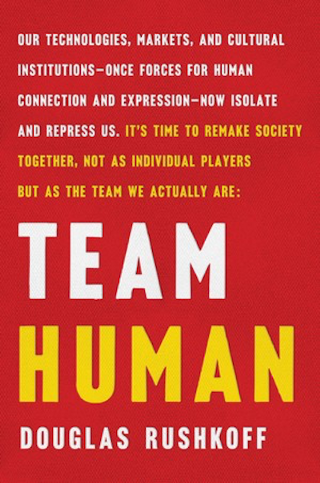
This was section 48 of the new book Team Human by Douglas Rushkoff, which is being serialized weekly on Medium. Read the previous section here and the following section here.