
The Difference Between Risk and Uncertainty
Plus: Four ways to reduce your own blind spots

The COVID-19 pandemic has created a lot of uncertainty about what the future holds. Will there be a vaccine? What will life look like in a year?
But is this uncertainty the same as risk?
The concepts are often discussed together. While related, they should be seen as distinct concepts.
Risk can be defined as:
The probability of an adverse outcome.
As Michael Maubossin has said, risk involves situations where “We don’t know what is going to happen next, but we do know what the distribution looks like.”
The definition of uncertainty is:
Predictions of future outcomes in which either the set of outcomes and/or the probability of particular outcomes is unknown.
This is also known as Knightian Uncertainty, after economist Frank Knight who first discussed this distinction at length. Sounds pretty similar, no?
But there’s a catch: with pure risk, you are aware of what all the possible outcomes are, as well as the probability of any particular one.
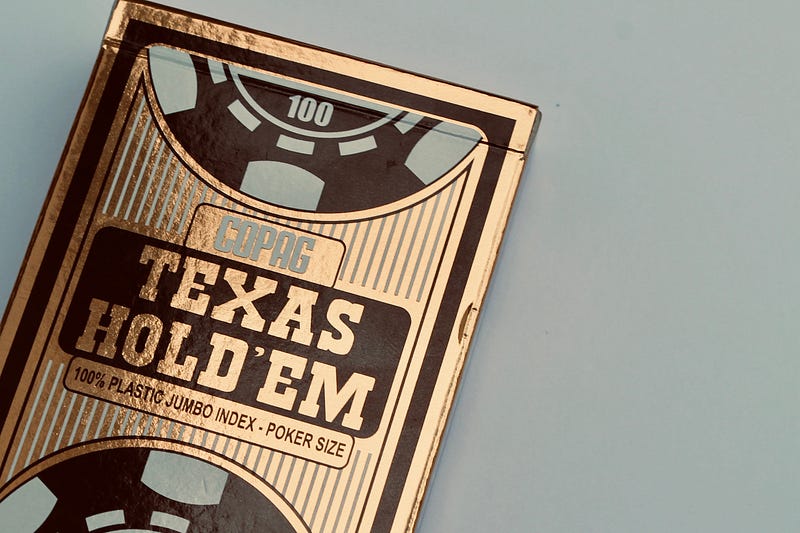
Take Texas Hold ’Em poker. The odds of any particular hand are known. While you do not know what cards will be dealt on the flop, turn or river, you can calculate the likelihood and make bets accordingly.
In uncertain situations, such a calculation is not possible. Think about where you were a year ago. If someone had asked you in 2019 what is the chance of a pandemic in 2020, what would you have said?
For some keen epidemiologists, perhaps they could have wagered a reasonable guess. But most of us were clueless. We were in the land of uncertainty.
Leaders deal with uncertainty daily. Think about it: if the risks were known and well-characterized, any competent member of an organization could make a decision without fear, as their call would be back up by data.
But what happens when data do not exist to support a decision? It gets bumped up to the top.
Donald Rumsfeld best characterized this when he was asked about the absence of Iraqi weapons of mass destruction:
“Reports that say that something hasn’t happened are always interesting to me, because as we know, there are known knowns; there are things we know we know. We also know there are known unknowns; that is to say we know there are some things we do not know. But there are also unknown unknowns — the ones we don’t know we don’t know. And if one looks throughout the history of our country and other free countries, it is the latter category that tend to be the difficult ones.”
It’s harder to be more concise than saying risk are the known unknowns while uncertainty represents the unknown unknowns.
One framework for exploring these concepts is the Johari window. A 2 x 2 matrix, the window lays out the 4 quadrants to knowledge and labels them as follows:
- Known to self and others: the arena
- Known to self but not others: the facade
- Not known to self but known to others: the blind spot
- Unknown to all: unknown
The window is then used as an exercise for group therapy, in which the subject and their peers place adjectives describing the subject into the matrix. On our own though, we can use the framework as a way to focus our attention on what is knowable but not known to us: the blind spot.
Biologically, your blind spot is the area of your visual field that exists but you are simply unaware of, no matter how much you look for it. It occurs because the point at which the optic nerve meets the retina is not covered by the retina. Your brain tricks you by using information from the adjacent visual field to fill in the blind spot. No matter you do, you cannot eliminate it.
But, you can minimize your mental blind spot! So, how do we reduce our blind spots? Here are a few strategies:
- Collaborate Discussing topics with others helps to bring out knowledge that is known to them but new to you.
- Diversify By taking a precautionary approach, you can make yourself resilient to a wider range of outcomes.
- Experiment By taking low risk approaches, you can shed light onto topics in which you are unfamiliar.
- Keep learning Knowledge is the best antidote to uncertainty. Essentially, you are building on the collected wisdom of all those who came before you.
Some economists have argued that the distinction between risk and uncertainty is academic. Their point is that any real decision is often so complex that it cannot be viewed as risk, defined as above.
The larger takeaway though is to beware situations where some is making confident predictions about the future in situations that are not well-defined, as if the risk were calculable.
Remember: the future is fundamentally unpredictable. You can be certain about that.
Thanks for reading! Follow me on Twitter for more reflections: @JayVillas2020.